Key takeaways
- Head and neck support: Measure from your seat to the top of your head and look for a backrest that reaches at least to mid-skull. Anything shorter leaves your neck unsupported when you doze off mid-feed, which is the single most common source of morning stiffness in new parents.
- Recline mechanism you can work one-handed: A push-back or power recline that engages with light pressure beats a side lever every time. Test whether you can move between upright and reclined positions without your forearms leaving the armrests.
- Quiet, sealed glide hardware: Ball-bearing glide systems with enclosed housings stay silent far longer than exposed metal-on-metal tracks. Squeaks almost always develop at the six-to-twelve-month mark, so weight this heavily.
- Low-VOC and certified materials: GREENGUARD Gold certification means the chair has been tested for chemical emissions in enclosed spaces — meaningful in a small room where an infant sleeps ten or more hours a day. FSC certification covers responsible wood sourcing in the frame.
- Real-world footprint: Gliders need rear clearance to recline and side clearance to swivel. Add roughly 18 inches behind the chair and 6 inches on each side to the listed dimensions before deciding it fits.
What's inside
Nighttime feedings don’t happen at convenient hours, and they rarely happen in a chair that was chosen with sleep in mind. Most parents shop for a nursery glider the way they shop for an accent chair — color first, comfort second — and then discover at 3 a.m. that the headrest stops at the shoulder blades, that the recline requires two hands and a good deal of core strength, and that the glide mechanism emits a faint tick that a lightly sleeping newborn hears perfectly well. From a sleep-wellness standpoint, this matters more than it sounds. The chair where you feed and settle a baby becomes a shared sleep cue for both of you, and a chair that forces you to brace, crane, or shift weight repeatedly keeps your nervous system in a mildly alert state precisely when you’re trying to wind down.
This guide evaluates the 2026 crop of nursery glider recliners through that lens: how well each one supports a relaxed, neutral spine during long stretches of sitting, how quietly and smoothly it moves, how easy it is to recline and exit while holding a sleeping infant, and how honestly it earns its place in a room after the nursery years end. Certifications, upholstery durability, and footprint are covered too, because a chair you resent by month nine isn’t a good buy at any price.
As an Amazon Associate we earn from qualifying purchases.


How to Choose a Nursery Glider Recliner (2026)
- Head and neck support: Measure from your seat to the top of your head and look for a backrest that reaches at least to mid-skull. Anything shorter leaves your neck unsupported when you doze off mid-feed, which is the single most common source of morning stiffness in new parents.
- Recline mechanism you can work one-handed: A push-back or power recline that engages with light pressure beats a side lever every time. Test whether you can move between upright and reclined positions without your forearms leaving the armrests.
- Quiet, sealed glide hardware: Ball-bearing glide systems with enclosed housings stay silent far longer than exposed metal-on-metal tracks. Squeaks almost always develop at the six-to-twelve-month mark, so weight this heavily.
- Low-VOC and certified materials: GREENGUARD Gold certification means the chair has been tested for chemical emissions in enclosed spaces — meaningful in a small room where an infant sleeps ten or more hours a day. FSC certification covers responsible wood sourcing in the frame.
- Real-world footprint: Gliders need rear clearance to recline and side clearance to swivel. Add roughly 18 inches behind the chair and 6 inches on each side to the listed dimensions before deciding it fits.
The Best Nursery Glider Recliners (2026) Reviewed
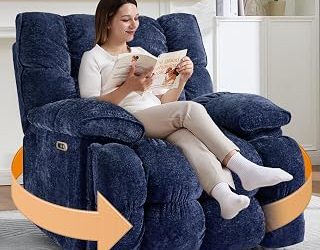
Korser 360° Swivel Rocker Recliner with Massage and Heating
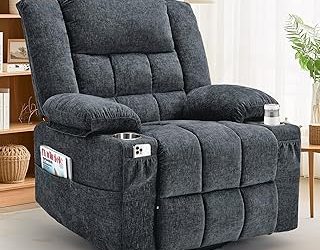
The heat and vibration functions sound like gimmicks until you’ve spent a week nursing with tight upper-back muscles, at which point localized lumbar warmth becomes genuinely restorative. It’s a generous, deeply padded chair with a cup holder and smooth swivel, best suited to rooms that can accommodate its bulk.
Carter’s by DaVinci Arlo Recliner
Our top pick for most nurseries: GREENGUARD Gold and FSC certified, quietly engineered, and tailored enough in silhouette to move into a bedroom or reading corner later without looking like leftover baby gear. The backrest support is well-judged for average-height adults, and the recline is effortless.
Boucle Power Swivel Glider Recliner with USB
Power recline is the meaningful upgrade here — you can adjust position with a fingertip while holding a sleeping baby, which manual chairs simply can’t match. The integrated USB port and included lumbar pillow make it the most practical choice for extended nighttime sessions.
Evolur Raleigh Upholstered Manual Glider Recliner
Evolur’s glide action is among the smoothest and quietest in this group, with a longer, more soothing travel than typical rockers. Dual GREENGUARD Gold and FSC certification plus a clean, modern profile in Light Sand make it a strong long-term furniture purchase.
YuuYee Oversized Nursery Glider Recliner
Best for taller parents or anyone who wants room to sit cross-legged: the oversized seat and high velvet back give real shoulder-to-head coverage. The phone holder is a small touch that spares you the neck flexion of looking down at a screen during feeds.
Frequently Asked Questions
Is a glider or a rocker better for a nursery?
Gliders move on a fixed horizontal track, which is quieter, safer around small toes, and produces a steadier motion that many infants settle to more readily. Rockers have a shorter, more pronounced arc. Most modern nursery chairs, including every model here, glide.
Should I choose a power or manual recline?
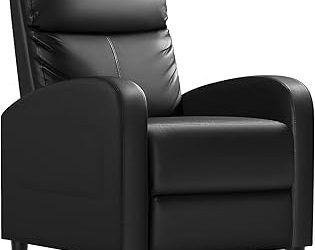
Choose power if you’ll be feeding at night frequently or recovering from a cesarean — the ability to adjust without engaging your abdominals or free hands is a real advantage. Manual recliners like the Korser Chenille or Evolur Raleigh cost less, need no outlet, and are perfectly serviceable for daytime use.
Are nursery gliders safe to sleep in?
Not with an infant. Falling asleep while holding a baby in a reclined chair carries a documented suffocation risk, and safe-sleep guidance is clear that babies belong on a firm, flat surface in their own space. Use the glider for feeding and soothing, then transfer the baby to a crib or bassinet.
What upholstery holds up best?
Performance-treated chenille and tight-weave polyester resist milk, spit-up, and repeated cleaning better than boucle, which is beautiful but traps residue in its loops. Whatever you choose, confirm the cushions have removable covers or that spot-cleaning is manufacturer-approved.
Final Thoughts
For most families, the Carter’s by DaVinci Arlo is the soundest overall buy — certified materials, quiet mechanics, and a shape that outlives the nursery. If night feeds dominate your routine, the boucle power glider’s one-touch recline and USB port justify the step up, while the Evolur Raleigh remains the pick for anyone prioritizing the smoothest, most silent glide in a room where every sound carries.