Key takeaways
- Read the load rating honestly: A 3,000 lb figure sounds absurd until you realize it’s a static test, not a dynamic one. Sitting down hard on the edge multiplies force briefly. Target at least four times your combined sleeper-plus-mattress weight so you’re operating nowhere near the limit.
- Count the legs and the center support: Two side rails and four corners is a bridge waiting to bow. Look for a center spine with its own feet, and treat every additional grounded leg as insurance against the sag that shows up in year three.
- Match the profile to your existing frame: Total sleep height equals frame plus foundation plus mattress. A 10-inch model inside a tall bed frame can push the surface past comfortable sitting height; a 2-inch bunkie board solves slat problems without raising the bed at all.
- Check slat spacing against your mattress warranty: Foam and hybrid makers commonly require gaps under 3 inches. Wider spacing lets the mattress settle into the voids, which reads as body impressions and voids coverage precisely when you’d want to claim it.
- Anticipate the noise: Squeak comes from metal sliding against metal or against the floor. Fully welded assemblies and non-slip contact points stay quiet; bolted designs are fine but expect to re-torque the hardware once during the first year.
What's inside
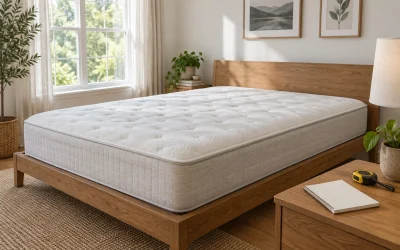
Sagging isn’t always the mattress’s fault. In my work reviewing sleep surfaces, the foundation underneath is the piece that quietly fails first — and it fails fastest under couples and larger sleepers. A traditional box spring is a wooden frame with a fabric skin and, if you’re lucky, a few staples holding its ambitions together. Load it with 500 pounds of combined body weight plus a 100-pound hybrid mattress, add years of getting in and out of bed on the same two spots, and the joints begin to work loose. You feel it as a dip at the edge, a lean toward the middle, or a creak that arrives every time you roll over.
This guide is about the foundations that don’t do that. Every option below is engineered rather than merely built: welded or bolted steel, load ratings in the thousands of pounds, and slat spacing tight enough to satisfy memory foam warranties. I’ve grouped them by profile — from 2-inch bunkie boards for people who already own a platform bed to 10-inch full-height replacements — and flagged what each one is genuinely good at. You’ll also find the buying criteria I use, and answers to the questions that come up most often once a heavier sleeper starts shopping for support instead of comfort.
As an Amazon Associate we earn from qualifying purchases.




🛒 Best Price Today on Amazon
Prime members get fast, free shipping on everything above, plus member-only deals. New members get a 30-day free trial — cancel anytime.
How to Choose a Box Spring For Heavy People (2026)
- Read the load rating honestly: A 3,000 lb figure sounds absurd until you realize it’s a static test, not a dynamic one. Sitting down hard on the edge multiplies force briefly. Target at least four times your combined sleeper-plus-mattress weight so you’re operating nowhere near the limit.
- Count the legs and the center support: Two side rails and four corners is a bridge waiting to bow. Look for a center spine with its own feet, and treat every additional grounded leg as insurance against the sag that shows up in year three.
- Match the profile to your existing frame: Total sleep height equals frame plus foundation plus mattress. A 10-inch model inside a tall bed frame can push the surface past comfortable sitting height; a 2-inch bunkie board solves slat problems without raising the bed at all.
- Check slat spacing against your mattress warranty: Foam and hybrid makers commonly require gaps under 3 inches. Wider spacing lets the mattress settle into the voids, which reads as body impressions and voids coverage precisely when you’d want to claim it.
- Anticipate the noise: Squeak comes from metal sliding against metal or against the floor. Fully welded assemblies and non-slip contact points stay quiet; bolted designs are fine but expect to re-torque the hardware once during the first year.
The Best Box Springs For Heavy People (2026), Reviewed
ROIL 10 Inch King Box Spring
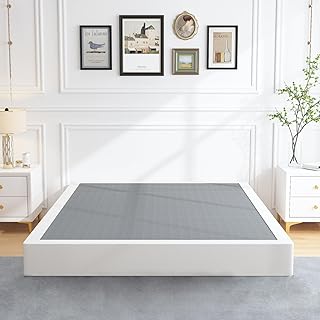
At 3,500 lbs across a king footprint with rounded corners and a full fabric cover, this is the most straightforward one-for-one swap for a failing traditional box spring in a large bed. The 10-inch height means you can pair it with a low frame or use it as the sole lift, and assembly is genuinely quick — no tools, no wrestling with a sewn-in cover.
Snaye Queen Box Spring, 9 Inch
The strongest all-around queen pick: 3,000 lbs of capacity, near-standard 9-inch height so your bedding still fits, and a tool-free build most people finish in under fifteen minutes. It’s the option I’d suggest to someone who wants to change nothing about their bed except the part that’s sagging.
MAF 2 Inch Queen Bunkie Board
If your platform bed’s slats are the weak link, this is the surgical fix — wood slats over a low-profile frame, 3,500 lbs rated, and only 2 inches of added height. It closes slat gaps to warranty-friendly spacing without turning your bed into a climbing exercise.
ALDRICH 7 Inch Queen Foundation
A lower-profile steel foundation at 3,000 lbs, with non-slip contact points and a wipeable cover that earns its keep in guest rooms and rentals. Choose this when a thick hybrid mattress already delivers most of your height and you just need unyielding support beneath it.
Greaton 8-Inch Wood Foundation
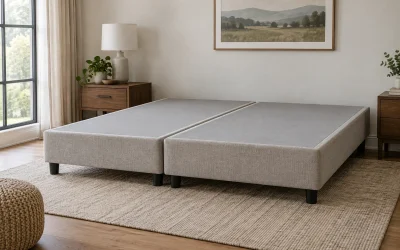
The traditionalist’s answer: Amish-made in the USA, arriving fully assembled in two halves that navigate tight stairwells far better than a single king slab. Wood flexes differently than steel — slightly more forgiving underfoot — and this one is quiet from day one.
Frequently Asked Questions
Does a heavy-duty box spring make a mattress feel firmer?
Slightly, and that’s usually welcome. A rigid foundation stops the mattress from borrowing give from below, so the feel you get is the one the mattress was engineered to deliver rather than a sagging composite of both layers.
Can I use a metal box spring with memory foam?
Yes, provided the support surface is continuous or the slats sit under roughly 3 inches apart. Steel foundations with fabric covers work well with foam; open wire grids with wide gaps do not.
Do I need a bed frame too?
Not always. Models like the 10 Inch Queen Metal Bed Frame are designed as dual-use foundations with their own legs, standing directly on the floor. Traditional-profile box springs, by contrast, still expect a frame or at minimum a headboard-and-rail setup.
How long should one of these last?
A welded steel foundation under heavy use should comfortably outlast two mattresses — think eight to ten years. Recheck the leg contact points annually and re-tighten any bolted joints; that five-minute habit prevents most of the noise complaints I hear about.
Final Thoughts
For most heavier sleepers replacing a tired queen box spring, the Snaye 9 Inch is the cleanest answer — standard height, 3,000 lbs, no tools. Kings should go straight to the ROIL 10 Inch for its 3,500 lb rating and full-coverage build, while anyone whose platform bed slats are the actual culprit should spend far less on the MAF 2 Inch bunkie board and fix the problem exactly where it lives.