Key takeaways
- Measure a duvet cover’s usable opening separately from overall size, record closure construction and compare access without stretching seams.
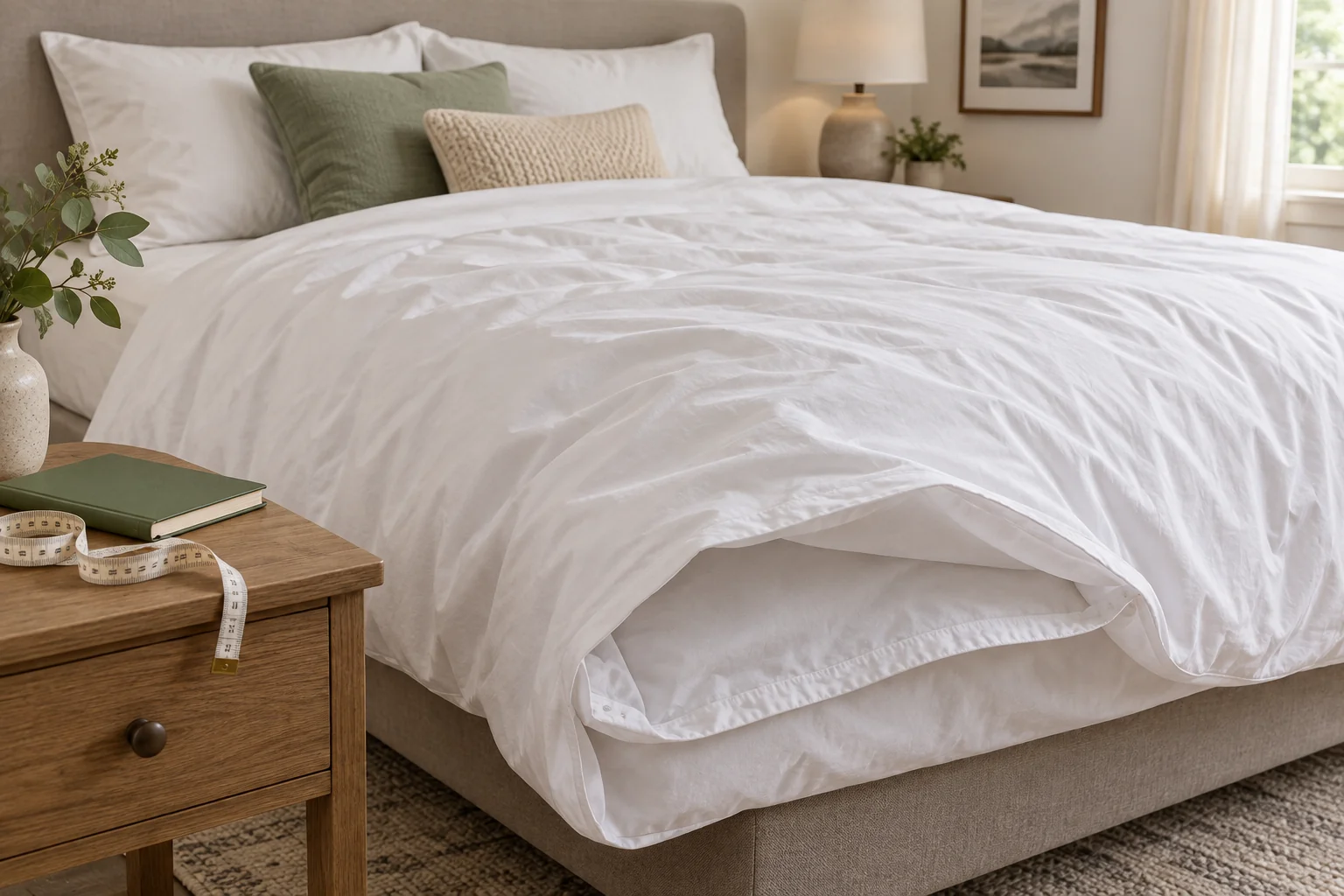
Compare duvet-cover opening widths by measuring the usable opening with the closure fully released as intended, separately from the cover’s overall width. Two covers with the same nominal bed size can offer different access for inserting and arranging a duvet. Closure type, fixed end sections and your usual handling method all affect how the opening works.
The aim is to describe access accurately before choosing a cover. It is not to stretch a seam, force a zipper or prove that a particular opening will be easiest for every user.
Separate three different measurements
Record the cover’s overall dimensions first, because those relate to the insert it is meant to contain. Then identify the closure span: the part fitted with buttons, snaps, a zipper or another closing arrangement. Finally, identify the clear opening available when that closure is open normally.
These measurements may not be identical. Fixed fabric at the ends, a zipper stop or an overlapping construction can make access different from the visible length of the closure. Do not infer the opening width from the cover’s product photograph or from the size printed on its package.
For example, IKEA’s PILTANDVINGE listing for article 806.237.78 identifies a bottom plastic press-stud closure and lists the Full/Queen cover at 86 by 86 inches. Those are useful product details, but the overall width is not a published clear-opening measurement. Ask for that measurement or check an accessible sample rather than treating 86 inches as the opening.
Measure without pulling the fabric out of shape
Lay an empty cover on a clean surface with the opening easy to reach. Release the closure according to its design and let the fabric lie naturally. Identify the two points beyond which the edge remains closed, then record the usable span between them without tension.
Describe exactly what you measured. For a zipper, distinguish the clear fabric opening from the length of the zipper tape. For a button or snap arrangement, record any permanently closed end sections. If an overlap changes how the opening is accessed, note that construction rather than forcing it into a misleading single number.
Use one unit throughout the comparison and retain the original value if converting. If a shop provides a measurement, ask whether it describes the clear opening or the closure hardware. An answer labeled only “width” may refer to the entire cover.
| Field | Cover A | Cover B |
|---|---|---|
| Exact product and size | Model, size, version | Model, size, version |
| Overall dimensions | Published or measured; identify which | Published or measured; identify which |
| Closure construction | Type, location, fixed end sections | Type, location, fixed end sections |
| Clear opening | Unstretched usable span and unit | Unstretched usable span and unit |
| Handling observation | Access for your normal method | Access for your normal method |
| Evidence limit | Measured sample or unanswered question | Measured sample or unanswered question |
Consider the insert without inventing a fit formula
An insert is flexible, so its full width does not need to pass through the opening as one flat rigid rectangle. However, that does not mean every smaller opening will be convenient. The insert’s bulk, the way it folds and the user’s handling method affect the task.
Keep insert-to-cover size compatibility separate from access. A large opening does not fix an incorrectly sized cover. Likewise, a cover with appropriate overall dimensions may still have an opening that feels awkward for the person making the bed.
If you can examine a sample with permission, assess access using the intended gentle handling method. Do not tug on the closure or force a bulky bundle through a resisting seam. Stop when the fabric or hardware is under strain rather than treating force as a successful fit check.
Worked example: equal cover size, different access
In a fictional comparison, Covers A and B have the same stated overall dimensions. The owner measures clear openings of 140 centimeters and 110 centimeters respectively, both without stretching. These numbers are invented for the example and do not describe a named product.
The owner records that Cover A offers a longer clear span. They still examine closure operation, fixed end sections and how their own insert can be arranged. They do not conclude that A saves a particular number of minutes or is easier for everyone solely because its measurement is larger.
If Cover B’s seller supplies only an overall width, the opening field stays “not confirmed.” That prevents an unknown measurement from being treated as equal to Cover A’s observed value.
Keep the comparison useful after purchase
Save the exact size and product reference with the worksheet. A different size in the same design may use a different opening arrangement, so avoid extending one measurement to the entire range. If the cover changes after laundering, follow its care label and record the condition in which a later measurement was taken.
Do not cut stitches or alter the closure to make a newly purchased cover easier to fill. Resolve a mismatch through the seller’s applicable process or an appropriate professional assessment instead of turning a comparison task into an unplanned modification.
A good buying question is specific: “What is the clear bottom opening on this exact size with the closure open normally?” That question, paired with overall dimensions and construction notes, gives you more useful information than bed-size labels alone.