Key takeaways
- Read bedding color-separation instructions alongside care symbols, record exact colorways and resolve unclear labels before planning a compatible laundry load.
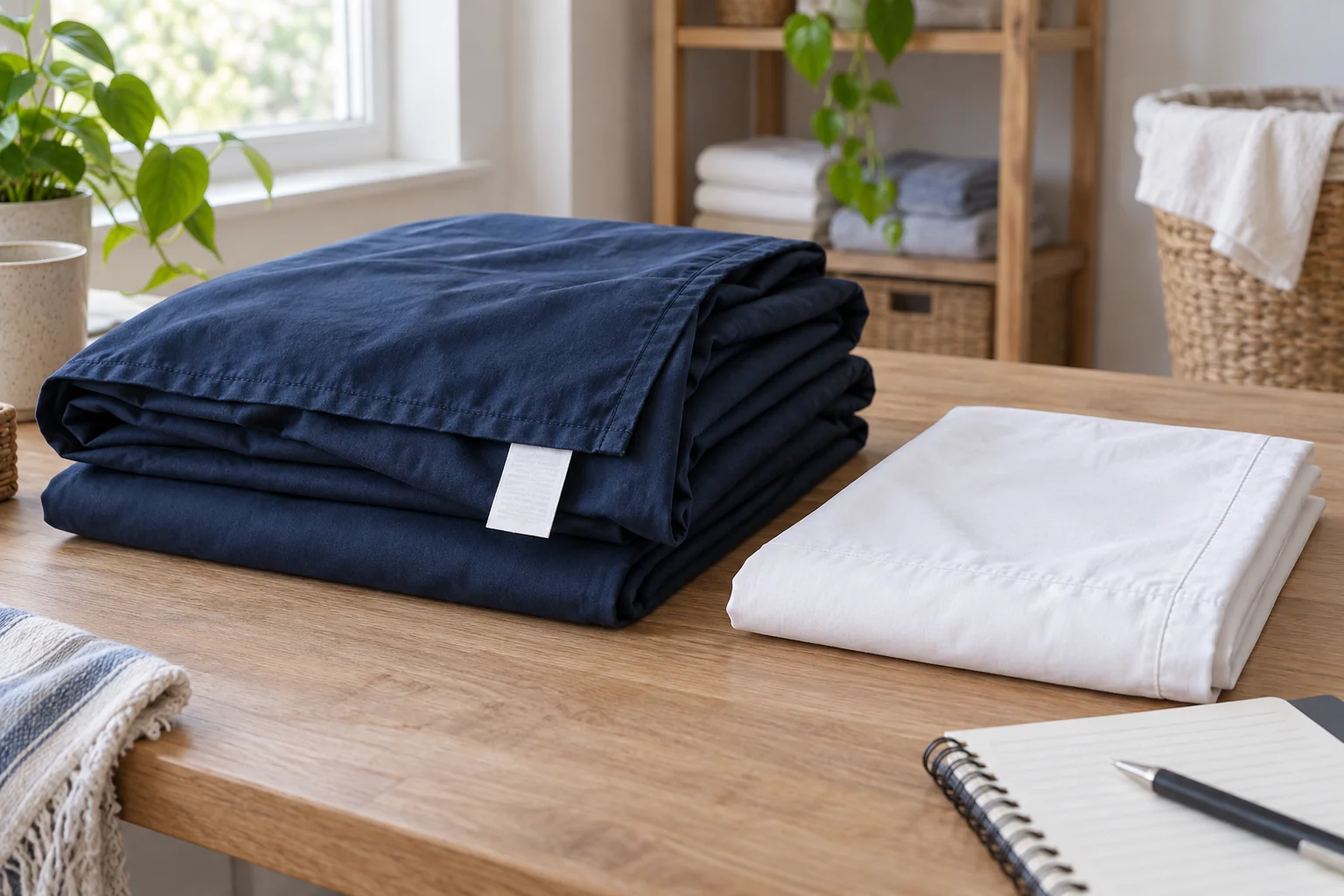
Check bedding color-transfer instructions by reading the complete care label and the maker’s guidance for the exact product and color. Washing symbols describe permitted care processes, while written directions may add requirements such as washing separately or with similar colors. Keep those words with the item instead of replacing them with a general rule for cotton, linen or dark fabric.
This guide helps plan a load and ask useful questions before washing. It is not a colorfastness test, a guarantee against dye transfer or a recipe for setting dye. A household observation cannot prove that future loads will behave the same way.
Identify the exact piece and colorway
Photograph the sewn label and save the product reference, size and color. For a bedding set, check the individual pieces rather than assuming every pillowcase, sheet and decorative cover has identical instructions. A trim, embroidery or printed panel may change the finished product’s care guidance.
Keep the fiber composition separate from the laundering decision. The bedding composition-label worksheet explains how shell and filling statements differ. Neither a high cotton percentage nor a familiar fabric name replaces the care instructions for a dyed finished item.
If shopping online, ask for a readable care-label photograph for the selected colorway before buying when separation requirements would affect your laundry routine. A generic care paragraph covering an entire collection may leave that question unanswered.
Preserve the words beside the symbols
Write down instructions about washing separately, washing with like colors, turning inside out or avoiding particular products exactly enough to retain their meaning. “Wash separately” should not become “put in a dark load” merely because that is more convenient.
Tide’s colored-laundry guidance notes that new colored items may bleed and advises checking their care labels. Its clothing advice supplies a general reason to pay attention to separation. For bedding, the exact bedding maker’s instructions still determine the permitted process.
If the label and website conflict, save both and ask the manufacturer which applies to your particular item. Do not resolve the conflict by selecting the cooler or easier setting and assuming that makes every other requirement irrelevant.
Build a load-compatibility sheet
| Item | Color instruction | Other care limits | Decision |
|---|---|---|---|
| New dark sheet | Copy exact separation wording | Permitted process and drying | Follow its named route |
| Light pillowcase | Maker’s grouping instruction | Check temperature and cycle | Do not add merely to fill the machine |
| Patterned cover | Instructions for complete item | Check trim and closures | Ask if wording is unclear |
| Unidentified spare piece | Unknown | Locate maker or prior record | Resolve before combining |
Color is only one part of load compatibility. Items also need compatible washing action, temperature, product restrictions and loading conditions. A shared dark appearance is not enough to combine a delicate cover with a bulky item requiring a different process.
Worked example: a set does not automatically make one load
Imagine a fictional purchase containing a dark duvet cover and pale decorative pillow covers. The duvet cover’s label says to wash separately. The decorative covers have their own care instructions. Matching packaging and a coordinated bedroom photograph do not cancel those differences.
The owner records each piece separately, plans the specified routes and checks whether the available machine can handle the duvet cover under its instructions. If the wording is ambiguous, the load waits for clarification instead of becoming an informal experiment with all the new pieces together.
After an uneventful first wash, the owner retains the original instruction. One successful cycle does not authorize a different load next time unless the maker’s guidance says so. The example illustrates instruction handling, not a tested result for any brand.
Avoid shortcuts that rewrite the label
A color-catching accessory or a detergent marketed for colors does not automatically override a requirement to wash separately. Check the accessory’s directions as well, but do not treat it as permission to ignore the bedding maker.
Do not add salt, vinegar, bleach or another treatment as a universal way to make new bedding colorfast. If the manufacturer provides a specific preparation or troubleshooting method, follow its complete instructions for the exact product. Otherwise, ask before introducing an additional chemical or step.
Similarly, a quick rub on a white cloth is not a substitute for a standardized test or a prediction of a full wash. Avoid damaging a new item in order to invent evidence that the label does not provide.
Record a problem without overstating the cause
If a change occurs, save photographs, product identity and the care instructions followed. Record which items shared the load, the machine program and any products used. Describe the observation plainly rather than declaring a manufacturing defect or blaming a particular item without evidence.
Contact the maker before trying a stain-removal process that could make the situation worse or conflict with the care label. Keep its reply with the worksheet. For dimensional changes, use the separate before-and-after measurement record; color observations and size measurements answer different questions and should remain distinct.