Key takeaways
- Match duvet and cover directions before fastening ties, using labeled dimensions, closure edges and a simple check for a quarter-turn mismatch.
What's inside
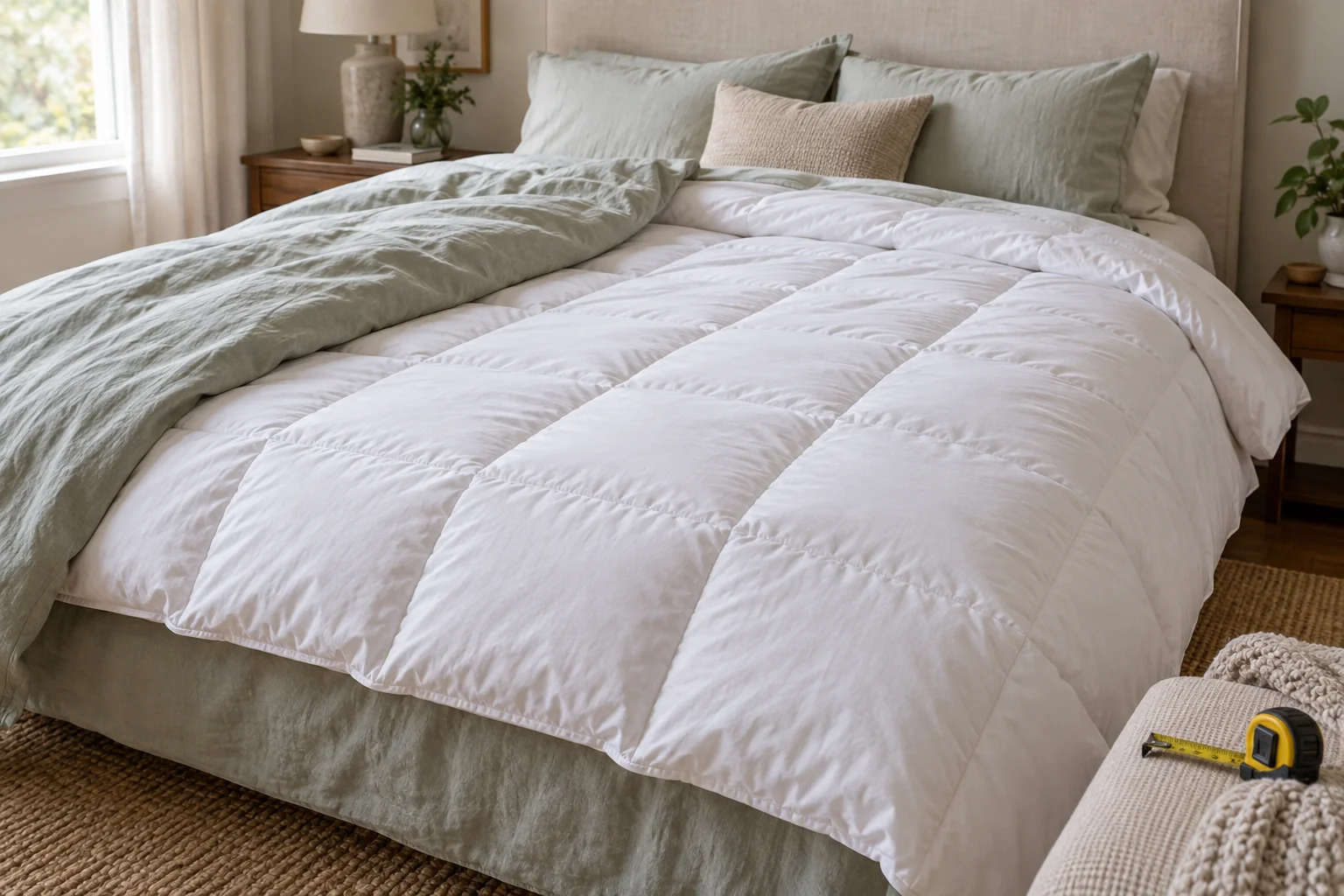
Check duvet-insert orientation before fastening it inside a cover by identifying the edges of both pieces and matching their intended directions. A cover that looks square across the bed may be rectangular, and decorative seams or a folded edge can disguise the difference. Turning the insert a quarter turn is worth checking before assuming that the bedding is the wrong size.
Do the comparison on a clean, adequately sized surface where you can see the edges without pulling or stretching them. This is an orientation check, not a method for forcing an incompatible insert into a cover. The manufacturer’s size and handling guidance still applies.
Identify the cover’s opening and named dimensions
Find the closure edge and read the size label or product specification. Note which dimension the maker calls width and which it calls length. For example, Brooklinen’s bedding size guide labels duvet-cover measurements as width by length and lists both square and rectangular sizes. That illustrates why the order and meaning of the numbers matter more than a quick visual guess.
Do not assume that every brand places the closure on the same edge or uses the same dimensions for a named bed size. If the specification does not identify direction clearly, ask the manufacturer. Keep any stated head, foot, top or bottom marking attached to its original meaning.
Map the insert independently
Read the insert’s instructions and inspect any orientation labels. Identify its corners, loops and any construction that the maker describes as directional. Do not treat a care label’s location alone as proof of which end belongs at the foot of the bed unless the maker says so.
Measure the two adjacent sides if the dimensions remain unclear, using the appropriate relaxed state and method for the product. Record them with their endpoints rather than rounding both to the same convenient number. A small difference can be hard to see when the insert is draped over a mattress.
| Feature | Cover record | Insert record |
|---|---|---|
| Width and length | Maker’s definition and stated dimensions | Maker’s definition and stated dimensions |
| Opening or direction | Closure edge and any top marking | Any specified head or foot orientation |
| Corners | Where ties are attached | Where corresponding loops are attached |
| Unclear detail | Question for cover manufacturer | Question for insert manufacturer |
Compare the edges before inserting
Lay the pieces in their proposed directions and compare the corresponding sides. Avoid folding a corner underneath where it can create a misleading edge. If the maker specifies a direction, keep that instruction in control while checking the fit.
For a nondirectional rectangular insert, compare the alternative quarter-turn position without fastening it. The goal is to see which side corresponds to which, not to choose the orientation that makes one corner easiest to reach. If neither position matches the intended dimensions, stop and verify compatibility rather than hiding the mismatch in a fold.
Use ties as connection points, not measuring marks
Brooklinen explains that its cover ties may sit a few inches away from the exact corners so the comforter corner can occupy the cover corner. This is a useful warning against treating every tie’s attachment point as the fabric’s geometric corner. Other products may use different arrangements.
Follow the relevant instructions for connecting ties and loops. Do not stretch the cover toward an incorrectly oriented insert or add improvised attachment points to make the first arrangement work. If the connection layout seems wrong, check orientation and the product instructions before continuing.
A fictional near-square comparison
Suppose a cover and compatible insert are each described as 220 by 230 centimeters. Viewed loosely on a bed, both look almost square. If the insert’s 230-centimeter edge is placed along the cover’s 220-centimeter edge, one direction has extra length while the other is short. Rotating the insert may resolve that directional mismatch when the maker permits either end of the insert to face the foot.
These invented dimensions explain the geometry; they are not a recommended pairing tolerance. In a genuinely square, nondirectional combination, rotating ninety degrees may make no practical difference. Do not invent a required “correct” side when the product has none.
Inspect the result without pulling the closure tight
After fitting the insert as instructed, check that the corners are seated and that the edges have not twisted. Look for a folded strip of insert or a corner tucked into the wrong place before deciding the size is at fault. Close the cover normally only when the fabric lies without forced tension.
If the problem returns despite correct orientation, separate the next question: actual dimensions, compatible attachment points or changed measurements after care. The existing before-and-after bedding measurement guide can help document a size change. Repeated rotation will not solve shrinkage or an incompatible pair.
Keep a simple note of any confirmed directional feature for the next change of bedding. A description such as “maker’s foot label toward closure edge” is useful only when both manufacturers’ instructions support that arrangement. Preserve the original labels and avoid adding marks or alterations that the product does not permit.