Key takeaways
- Map bed drawer width, travel and height against the nightstand footprint, with a clearance worksheet and a worked overlap example.
What's inside
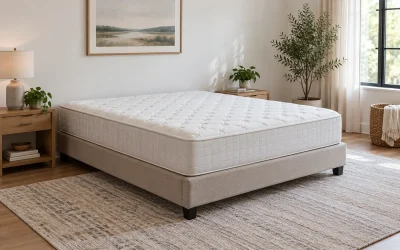
Check a storage bed beside nightstands by mapping each drawer’s width, outward travel and position along the bed. A clear aisle beside the mattress does not guarantee that the head-end drawer will pass a nightstand. Test the complete drawer path and the space needed to retrieve its contents before choosing a bed or replacing bedside furniture.
Start with the bed frame, not the mattress
Record the bed’s outside dimensions, including projecting rails, upholstered edges and handles. Then find the drawer positions in the manufacturer’s drawing. Two queen storage beds can place their drawers differently even though both hold a queen mattress. A product photo may hide the drawer closest to the headboard behind bedding.
Identify how the drawer moves. A drawer on runners has a defined path; a separate box on castors can behave differently and may need room for full removal. Do not assume a wheeled box can turn around a nightstand merely because it is not attached to slides. Its width, height and the bed opening still constrain the route.
As a concrete specification example, IKEA’s MALM storage box 202.527.23 is listed for the high Queen/King MALM frame, with outside depth 24⅜ inches and inside depth 23¼ inches. Those are different measurements, and neither alone states the complete aisle space required for your use.
Measure the nightstand’s obstructing footprint
Measure the nightstand top, body, base and projecting handles. A narrow base under an overhanging top can be relevant when checking drawer height, but do not assume the drawer can pass underneath without measuring the actual vertical gap and path.
Mark where the nightstand sits relative to the headboard and the first drawer edge. Include a wall gap or baseboard that prevents pushing it farther back. If it must stay in a particular position to reach a light or switch, treat that position as a real constraint rather than sliding the paper rectangle until the plan looks successful.
Also open the nightstand’s own drawer or door. The bed drawer may work only when the nightstand is closed, or the two may collide. Write down the interaction so the household can decide whether it is acceptable during ordinary use.
| Measurement | Bed drawer | Nightstand or room | Result to record |
|---|---|---|---|
| Position along bed | Start and end of drawer front | Start and end of nightstand | Do their ranges overlap? |
| Outward movement | Confirmed open travel or removal path | Nearest obstruction | Can it reach the needed position? |
| Height | Highest projecting part | Lowest obstructing part | Is apparent under-clearance real? |
| Everyday access | Contents you retrieve | Your usable working position | Can you actually load and unload? |
Draw the drawer path as a rectangle
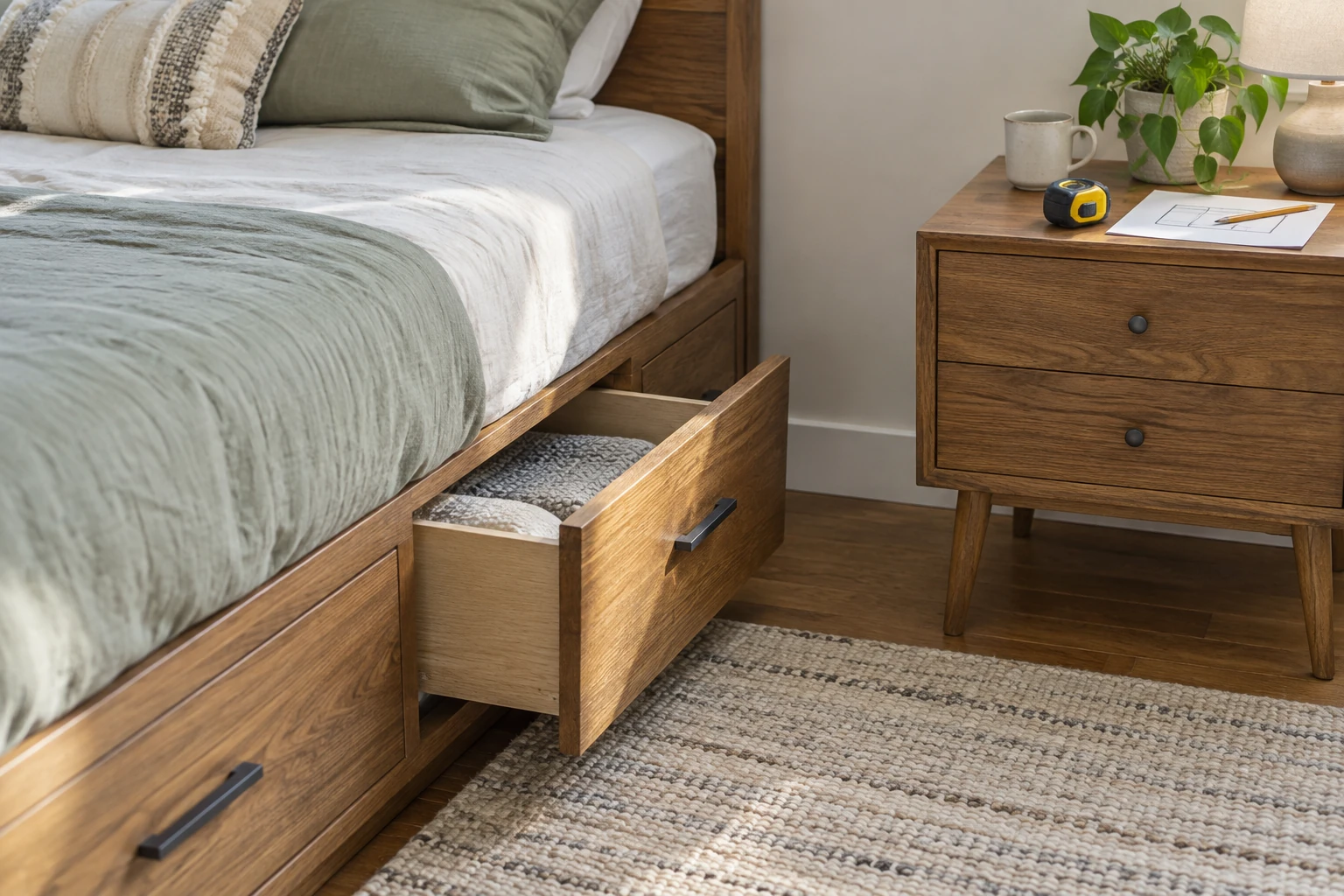
On a top-down sketch, draw the closed bed and nightstand. Extend the drawer’s full width outward by its confirmed travel. Shade that area. If the nightstand overlaps the shaded region, moving the drawer straight out will encounter a conflict even if most of the bedside aisle is empty.
Keep the height check separate. A top-down overlap may be harmless only if the actual components clear vertically throughout movement; do not infer that from perspective in a product image. Ask for the missing dimensions or measure the assembled model if you have appropriate access to it.
Repeat the drawing for each drawer. A head-end drawer and foot-end drawer can have different outcomes. One usable drawer should not cause the complete storage system to be marked as accessible.
Worked example: the head-end drawer overlaps
Imagine a drawer front spanning from 10 to 50 inches along the bed, measured from the head end. A nightstand occupies the interval from 0 to 20 inches along that same axis and stands beside the bed. The overlap is 10 inches, from the 10-inch mark to the 20-inch mark. These are illustrative dimensions.
If both objects occupy the same height range, the nightstand blocks part of the outward path. Increasing the aisle width farther down the bed does not remove that overlap. Possible revisions include relocating the nightstand, choosing a compatible smaller bedside piece or choosing a bed with a different drawer arrangement.
Each revision needs a second check. Moving the nightstand toward the headboard may not be possible because of the wall. Raising it is not automatically appropriate or stable. Leaving the drawer partly open may prevent access to the items at the back. The worksheet should record the actual workable arrangement, not just a reduced collision on paper.
Rehearse loading, not just opening
If you already own the bed, operate the drawer normally according to its instructions and check retrieval with the intended contents. Do not overload it for a test. If you are planning a purchase, use the confirmed dimensions to compare the space and ask the retailer about any missing opening information.
Include rugs, bedding that hangs into the path and items that collect beside the bed. Check whether the drawer can be removed for cleaning when required. A route that works only after moving a heavy nightstand every time may be a poor match for frequently used storage.
Keep the approved sketch with the product number and dimensions. It becomes useful again when replacing a nightstand or rearranging the room. The aim is usable storage beside the bed, with every drawer’s path and everyday access accounted for.