Key takeaways
- Check individual coverage, cover fit, center overlap and daily folding before choosing two separate duvets for a shared bed.
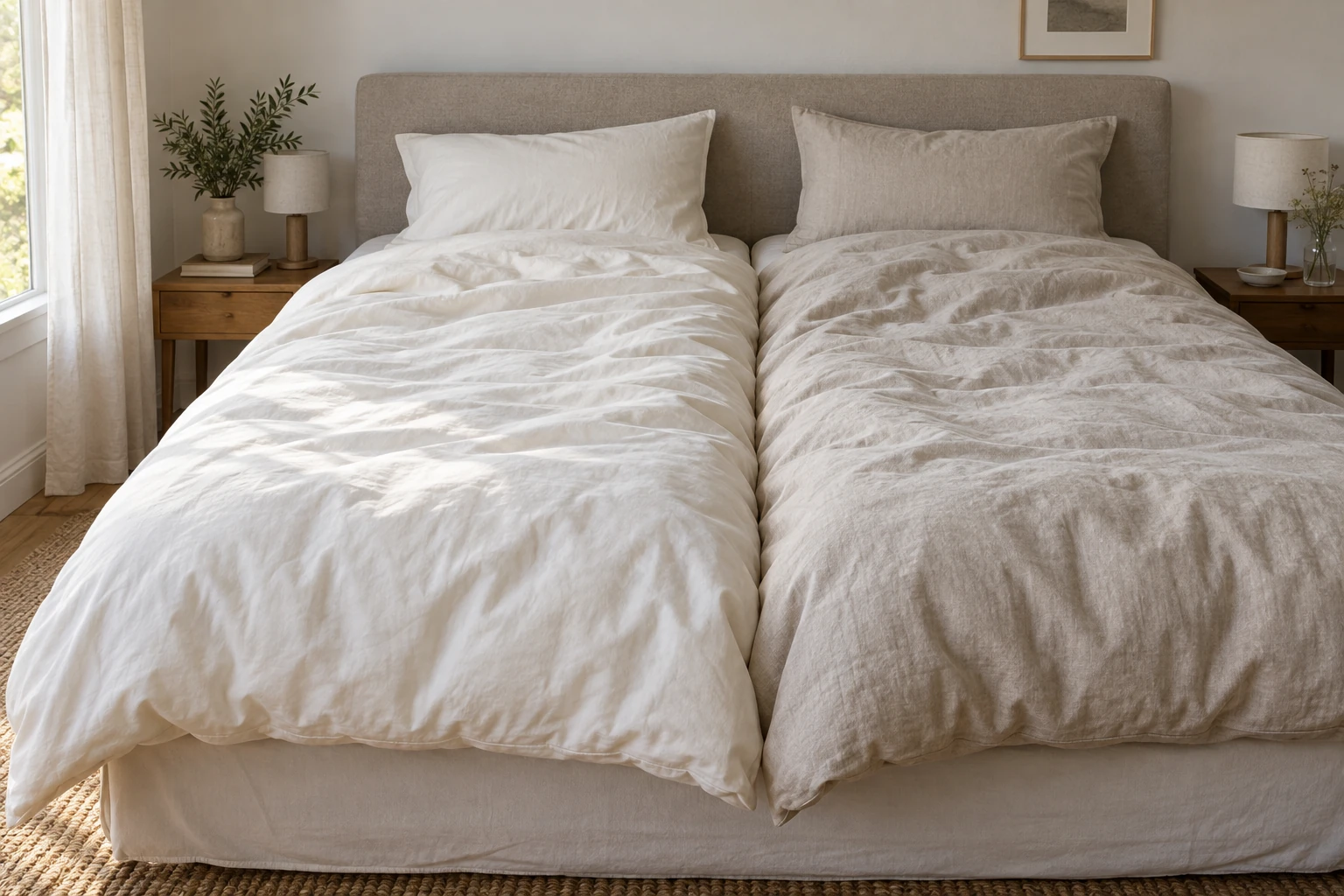
Two separate duvets on one bed means each person has an insert and its own cover. Choose the pair by actual dimensions, individual coverage and how the bedding will be folded and washed. Do not simply divide the mattress width in half and buy that width: the fabric also has to cover a person and accommodate movement.
Define the arrangement before choosing sizes
Decide whether you want two independent covers throughout the night or only separate layers within shared bedding. Two inserts inside one large cover are a different arrangement: they remain attached through the same cover and do not give each person an independently movable duvet. This guide concerns the separate-cover setup.
Measure the mattress width, length and height above the frame. Record whether either side sits against a wall. Then look at the bedding each person already finds usable. Measure it laid flat and note where it feels short or bulky. Those observations are more useful than choosing a regional size label without checking inches or centimeters.
Match each cover to its own insert
Make two complete pairs: left insert with left cover, right insert with right cover. Copy actual listed dimensions, closure details and the manufacturer’s fit guidance. If a retailer uses “single,” “twin” or “double,” check the measurements for the market you are buying from. Do not assume the same label has the same dimensions across brands.
For a concrete US product example, IKEA’s SMÅSPORRE light-warm twin insert lists a width of 64 inches and a length of 86 inches. That is one named product’s size, not a rule for all twin inserts or a recommendation that it fits every two-duvet arrangement.
| Record | Left side | Right side |
|---|---|---|
| Insert identity and dimensions | Brand/model, width × length | Brand/model, width × length |
| Cover identity and dimensions | Exact pair and fit notes | Exact pair and fit notes |
| Individual coverage check | Length, turning, side coverage | Length, turning, side coverage |
| Center and outer edges | Bunching or excessive overhang? | Bunching or excessive overhang? |
| Daytime position | Folded on bed or stored where? | Folded on bed or stored where? |
| Care | Insert and cover labels | Insert and cover labels |
Use flat-bed arithmetic only as a first sketch
Here is an illustrative geometry exercise. Suppose your measured bed is 60 inches wide and you are considering two inserts that each measure 64 inches wide. Their combined flat width is 128 inches. If you draw a 12-inch overlap at the center, the outer span is 128 − 12 = 116 inches. Centering that flat span over the bed leaves 28 inches beyond each side: (116 − 60) ÷ 2.
That result explains why two generous duvets can look bulky when spread fully flat. It does not predict actual coverage while occupied, because fabric drapes over bodies, folds and shifts. Nor does it mean you must buy narrower bedding. It tells you to plan a folded daytime arrangement and check each person’s usable coverage separately.
Rehearse the arrangement with bedding you own
Before buying a complete set, use two existing suitable blankets or duvets to explore independent movement and morning storage. This rehearsal tests the arrangement rather than reproducing the feel of a product you have not purchased. Avoid treating a thin sheet as evidence of how a thick insert will drape.
Each person should check whether they can turn without immediately uncovering the side or pulling the other duvet. Look at the center: is there an awkward pile, an unwanted gap or enough independence for your preference? Check whether outer edges trail into a walking route. Record the specific issue instead of deciding only that the setup “works” or “does not work.”
Choose a daytime folding routine
Try folding each duvet lengthwise within its half of the bed, with both folded ends aligned. Alternatively, fold each at the foot if the actual bulk fits without falling into the route around the bed. A decorative shared cover is optional; give it a destination at night if you use one.
Do not buy a storage bench solely from its outer dimensions. Measure the folded pair and the usable interior opening first. If different covers look confusing during bed-making, use distinct textures or a discreet identifying label consistent with the care instructions. Keep the choice practical enough that both people can restore the bed without a complicated styling routine.
Plan laundry for two complete pairs
Record the care label for each insert and each cover separately. The named SMÅSPORRE product, for example, specifies machine washing up to 140°F/60°C and medium tumble drying. Those directions do not apply automatically to another insert or its cover. Check your appliance instructions and the actual item’s care requirements before deciding what can share a load.
Work out where the second pair will wait while the first is being cleaned, and whether you need spare covers. More independent pieces can mean more handling even if each piece is smaller than a shared duvet. Keep that tradeoff in the decision alongside fit and appearance.
Approve the arrangement when each person has workable coverage, the center feels acceptable, daytime folding is manageable and the care routine fits your household. Separate duvets are a bedding configuration to evaluate, not a guaranteed improvement in sleep or health.
If you decide to keep one shared cover instead, see our queen duvet-cover sizing guide. That is a different arrangement from the two independently covered inserts measured here.