Key takeaways
- “Latex” with no mention of natural, blended, Dunlop, or Talalay. The seller is likely hiding a mostly synthetic product.
- No ILD or density number anywhere. Reputable makers publish at least one; “medium feel” alone is meaningless.
- Weight that seems too light. A 3-inch queen natural latex topper under 30 pounds is either Talalay at the very soft end or not fully latex.
- Prices under $100 for a 3-inch queen. Natural latex costs more than that to produce; expect blended or synthetic foam.
- “Latex-infused” or “latex-like.” These are polyurethane foams with marketing attached.
- Strong chemical smell after a week. Natural latex smells faintly of rubber for a few days at most.
- No return option. Latex feel is personal; a seller confident in the product will allow a trial.
- Warranty shorter than 2 years on a premium price. Signals the maker expects it to soften.
What's inside
Most people who are disappointed by a latex mattress topper bought the wrong density or the wrong thickness, not the wrong brand. The common mistakes are predictable. Buying a 3-inch soft topper to fix a mattress that is already too soft, and sinking further into the sag. Buying a 1-inch firm topper hoping to soften a rock-hard bed, and feeling almost nothing. Ordering “latex” without checking whether it is natural, blended, or synthetic, and getting a foam that softens within a year. Ignoring the weight, then discovering a 3-inch queen topper is a 40-pound slab that two people have to wrestle onto the bed. Latex is one of the most durable, breathable, and responsive topper materials you can buy, and a good one should last 8 to 15 years, but only if you match the density and thickness to your body, your sleep position, and the mattress underneath. This guide walks through the decisions in the order that matters.
Decide These 3 Things First
1. What is wrong with your current mattress? If it is too firm and you wake with sore hips or shoulders, you need a softer, thicker topper, typically 2 to 3 inches at a soft or medium firmness. If it is too soft or slightly saggy and your lower back aches, you need a firmer, thinner topper, usually 2 inches at firm, and you should accept that no topper fixes a dip deeper than about an inch. If it is fine but sleeps hot, a 2-inch medium latex topper will improve airflow without changing feel much.
As an Amazon Associate we earn from qualifying purchases at no extra cost to you. Product prices and availability are accurate as of the date shown and are subject to change.


2. How do you sleep and how much do you weigh? Side sleepers under about 180 pounds do best with soft; side sleepers over that with medium. Back sleepers usually want medium. Stomach sleepers and anyone over 230 pounds should choose firm to keep the hips from sinking. Couples with different needs can order a split topper or accept a medium compromise.
3. How much height can your bed take? Adding 2 to 3 inches to a 12-inch mattress means 14- to 15-inch total depth, which requires sheets with 15- to 18-inch pockets and may change how the mattress sits against a headboard or in a frame with side rails. Measure first.
Material: Natural, Blended, or Synthetic
Natural latex comes from rubber tree sap and is the most durable and resilient option, with a lifespan of 8 to 15 years as a topper. Blended latex mixes natural with synthetic styrene-butadiene rubber, often 30 to 70 percent natural, and typically lasts 5 to 8 years. Fully synthetic latex is the least expensive and least durable, closer to 3 to 5 years, and lacks the springy feel that makes latex worth buying. Look for GOLS certification, which guarantees at least 95 percent organic natural latex, and Oeko-Tex or eco-INSTITUT labels for low emissions. Be wary of listings that say “latex” without specifying; the word alone can legally describe a blend that is mostly synthetic. Natural latex has a faint, sweet rubber smell for a few days; a sharp chemical odor suggests synthetic content.
Construction: Dunlop vs Talalay
Dunlop latex is poured into a mold and baked, producing a denser foam that is slightly firmer at the bottom than the top. It is heavier, more supportive, and less expensive, and it is the better choice for a firm or medium topper meant to add support. Talalay latex is vacuum-sealed and flash-frozen before baking, which creates a more uniform, lighter, and bouncier foam with a plusher surface feel. It costs 20 to 40 percent more and excels as a soft comfort layer. For a queen, a 2-inch Dunlop topper weighs about 25 to 30 pounds and a 3-inch about 38 to 45 pounds; Talalay of the same thickness weighs roughly 15 to 20 percent less. Both types have pinhole ventilation from the mold, which is what makes latex sleep cooler than memory foam.
Density and Firmness: Reading the Numbers
Firmness in latex is measured by ILD, the pounds of force needed to compress a sample by 25 percent. Soft is roughly 19 to 24 ILD, medium 25 to 31, firm 32 to 40, and extra firm above 40. Density, expressed in pounds per cubic foot or in kilograms per cubic meter, tracks firmness in Dunlop: soft Dunlop is around 4 to 4.5 pounds per cubic foot (65 to 75 kg/m³), medium 4.5 to 5.3 (75 to 85 kg/m³), firm 5.3 to 6 (85 to 95 kg/m³). Talalay is less dense at the same ILD because of its open structure. Higher density means better durability and less body impression over time. A good rule: if you are unsure between two firmnesses, choose the firmer one for a 3-inch topper and the softer one for a 2-inch topper, since thickness amplifies the feel.
Thickness: 1, 2, or 3 Inches
A 1-inch topper changes surface feel slightly and adds airflow but does little for pressure relief or support; it suits people who like their mattress and want a touch of latex bounce. A 2-inch topper is the most versatile: it meaningfully softens a firm bed at soft or medium ILD, or adds noticeable support at firm ILD, without dramatically changing the mattress’s character. A 3-inch topper delivers the deepest pressure relief and effectively becomes the new comfort layer of the bed; it is the right choice for side sleepers on a very firm mattress or for anyone who wants the full latex feel. Toppers thicker than 3 inches are rare and usually unnecessary. For example, Pure Green sells a 2-inch Firm GOLS-certified natural queen topper for about $249, a 2-inch Soft for about $179, and a 3-inch Soft for about $269, which illustrates how thickness and firmness both move the price.
Cover and Fit
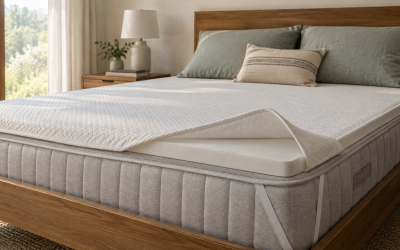
Many latex toppers ship bare, which protects the price but leaves the foam vulnerable to UV light, skin oils, and tearing when moved. A separate zippered cover in organic cotton or a cotton-bamboo blend costs $40 to $90 and is worth it; latex degrades faster when exposed to light and air, and a bare topper is hard to keep centered. Check that the topper is cut to true mattress dimensions: 60 by 80 inches for queen, 76 by 80 for king, 72 by 84 for California king. Latex can be an inch shy in each direction and still be considered in spec, so a fitted cover that hugs both topper and mattress helps.
Price Tiers
Budget latex toppers, $100 to $180 for a queen, are usually blended or synthetic, 1 to 2 inches, and often lack certifications; expect 3 to 5 years. Mid-range, $180 to $300, gets you 2 to 3 inches of certified natural Dunlop with a 5- to 10-year expected life; this is where most buyers should shop in 2026. Premium, $300 to $500, buys Talalay, thicker layers, included organic covers, and longer warranties of 5 to 10 years. King sizes add 25 to 40 percent to each tier. A soft 2-inch Talalay queen topper at around $329.40 sits at the lower edge of premium and shows the Talalay markup over Dunlop of similar spec.
Warranty, Trial, and Delivery
Look for at least a 30-night trial with free or low-cost returns, because latex feel is hard to judge from a description and a topper needs a week or two to settle. Warranties range from 1 year on budget toppers to 10 years on premium; a 5-year warranty on natural latex is a reasonable expectation. Toppers ship compressed and rolled in a box roughly 16 by 16 by 44 inches for a queen, weighing 30 to 50 pounds. Unroll it on the bed, not the floor, because a 3-inch latex slab is unwieldy to lift once flat. It expands fully within 24 hours and any smell fades in 2 to 3 days. No assembly beyond adding a cover.
Spec Checklist
| Spec | Budget | Mid | Premium |
|---|---|---|---|
| Material | Blended or synthetic latex, no certification | Natural Dunlop, GOLS or Oeko-Tex certified | Natural Talalay or Dunlop, GOLS plus emissions certification |
| Thickness | 1 to 2 inches | 2 to 3 inches | 2 to 3 inches, sometimes layered soft over firm |
| Density (Dunlop) | Under 4 lb/ft³ or unspecified | 4.5 to 5.5 lb/ft³ | 5 to 6 lb/ft³, ILD specified precisely |
| Firmness options | One or two generic levels | Soft, medium, firm with ILD ranges | Four or more ILD choices, split options for couples |
| Cover | None or thin polyester | Optional organic cotton, $40 to $90 | Included organic cotton or wool-quilted cover |
| Weight (queen, 2 inch) | 18 to 25 pounds | 25 to 32 pounds | 22 to 30 pounds (Talalay lighter) |
| Expected life | 3 to 5 years | 6 to 10 years | 10 to 15 years |
| Warranty | 1 to 2 years | 3 to 5 years | 5 to 10 years |
| Trial period | None or 30 days with fees | 30 to 60 nights | 60 to 120 nights, free return |
| Price (queen) | $100 to $180 | $180 to $300 | $300 to $500 |
Red Flags
- “Latex” with no mention of natural, blended, Dunlop, or Talalay. The seller is likely hiding a mostly synthetic product.
- No ILD or density number anywhere. Reputable makers publish at least one; “medium feel” alone is meaningless.
- Weight that seems too light. A 3-inch queen natural latex topper under 30 pounds is either Talalay at the very soft end or not fully latex.
- Prices under $100 for a 3-inch queen. Natural latex costs more than that to produce; expect blended or synthetic foam.
- “Latex-infused” or “latex-like.” These are polyurethane foams with marketing attached.
- Strong chemical smell after a week. Natural latex smells faintly of rubber for a few days at most.
- No return option. Latex feel is personal; a seller confident in the product will allow a trial.
- Warranty shorter than 2 years on a premium price. Signals the maker expects it to soften.
FAQ
Is a 2-inch or 3-inch latex topper better for back pain?
It depends on the mattress under it. On a too-firm mattress, a 3-inch soft or medium topper cushions the hips and shoulders and lets the spine settle into alignment. On a too-soft mattress, a 2-inch firm topper adds the support the lower back is missing. Thicker is not automatically better for pain; matching the topper to the problem is.
How heavy is a latex mattress topper?
A 2-inch queen natural Dunlop topper weighs about 25 to 30 pounds and a 3-inch about 38 to 45 pounds. Talalay runs 15 to 20 percent lighter. Kings add roughly 25 percent. Plan on two people for a 3-inch topper and keep it in a cover with handles if you expect to move it.
Does latex sleep hot?
No, it is one of the coolest foam options. The open cell structure and pinhole ventilation move air, and latex does not trap heat the way closed-cell memory foam does. Talalay breathes slightly better than Dunlop, and a cotton or wool cover keeps it cooler than a polyester one.
How long does a latex topper last compared to memory foam?
Natural latex toppers typically last 8 to 15 years before noticeable softening, while memory foam toppers usually last 2 to 4 years. Blended latex falls in between at 5 to 8 years. The higher upfront cost of natural latex is offset by not replacing it two or three times over the same period.