Key takeaways
- Edge behavior: Reinforced perimeter foam is fine; a steel edge wire is not. You need firm edges that still flex, otherwise the mattress creeps forward on the base over time.
- Heat: Elevated sleeping reduces the airflow beneath your torso. Gel infusions, graphite, copper, and open-cell foams all help, and hybrids breathe better than solid foam by default.
- Warranty language: Read the exclusions. Some manufacturers void coverage for adjustable-base use, and others require a specific number of support points.
- Retention straps or a non-slip cover: Almost every adjustable base includes them. Use them.
An adjustable base changes the physics of your bed. Instead of resting on a flat, rigid platform, your mattress is being asked to bend at the hips and shoulders, hold that bend for hours, and then return to flat without complaint — sometimes several times a night. A mattress that feels wonderful on a box spring can turn into a stubborn plank on a base like this: gapping at the head, bunching at the knee break, or slowly cracking its internal support layers until you feel a ridge under your lower back. The mattress, not the motor, is usually what decides whether an adjustable bed feels like an upgrade or a disappointment.
This guide walks through what actually makes a mattress adjustable-friendly: flexibility, height, construction type, edge behavior, and the split-size question that trips up most couples. You’ll also learn how to test flex before you commit, why some warranties quietly exclude adjustable use, and which trade-offs are worth accepting. Whether you’re building a setup from scratch or replacing a mattress that no longer bends, you’ll finish with a clear shortlist rather than a browser full of tabs.
Our top picks


As an Amazon Associate we earn from qualifying purchases at no extra cost to you. Ratings are shown as listed on Amazon.
🛒 Best Price Today on Amazon
Prime members get fast, free shipping on everything above, plus member-only deals. New members get a 30-day free trial — cancel anytime.
Flexibility Is the First Requirement — Everything Else Is Secondary
Your mattress has to articulate smoothly across at least two hinge points without resisting the motor or creasing permanently. All-foam builds are the natural fit here: memory foam and latex bend along their entire length and hold no internal structure that can snap. Modern pocket-coil hybrids also work well, because each spring is individually encased and moves independently of its neighbors — the reason models like the Mielmoon Split Queen hybrid and the Liberty Hybrid graphite pocket-coil mattress are marketed specifically for adjustable use. What does not work: interconnected or continuous-coil innersprings, anything with a rigid perimeter wire, and traditional pillow-tops that fold into a hard lip at the shoulder break. If a spec sheet says “Bonnell” or “offset coil,” walk away.
Height and Weight: The 10-to-14 Inch Sweet Spot
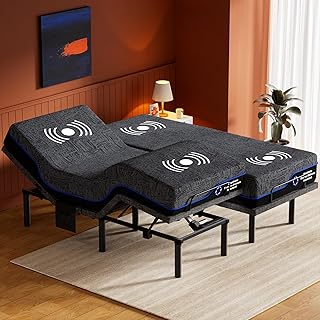
Thickness is where good intentions go wrong. Under roughly 8 inches, a mattress may bend easily but won’t offer enough support at the hips when you’re inclined. Above 14 inches, the mattress becomes stiff enough to fight the base, and a 15-inch luxury build often reduces your maximum incline angle noticeably. Ten to fourteen inches is the practical range, which is exactly why complete sets like the Amada 14-inch cooling gel package and the EGOHOME 14-inch split king pair a base with a mattress at that depth — they’re engineered as a unit. Also check weight: heavy mattresses shorten motor life and can strain the base’s lifting capacity, particularly on budget frames.
Split Sizes Solve the Couples Problem
If two people share the bed and only one wants to sleep elevated, a single king mattress on a dual-motor base is a compromise you’ll feel every night. Split king means two twin XL mattresses side by side, each with its own base half and its own remote — one person reads at 40 degrees while the other lies flat. Split queen works the same way at a smaller footprint, though the two halves are 30 inches wide each and can feel narrow. The trade-off is the center gap. A wedge or a zip-together kit closes it, but if you sleep pressed against each other, a single flexible king mattress on a synchronized base may serve you better. Decide this before you shop, because it dictates every other choice.
Edge Support, Cooling, and the Long-Term Details
- Edge behavior: Reinforced perimeter foam is fine; a steel edge wire is not. You need firm edges that still flex, otherwise the mattress creeps forward on the base over time.
- Heat: Elevated sleeping reduces the airflow beneath your torso. Gel infusions, graphite, copper, and open-cell foams all help, and hybrids breathe better than solid foam by default.
- Warranty language: Read the exclusions. Some manufacturers void coverage for adjustable-base use, and others require a specific number of support points.
- Retention straps or a non-slip cover: Almost every adjustable base includes them. Use them.
Tips
- Test the flex yourself: lift the head to full incline, then lie down and reach behind your lower back. If you feel a hard ridge or a hollow, the mattress isn’t articulating properly.
- Give bed-in-a-box models two to three days to fully expand before judging their bend — compressed foam is temporarily stiffer than it will be later.
- Use a long generous trial window. The Sleepmax hybrid’s 365-night trial is the kind of runway that lets you evaluate a mattress across a full season of temperature changes.
- Skip the box spring entirely and remove the frame’s legs if you need lower total height. Never stack a mattress on a foundation on top of an adjustable base.
Frequently Asked Questions
Can I use my existing mattress on an adjustable base?
Possibly, if it’s all-foam, latex, or a pocket-coil hybrid under 14 inches with no perimeter wire. Lay it on the base and run a full cycle before committing — resistance, creaking, or visible creasing means it’s not suitable.
Do latex mattresses work as well as memory foam?
Yes, and they run cooler and last longer, though they’re heavier and considerably more expensive. Talalay and Dunlop latex both flex beautifully.
Will an adjustable base shorten my mattress’s lifespan?
Only marginally, if the mattress is designed for it. Repeated flexing on an incompatible mattress, however, can cause visible degradation within a year.
Is buying a matched base-and-mattress bundle worth it?
Often yes. Bundles like the Amada or EGOHOME split king sets guarantee compatible height, weight, and flex — and remove any warranty ambiguity about pairing.
Conclusion
The right mattress for an adjustable bed is flexible, 10 to 14 inches deep, built from foam or pocket coils, breathable enough to compensate for reduced airflow, and — if you share the bed with someone whose preferences differ from yours — split. Match those criteria and the base does what it was designed to do: let you find the exact angle where your back stops aching and your breathing settles. Get them wrong, and you’ll spend a lot of money learning that a motor can’t fix a mattress that refuses to bend.