Key takeaways
- Best for: 1 child, 1 teen, or 1 adult in a studio or small bedroom
- Footprint: Usually 80″ L x 42″ W to 81″ L x 58″ W including ladder and desk overhang
- Vertical clearance: Requires at least 84″ ceiling height, 96″ is ideal for sitting up comfortably on top
- Desk type: Compact, often 35″ to 48″ wide and 18″ to 22″ deep
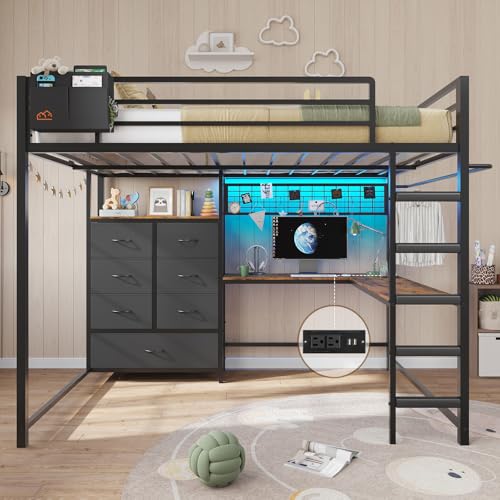
A bunk bed with desk saves the most space as a twin loft bed with desk underneath for single sleepers in rooms under 100 sq ft, while an L-shaped bunk bed with desk works better when you need two beds plus a usable desk in a 10×12 ft room or larger.
Our top picks



As an Amazon Associate we earn from qualifying purchases at no extra cost to you.
Loft vs L-Shape: The Core Difference
Both layouts combine sleep and study, but they use floor space very differently. Choosing the wrong one makes a small room feel cramped even if the furniture itself fits.
Twin Loft Bed with Desk
This is a single elevated twin or twin XL bed with an open area underneath for a desk, shelves, or a small wardrobe. The desk is typically built-in and perpendicular or parallel to the bed frame. It has the smallest footprint of any bunk bed with desk configuration and leaves the most usable floor space.
- Best for: 1 child, 1 teen, or 1 adult in a studio or small bedroom
- Footprint: Usually 80″ L x 42″ W to 81″ L x 58″ W including ladder and desk overhang
- Vertical clearance: Requires at least 84″ ceiling height, 96″ is ideal for sitting up comfortably on top
- Desk type: Compact, often 35″ to 48″ wide and 18″ to 22″ deep
L-Shaped Bunk Bed with Desk
An L-shaped design places two beds perpendicular to each other, often with a twin loft on top and a lower twin or full bed at a right angle. The desk is built into the corner where the two beds meet, creating a larger, more enclosed workstation.
- Best for: Shared kids’ rooms, siblings with an age gap, or a small apartment that needs to host two sleepers
- Footprint: Usually 80″ L x 80″ W to 84″ L x 84″ W in an L shape, needs a corner placement
- Vertical clearance: Same ceiling requirement as a loft, but needs more wall length on two sides
- Desk type: Larger L-shaped or rectangular desk, often 42″ to 60″ wide and 20″ to 24″ deep
| Feature | Twin Loft with Desk | L-Shaped Bunk with Desk | Standard Twin-over-Twin Bunk with Desk |
|---|---|---|---|
| Sleep Capacity | 1 (twin / twin XL) | 2 (twin + twin or twin + full) | 2 (twin over twin) |
| Typical Footprint | 29-32 sq ft | 44-49 sq ft | 32-35 sq ft |
| Desk Size | 35″ x 20″ to 42″ x 22″ | 50″ x 22″ to 60″ x 24″ | 39″ x 18″ to 42″ x 20″ (often pull-out) |
| Ceiling Height Needed | 84″ minimum, 96″+ ideal | 84″ minimum, 96″+ ideal | 84″ minimum |
| Weight Limit (Top Bunk) | 200-250 lbs | 200-250 lbs | 175-225 lbs |
| Best Room Size | 7×10 ft to 10×10 ft | 10×12 ft or larger | 8×10 ft to 10×12 ft |
Exact Footprint and Clearance: Will It Fit?
Product dimensions alone are not enough. You need clearance for safety, chairs, and drawers.
- Desk chair clearance: Leave at least 30″ to 36″ behind the desk for a chair to slide out. For a desk that is 20″ deep, you need a total depth of 50″ to 56″ from the wall.
- Ladder / stairs clearance: A side ladder adds 6″ to 12″ to the width. Staircase drawers add 18″ to 24″ and need 36″ of clear floor in front to open. For narrow rooms, choose an end-ladder or angled ladder.
- Top bunk headroom: Measure from the top of the mattress to the ceiling. You need 30″ to 36″ above the mattress to sit up without hitting your head. With an 8-foot (96″) ceiling and a 65″ high loft, a 6″ mattress leaves about 25″ of headroom, which is tight for teens and adults.
- 10×12 ft room test: A twin loft with desk (81″ x 44″) placed on the 10 ft wall leaves about 76″ of open floor length and 38″ on the side for a dresser. An L-shaped bunk (81″ x 81″) in the corner leaves a 39″ x 40″ open corner on the opposite side, enough for a small wardrobe but not much else. If your room has a window or closet on one of those walls, the L-shape may block it.
- Doorway and hallway fit: Boxed rails are often 80″ long. Most interior doors are 29″ to 30″ wide. Long rails will not turn sharply in a hallway under 36″ wide, which matters for apartments.
Desk Dimensions and Ergonomics That Matter
A bunk bed with desk is only useful if the desk can be used for hours without discomfort.
- Standard desk height: 29″ to 30″ is correct for most chairs. Youth loft desks are sometimes 26″ to 28″ high, which is too low for a teen over 5’4″ and causes hunching.
- Underside clearance: You need at least 25″ from the top of the desk to the bottom of the bed slats for knee space and a monitor. Cheaper lofts offer only 22″ to 24″, which forces you to use a low-profile chair.
- Desk depth: 18″ is enough for a laptop only. 22″ to 24″ is needed for a monitor + keyboard or for spreading out school books. L-shaped desks naturally provide this depth.
- Lighting: The bed above blocks overhead light. Plan for a clamp-on LED or under-bunk light strip. Without it, the desk area measures 40-60% darker than the rest of the room.
For kids under 12, a 35″ to 42″ wide desk is sufficient. For teens and adults working from home, look for at least 42″ wide and 22″ deep to fit a 24″ monitor with proper viewing distance (20″ to 26″ from eyes to screen).
Weight Limits and Who It’s Built For
Always check the manufacturer’s stated weight limit for the top bunk and the desk, not just the bed size.
- Kids (ages 6-12): A 175-200 lb top bunk limit is adequate. Low lofts (50″ to 55″ high) are safer and easier to make.
- Teens: Choose 200-250 lbs on the top bunk and 250-400 lbs on a lower full bed if present. Teens need more headroom and a deeper desk, so a mid-high loft (65″ to 72″ high) is better.
- Adults / small apartments: Look for a metal frame or solid wood loft rated to 250-300 lbs on top and 400-500 lbs on the bottom. Metal platforms often have higher limits than wood slats but can be noisier.
- Desk load: Most built-in desks are rated for 50-100 lbs. That is fine for a computer setup but not for sitting or standing on.
Safety note: The top bunk is not recommended for children under 6. Guardrails should be at least 5″ above the top of the mattress, and the mattress thickness should not exceed the maximum stated by the maker, usually 6″ to 8″ for the top bunk.
Material and Construction Trade-Offs
The material determines weight, noise, durability, and how the bunk bed with desk handles moves.
| Material | Pros | Cons | Best For |
|---|---|---|---|
| Solid Wood (pine, rubberwood) | Strong joints, reparable, stable, quiet | Heavier (150-220 lbs total), usually $500–$900, can dent | Long-term kids’ rooms, families who want to keep it for years |
| Engineered Wood (MDF / particleboard with veneer) | Lower price (usually $300–$600), smooth finish | Weaker screw hold, swells with moisture, chips on edges, heavier than it looks | Budget or short-term use, 2-4 years |
| Metal (steel tube frame) | Highest weight limits, lightest to move, easy to clean | Can wobble if not braced, welds and joints may squeak, colder look | Teens, college, small apartments, renters |
| Hybrid (wood desk + metal frame) | Stable sleeping area + solid desk surface | Mixed hardware, assembly more complex | Work-from-home setup in a loft |
Check the slat system: Solid wood slats with center support legs are more durable than widely spaced wire mesh or thin plywood. For the desk, a 0.75″ thick top with edge banding resists warping better than 0.5″ honeycomb tops found on low-cost models.
Decision Matrix: Pick by Your Situation
| Your Situation | Best Pick | Why |
|---|---|---|
| Room smaller than 10×10 ft, one sleeper | Twin loft with desk | Smallest footprint, keeps at least 50 sq ft of open floor |
| Shared room for two kids, need homework space | L-shaped bunk with corner desk | Two beds without stacking desks in the middle of the room |
| Small apartment / studio, adult sleeper | Full-size loft with desk (twin XL or full) | Higher weight limit and 55″+ under-bed clearance for a real office chair |
| Renter who moves often | Metal loft with desk | Lighter boxes (70-110 lbs per box vs 130-180 lbs for wood), fewer parts to damage |
| Low ceiling (under 8 ft) | Low loft (50″-55″ high) with desk | Preserves 30″+ headroom on top bunk |
Assembly, Moving and What Wears Out First
A bunk bed with desk is one of the heaviest flat-pack items for a home. Plan before you buy.
- Box weight and delivery: Expect 2 to 3 boxes totaling 130-220 lbs for solid wood, 90-140 lbs for engineered wood, and 70-120 lbs for metal. Stair carries in walk-up apartments often require two people.
- Assembly time: 2 to 4 hours with two adults. L-shaped models take longest due to the corner desk alignment. You will need a Phillips screwdriver, Allen keys (usually included), and ideally a drill with low torque for pilot holes.
- What loosens first: Ladder bolts, desk-to-frame connectors, and slat screws. Re-tighten after the first 30 days of use and every 6 months after. Metal frames squeak at the joint sleeves; a thin nylon washer helps.
- What wears first: On engineered wood, desk edge banding and ladder rung finish. On wood, guardrail joints if kids climb them. On any type, the finish under the desk chair mats without a mat.
- Moving tip: Disassemble the desk top and ladder before moving. Dragging a fully assembled loft through a 30″ doorway will damage both the frame and the door trim.
FAQ
Can an adult sleep on a loft bed with desk underneath?
Yes, if the top bunk is rated to at least 250 lbs and the ceiling allows 30″ or more above the mattress. Look for a full or twin XL loft with a steel reinforcement bar or solid wood posts at least 2.5″ square.
How much headroom do I need under the loft for a desk chair?
You need 52″ to 58″ from floor to the bottom of the bed slats to sit upright without crouching. Measure your seated height: floor to top of head while in your chair is typically 48″ to 52″ for an adult.
Is stairs or ladder better for a small room?
A ladder saves 12″ to 18″ of floor space compared to storage stairs, but stairs are safer for younger kids and provide drawers. In a room under 100 sq ft, an end ladder or angled ladder is the most space-efficient.