Key takeaways
- Score the line first with a sharp utility knife, two or three light passes. This severs the hard face layer so the blade can’t lift it.
- Apply painter’s tape over the cut line and mark on the tape. It supports the surface and gives you a crisp pencil line on a slick face.
- With a circular saw, cut with the good face down; the teeth exit through the back. With a hand saw or jigsaw, cut with the good face up.
- Support the panel fully on both sides of the cut — foam insulation board on the floor or sawhorses with sacrificial battens. Unsupported pegboard flexes and snaps.
What's inside
As a sleep-wellness consultant, I spend most of my working hours talking about light, temperature, and the quiet mental clutter that keeps people staring at the ceiling at 2 a.m. Pegboard comes up more often than you’d expect. A wall of tidy, vertical storage in a bedroom closet, a nursery, or the corner office that shares a wall with your headboard does real work for sleep hygiene — it gets objects off the floor and out of your visual field, which lowers the low-grade arousal that a cluttered room produces at bedtime. The catch is that pegboard almost never fits your wall at its factory 24×48 or 48×96 dimensions, and a bad cut leaves you with crumbling edges, a fine hardboard dust that settles into bedding for weeks, and a project you abandon half-finished.
This guide walks through the best way to cut pegboard in 2026: how the material actually behaves, which tool to reach for depending on how many cuts you’re making and where you’re making them, how to keep the surface layer from chipping, and how to manage dust in a room you intend to sleep in that same night. I’ll also flag the tools that look right for this job but aren’t, because knowing what to skip saves more money than any discount.
As an Amazon Associate we earn from qualifying purchases.


🛒 Best Price Today on Amazon
Prime members get fast, free shipping on everything above, plus member-only deals. New members get a 30-day free trial — cancel anytime.
Understand What Pegboard Actually Is
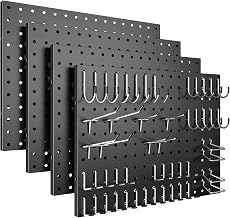
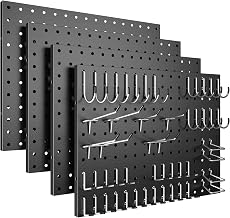
Pegboard is tempered hardboard — wood fibers compressed with resin under heat, then finished with a hard, slick face. That density is why it holds hooks under load, and it’s also why it fights you. It doesn’t split along a grain like plywood; it fractures. The perforations create built-in weak points, so a cut that passes through a row of holes wants to blow out the thin webbing between them. Two practical consequences: always cut on the finished face with the tool’s blade entering from that side (or the reverse, depending on the tool — more below), and never plan a cut line that runs directly through the center of a hole row. Shift your line to the solid material between rows, even if it means losing a half inch.
Match the Tool to the Number of Cuts
For one or two straight trims, a manual saw is genuinely the right answer. The 8-in-1 Multi Blades Hand Saw is the kind of tool I recommend for bedroom work: its quick-change mechanism lets you fit a fine-tooth wood or hacksaw blade, and a hacksaw blade’s high tooth count is ideal for hardboard because it shears fibers rather than tearing them. It also makes almost no airborne dust compared to a power tool, and no noise that will wake anyone.
For a full 4×8 sheet, or several panels, go powered. The SEESII Mini Circular Saw is a good fit here specifically because it’s small: a 4-1/2″ compact saw with a laser guide is easier to steer along a straightedge on thin stock than a full-size circular saw, which tends to bully quarter-inch material. Its dust extraction port matters more than the laser does — connect a shop vacuum and you’ll capture the majority of the fines at the source.
Prevent Chipping at the Cut Line
- Score the line first with a sharp utility knife, two or three light passes. This severs the hard face layer so the blade can’t lift it.
- Apply painter’s tape over the cut line and mark on the tape. It supports the surface and gives you a crisp pencil line on a slick face.
- With a circular saw, cut with the good face down; the teeth exit through the back. With a hand saw or jigsaw, cut with the good face up.
- Support the panel fully on both sides of the cut — foam insulation board on the floor or sawhorses with sacrificial battens. Unsupported pegboard flexes and snaps.
Dust Control Is a Sleep Issue
Tempered hardboard dust is fine, resin-laden, and an airway irritant. If you’re installing in or near a bedroom, cut outdoors or in a garage — full stop. If that’s impossible, seal the doorway, run the vacuum at the saw, wear an N95, and wet-wipe (never dry-dust) every horizontal surface afterward, including the top of the headboard and window trim. Strip and wash the bedding rather than sleeping on it. I’d also give the room a night of ventilation before you sleep in it, which is a fair reason to schedule this project for a Saturday morning rather than a Sunday evening.
Tools That Won’t Do This Job
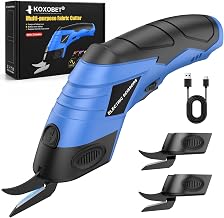
A few popular cutters get recommended for pegboard online and shouldn’t be. The Multi-Cut 401 is explicitly rated for soft wood, cardboard, plastic, and leather — not compressed wood — and pegboard is compressed wood by definition. The 13In Laminate Floor Cutter shears flooring planks cleanly and dust-free, which sounds perfect, but its blade geometry is built for a narrow plank width, not a 24-inch panel, and it will crush perforated hardboard rather than shear it. Battery-powered rotary cutters like the Fanttik C10 Pro BowGuide and the 2026 Upgrade Cordless Cutting Tool are excellent for the adjacent tasks — slicing the cardboard you’re using as a wall template, trimming felt or cork backing, opening the packaging — and I keep one in the kit for exactly that. They will not cut pegboard.
Tips
- Make a cardboard template of the wall opening first, including outlet cutouts, and test-fit it before touching the panel.
- Pegboard needs a furring-strip gap behind it — about 1/2 inch — so hooks have clearance. Plan your cut dimensions around the frame, not the drywall.
- Seal fresh cut edges with primer or edge banding. Raw hardboard edges absorb humidity, swell, and shed fibers.
- Keep a spare blade on hand. Hardboard resin dulls teeth fast, and a dull blade is the single biggest cause of blowout.
Frequently Asked Questions
Can I cut pegboard with a jigsaw?
Yes, and it’s the best choice for curves, notches, and outlet cutouts. Use a fine-tooth or reverse-tooth blade, set the orbital action to zero, and move slowly. For long straight runs a jigsaw tends to wander, so clamp a straightedge.
Do I need to seal the cut edges?
For a garage, it’s optional. For a bedroom, closet, or nursery, seal them. Sealing reduces ongoing fiber shed and keeps the edge from fuzzing, which matters if the panel is within arm’s reach of a bed.
What’s the quietest way to cut pegboard?
A fine-tooth hand saw with a scored line, cutting on a foam-supported panel. It takes a few minutes per cut and produces coarse crumbs instead of airborne dust — the right approach if you’re working around a napping child or a shift-worker’s sleep schedule.
How do I keep the holes aligned across two panels?
Lay both sheets face up, edges butted, and align the hole rows before you mark anything. Trim from the outside edges only, never the meeting edges, so the grid reads as continuous across the seam.
Conclusion
The best way to cut pegboard is boring and repeatable: score the line, support the panel, use a fine-tooth blade, keep the cut off the hole centers, extract the dust at the source, and seal the edge. A quick-change hand saw handles a couple of trims quietly; a compact circular saw with vacuum extraction handles a whole sheet cleanly. Get those two decisions right and the wall goes up in an afternoon — and the room it’s in becomes noticeably easier to fall asleep in.