Key takeaways
- Match the orifice to your machine: This is the single most common buying mistake. A 4.0 orifice paired with a small 2.0 GPM electric washer will bleed pressure and feel weak, while an undersized orifice on a gas unit can spike pressure and strain your pump. Check your washer’s GPM and PSI plate before ordering.
- Read the PSI rating as a ceiling, not a promise: A nozzle rated to 4000 PSI max is telling you what it can survive, not what it will produce. Your pump determines output; the nozzle just has to tolerate it with margin to spare.
- Prioritize stainless steel and a sealed bearing: The spinning ceramic head rides on a bearing that takes constant hammering. Stainless housings resist corrosion from hard water and detergent residue, and sealed bearings are the difference between one season and five.
- Confirm hot-water capability if you clean grease: Only some nozzles are rated for heated inlet water up to roughly 212°F. If you’re tackling oil-stained concrete or restaurant-grade grime, that rating matters; if you’re washing a car, it doesn’t.
- Decide between a single tip and a kit: A standalone turbo nozzle is ideal if you already own a full set of fan tips. If you’re starting from scratch, a bundled 6-in-1 or 7-piece kit gives you soap, rinse, and detail angles alongside the turbo head for very little extra outlay.
What's inside
Ask any homeowner what eats into their downtime and the answer is rarely the big stuff. It’s the drawn-out Saturday chores — the two hours spent dragging a fan-tip wand back and forth across a driveway that still looks gray when you’re done. As someone who spends most of my working life studying rest and recovery, I’ve come to see slow, repetitive outdoor maintenance as a genuine sleep-hygiene issue: late-afternoon frustration and physical strain follow you indoors, and they follow you to bed. A turbo nozzle is one of the cheapest fixes available. By concentrating a pencil-thin jet and spinning it in a tight cone, it strips grime in a fraction of the passes, which means less wrist fatigue, fewer lost evenings, and a cleaner handoff between chore time and wind-down time.
This guide covers the turbo nozzles worth buying in 2026, chosen for build quality, honest pressure ratings, and how well they hold up after a season of real use. I’ll walk through the specifications that actually determine performance — orifice sizing, GPM matching, bearing construction, hot-water tolerance — and then review the standouts individually, from single-tip workhorses to kits that bundle a full spray-angle set. Whether you’re restoring pavers, stripping algae from siding, or prepping a deck for stain, there’s a match below.
As an Amazon Associate we earn from qualifying purchases.


🛒 Best Price Today on Amazon
Prime members get fast, free shipping on everything above, plus member-only deals. New members get a 30-day free trial — cancel anytime.
How to Choose a Turbo Nozzle Pressure Washer (2026)
- Match the orifice to your machine: This is the single most common buying mistake. A 4.0 orifice paired with a small 2.0 GPM electric washer will bleed pressure and feel weak, while an undersized orifice on a gas unit can spike pressure and strain your pump. Check your washer’s GPM and PSI plate before ordering.
- Read the PSI rating as a ceiling, not a promise: A nozzle rated to 4000 PSI max is telling you what it can survive, not what it will produce. Your pump determines output; the nozzle just has to tolerate it with margin to spare.
- Prioritize stainless steel and a sealed bearing: The spinning ceramic head rides on a bearing that takes constant hammering. Stainless housings resist corrosion from hard water and detergent residue, and sealed bearings are the difference between one season and five.
- Confirm hot-water capability if you clean grease: Only some nozzles are rated for heated inlet water up to roughly 212°F. If you’re tackling oil-stained concrete or restaurant-grade grime, that rating matters; if you’re washing a car, it doesn’t.
- Decide between a single tip and a kit: A standalone turbo nozzle is ideal if you already own a full set of fan tips. If you’re starting from scratch, a bundled 6-in-1 or 7-piece kit gives you soap, rinse, and detail angles alongside the turbo head for very little extra outlay.
The Best Turbo Nozzle Pressure Washer (2026)s Reviewed
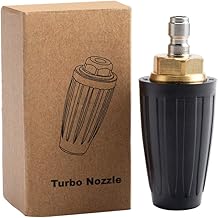
AURORA CAR Turbo Nozzle, 4000 PSI Max
A straightforward stainless turbo tip with a 4.0 orifice and 4.0 GPM rating, making it a natural fit for mid-to-large gas washers rather than compact electrics. The rotation stays smooth under load, and it chews through embedded dirt on brick, concrete, and vinyl with noticeably fewer passes than a 25-degree fan tip.
Simpson 80144 Turbo Nozzle, 4500 PSI
The premium choice here, and the one I’d recommend if you clean often or clean professionally. The oscillating jet delivers a genuinely faster cut, the 4500 PSI ceiling leaves real headroom on powerful gas units, and hot-water capability up to 212°F makes it the only pick on this list I’d trust for greasy driveway work.
Tool Daily Stainless Steel Turbo Nozzle, 3600 PSI
Tuned for 3.0 GPM machines, which covers a large share of consumer gas washers and the strongest electrics. It’s the most forgiving option for wood — the rotating cone spreads impact enough to lift gray from decking without the gouging you get from holding a zero-degree tip too close.
AURORA CAR Turbo Nozzle & 6-in-1 Quick Changeover
Essentially the AURORA turbo tip bundled with a rotating six-angle selector, so you can swap from turbo to soap to wide rinse without hunting through a bag of loose tips. Best value on the list for anyone outfitting a new washer from zero.
Stainless Steel 360° Rotating Turbo Nozzle, 3.0 GPM
A no-frills 3.0 GPM stainless tip that does one job competently at a low price. It’s my pick for car and garden use, where you want the speed of rotation but don’t need the aggression — or the cost — of a 4.0 orifice unit.
Frequently Asked Questions
Will a turbo nozzle damage my surfaces?
It can. Turbo nozzles concentrate force, so they’re excellent on concrete and brick but risky on soft wood, painted siding, window seals, and automotive clear coat. Start 18 inches back, test an inconspicuous patch, and close the distance gradually.
How do I know which orifice size I need?
Find your washer’s GPM on the spec plate and buy a nozzle rated for that flow. A 4.0 orifice suits roughly 4.0 GPM machines; a 3.0 orifice suits 3.0 GPM. Mismatches cost you pressure or overwork your pump.
Are turbo nozzles safe for electric pressure washers?
Yes, provided you size correctly. Most electric units run 1.2–2.0 GPM, so look for a smaller orifice rather than a 4.0. An oversized nozzle on a small pump produces a soft, disappointing stream.
Why did my turbo nozzle stop spinning?
Usually debris in the ceramic seat or a worn bearing. Back-flush it with clean water, use an inline filter on well or sediment-heavy supply lines, and never run it dry — dry cycling is the fastest way to kill the bearing.
Final Thoughts
If you want the fastest, most durable option and your washer can feed it, the Simpson 80144 is the clear winner — hot-water rated, generously overbuilt, and the best pick for frequent heavy cleaning. For a strong single-tip upgrade on a 3.0 GPM machine, the Tool Daily stainless nozzle is hard to beat, and the AURORA CAR 6-in-1 kit is the smartest buy if you’re building out a nozzle set from scratch. Any of the three will hand you back a chunk of your weekend, which is ultimately the point.