Key takeaways
- Rip capacity over blade diameter: An 8-1/4″ saw with 24″ of rip will handle plywood better than a 10″ saw that stops at 16″. Measure the widest panel you realistically break down and buy above that number.
- Fence quality: The fence is the saw. Look for a rack-and-pinion mechanism that stays square when you lock it down; a fence that flexes under hand pressure will cost you more wood than it saved you in purchase price.
- Footprint and mobility: Decide now whether the saw lives on a rolling stand, a benchtop, or a shelf. A folding rolling stand pays for itself in a one-car garage; a benchtop model needs a dedicated surface you can actually clear.
- Noise and vibration: Universal motors are loud by nature, but a heavier cast tabletop and rubber-isolated feet make a real difference through shared walls. If evening shop sessions matter, plan for hearing protection and an anti-vibration mat as part of the purchase.
- Dust extraction and safety kit: Confirm the dust port fits your shop vac hose, and check that the riving knife, anti-kickback pawls, and blade guard are quick to remove and reinstall — safety gear you have to fight with is safety gear you’ll leave in a drawer.
What's inside
Small shops punish bad tool choices. When a saw has to share floor space with a workbench, a lumber rack, and whatever project is currently half-finished, the machine that looked reasonable in a big-box aisle suddenly eats a third of your working area — and the rip fence you never checked turns out to drift a sixteenth of an inch over a four-foot cut. Add the fact that many home woodworkers get their shop time late in the evening, after the household has gone quiet, and the calculus changes again: a saw that screams and rattles through the floor joists is a saw you’ll stop using. Motor noise, vibration, and dust are not just comfort issues; they decide whether the tool actually gets used or becomes a very expensive side table.
This guide looks at compact table saws through that lens — genuine cutting capacity, fence accuracy, footprint and mobility, dust control, and how tolerable the machine is to run in a garage attached to a house where somebody is trying to sleep. Below you’ll find the models worth shortlisting in 2026, a buying framework you can apply to anything not on the list, and answers to the questions that come up most often once the box is open.
As an Amazon Associate we earn from qualifying purchases.


🛒 Best Price Today on Amazon
Prime members get fast, free shipping on everything above, plus member-only deals. New members get a 30-day free trial — cancel anytime.
How to Choose a/an Small Shop Table Saw (2026)
- Rip capacity over blade diameter: An 8-1/4″ saw with 24″ of rip will handle plywood better than a 10″ saw that stops at 16″. Measure the widest panel you realistically break down and buy above that number.
- Fence quality: The fence is the saw. Look for a rack-and-pinion mechanism that stays square when you lock it down; a fence that flexes under hand pressure will cost you more wood than it saved you in purchase price.
- Footprint and mobility: Decide now whether the saw lives on a rolling stand, a benchtop, or a shelf. A folding rolling stand pays for itself in a one-car garage; a benchtop model needs a dedicated surface you can actually clear.
- Noise and vibration: Universal motors are loud by nature, but a heavier cast tabletop and rubber-isolated feet make a real difference through shared walls. If evening shop sessions matter, plan for hearing protection and an anti-vibration mat as part of the purchase.
- Dust extraction and safety kit: Confirm the dust port fits your shop vac hose, and check that the riving knife, anti-kickback pawls, and blade guard are quick to remove and reinstall — safety gear you have to fight with is safety gear you’ll leave in a drawer.
The Best Small Shop Table Saw (2026)s Reviewed
DEWALT DWE7491RS 10-Inch with Rolling Stand
This remains the benchmark for serious small shops: 32-1/2″ of rip capacity means full sheet goods are genuinely manageable, and the rack-and-pinion fence holds its setting better than anything else in the class. The foldable rolling stand is the reason it works in tight spaces — it stores against a wall and deploys in seconds.
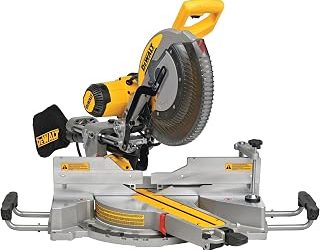
DEWALT DWE7485 Compact 8-1/4″ Jobsite Saw
A smaller, lighter sibling that gives up blade diameter but keeps DEWALT’s fence geometry and a surprising 24-1/2″ rip. Ideal if you’re building furniture from dimensional stock and need to lift the saw onto a bench between sessions.
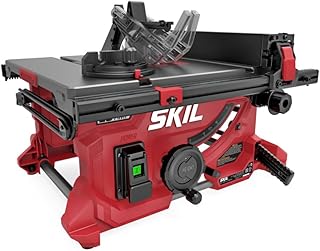
SKIL TS6308-00 15 Amp 8-1/4″ Portable Saw
The standout value pick, with a solid cast aluminum table and one of the smoothest fences at this price. Note that the SFS0001 stand is a separate purchase, so budget for it or plan on a sturdy bench.
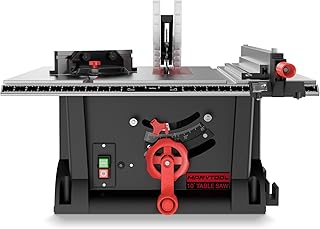
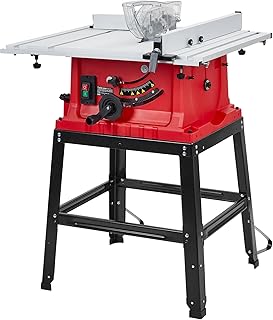
10-Inch 15 Amp Table Saw with Stand and Protective Cover
A 36″ x 25″ tabletop and 5000 RPM make this the most generous work surface here for the money, and the included stand plus cover suits a shop that doubles as a carport. Expect to spend an hour dialing in the fence and blade alignment before first use.
15 Amp Portable 10-Inch Compact Table Saw with 36T Blade
A lightweight benchtop option at 4600 RPM with standard 90° crosscut and 0–45° bevel range, aimed squarely at DIY furniture building. Best as a second saw or a starter machine rather than a daily driver.
Frequently Asked Questions
Is an 8-1/4″ saw powerful enough for furniture work?
Yes, for the vast majority of it. Depth of cut is the real limit — roughly 2-1/2″ at 90° — which covers hardwood boards and sheet goods but not thick slab work in a single pass.
Do mini table saws have a place in a small shop?
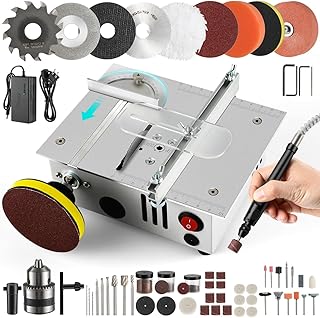
They do, as specialists. A mini multi-function table saw handles PCB, acrylic, thin plywood, and model stock with far more control than a full-size machine, but it is a complement to a jobsite saw, not a substitute.
How do I cut down noise for late-night shop time?
Set the saw on a rubber anti-vibration mat, keep a sharp thin-kerf blade installed, and connect a dust extractor with a muffled hose. A blunt blade is the single biggest noise source in a home shop.
Do I need to upgrade the included blade?
Almost always. Stock blades are typically 24T–36T general purpose; a 60T–80T thin-kerf crosscut blade transforms finish quality on hardwood and veneered plywood.
Final Thoughts
For most small shops the DEWALT DWE7491RS is worth the stretch — the rip capacity and fence accuracy simply outclass the field, and the rolling stand solves the space problem instead of adding to it. If your ceiling is lower, the SKIL TS6308-00 delivers most of that fence quality for far less, and the DEWALT DWE7485 is the pick when weight and storage are the binding constraints.