Key takeaways
- Independent articulation range: The headrest should tilt forward far enough to support the neck when you are fully reclined, not merely nudge a few degrees. If a chair also offers power lumbar, you gain a second adjustment axis and can dial in support for the lower back separately — a meaningful upgrade for anyone who dozes in the chair.
- Seat depth versus your leg length: A seat that is too deep forces you to slide forward, which collapses lumbar contact and drags the head off the headrest entirely. Taller users generally want 21 inches or more of depth; shorter users are better served by a compact or swivel-glider footprint.
- Wall clearance: Zero-wall and wall-hugger mechanisms recline within a few inches of the wall, which is what makes a full-size recliner workable in a bedroom or a narrow den rather than only a large living room.
- Upholstery and thermoregulation: Core body temperature has to fall for sleep to arrive easily. Genuine leather breathes and sheds heat well; performance faux leather cleans up better around pets and children but tends to run warmer over long sessions.
- Power delivery and controls: USB-A and USB-C ports on the chair keep cables off the floor, and a backup battery pack means a power cut does not leave you stranded in a reclined position. Check that the control pad is intuitive in the dark.
What's inside
The head is the part of the body most people forget when they buy a recliner. They test the seat, press on the armrests, check whether the footrest clears the coffee table — and then, three weeks later, they notice a dull ache at the base of the skull every evening around nine o’clock. A fixed backrest sends your neck into flexion the moment you lean back, so your chin drops toward your chest and the muscles along the back of your neck spend the whole evening quietly holding your skull up. That is not rest. That is isometric exercise performed by someone who thinks they are relaxing.
A power headrest solves the geometry problem. Because it articulates independently of the backrest, you can recline deeply for circulation and lumbar relief while keeping the cervical spine in a neutral, supported line — the same principle behind a well-chosen pillow. From a sleep-wellness perspective this matters twice over: it makes evening wind-down genuinely restorative, and it makes the chair a viable place for the intentional 20-minute nap without the stiff-necked penalty. Below, we look at six power-headrest recliners worth considering in 2026, from oversized leather wall huggers to a dual-motor lift chair, plus the specifications that actually predict comfort.
As an Amazon Associate we earn from qualifying purchases.


🛒 Best Price Today on Amazon
Prime members get fast, free shipping on everything above, plus member-only deals. New members get a 30-day free trial — cancel anytime.
How to Choose a Recliner With Power Headrest (2026)
- Independent articulation range: The headrest should tilt forward far enough to support the neck when you are fully reclined, not merely nudge a few degrees. If a chair also offers power lumbar, you gain a second adjustment axis and can dial in support for the lower back separately — a meaningful upgrade for anyone who dozes in the chair.
- Seat depth versus your leg length: A seat that is too deep forces you to slide forward, which collapses lumbar contact and drags the head off the headrest entirely. Taller users generally want 21 inches or more of depth; shorter users are better served by a compact or swivel-glider footprint.
- Wall clearance: Zero-wall and wall-hugger mechanisms recline within a few inches of the wall, which is what makes a full-size recliner workable in a bedroom or a narrow den rather than only a large living room.
- Upholstery and thermoregulation: Core body temperature has to fall for sleep to arrive easily. Genuine leather breathes and sheds heat well; performance faux leather cleans up better around pets and children but tends to run warmer over long sessions.
- Power delivery and controls: USB-A and USB-C ports on the chair keep cables off the floor, and a backup battery pack means a power cut does not leave you stranded in a reclined position. Check that the control pad is intuitive in the dark.
The Best Recliners With Power Headrest (2026) Reviewed
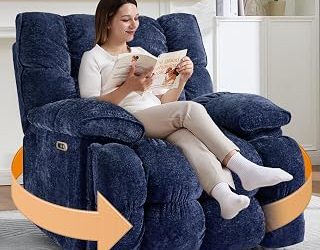
Watson & Whitely Oversized Genuine Leather Power Recliner, Navy Blue
Built for big-and-tall users who have spent years perching on undersized chairs, this wall hugger pairs a generous seat with genuine leather that stays cool through a long evening. The power headrest travels far enough to keep the cervical spine neutral at deep recline angles, and integrated charging ports mean your phone is not migrating to the floor.
Flexsteel Crew Power Recliner with Power Headrest and Lumbar
The addition of power lumbar alongside the headrest is what elevates the Crew: you can tune neck and lower-back support independently, which is the closest a recliner gets to adjustable-bed control. Flexsteel’s frame engineering and restrained transitional lines also make it the pick for anyone who wants the chair to disappear into a living room rather than dominate it.
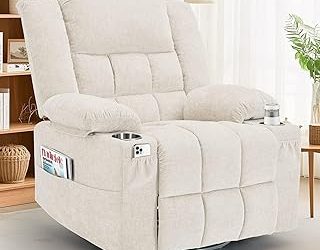
Watson & Whitely Swivel Recliner with Power Headrest, Khaki Fabric
A small-footprint glider-rocker with real power headrest articulation is a rare combination, and this one fits nurseries, bedrooms, and apartment corners where a full-size recliner would not. The fabric upholstery is the most breathable option here, which helps if you tend to overheat while winding down.
Watson & Whitely Genuine Leather Recliner with Power Headrest, Grey
Essentially the leather sibling of the khaki swivel model, this one adds USB-C charging and a smoother glide, making it a strong bedside reading chair. Expect a firmer initial seat that softens over the first month of regular use.
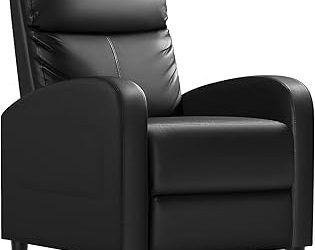
Pet Friendly Leather Power Recliner, Zero Wall Hugger
Scratch-resistant, waterproof faux leather and a down-filled cushion make this the practical choice for households with dogs, cats, or small children, and the zero-wall mechanism suits RVs and tight rooms. Just note that the sealed upholstery traps more heat than genuine hide over a two-hour sitting.
Frequently Asked Questions
Is sleeping in a recliner bad for you?
Occasional recliner sleep is generally fine and can help people with reflux, sleep apnea, or post-surgical recovery, provided the neck is properly supported — which is precisely what a power headrest delivers. For nightly sleep, a bed remains the better long-term choice for spinal alignment and pressure distribution.
What is the difference between a power headrest and a power lift chair?
A power headrest adjusts the top of the backrest to support your neck. A lift chair uses motors to tilt the whole chair forward and help you stand, which addresses mobility rather than posture. The Korser lift recliner combines both functions with added massage and heat.
Do power recliners need to be near an outlet?
Yes, though most accept a rechargeable battery pack that provides limited cycles between charges. Plan placement around a nearby outlet, and confirm cord length before committing to a wall.
How much wall clearance should I leave?
Standard power recliners need roughly 12 to 18 inches behind them; wall huggers and zero-wall designs need only 3 to 6 inches. Measure before you order, since the mechanism type is not always obvious from photographs.
Final Thoughts
For most buyers, the Flexsteel Crew is the strongest all-round choice, since power lumbar plus power headrest gives you genuine control over spinal alignment. Larger users should go straight to the Watson & Whitely Oversized Leather Power Recliner for its seat dimensions and breathable hide, while anyone with mobility needs will get far more from the Korser Dual Motor Lift Recliner and its heat and massage functions.