Key takeaways
- Lumbar contact, not lumbar labeling: Nearly every listing claims lumbar support. What matters is whether the cushion actually meets the inward curve of your lower back when you’re reclined, not just seated upright. If there’s a gap you can slide a fist into, the chair is transferring load to your discs instead of your seat bones.
- Recline range and the 130-degree window: Pressure on lumbar discs drops meaningfully once your torso passes roughly 130 degrees from your thighs. A chair that stops at 110 degrees is a slightly tilted seat, not a decompression tool. Look for a genuine deep-recline or near-flat position.
- Seat depth versus your femur length: A seat that’s too deep forces you to slide forward, which collapses the lumbar curve and undoes the support you paid for. Aim for two to three fingers of clearance between the cushion edge and the back of your knees.
- Lift assistance if standing is the hard part: For many people with chronic back pain or arthritis, the painful moment is the transition out of the chair. A power lift base that tilts you gently to your feet eliminates the twisting, bracing motion that commonly triggers flare-ups.
- Heat and vibration as adjuncts: Warmth increases tissue extensibility and can quiet protective muscle spasm, which is genuinely useful before bed. Treat these features as comfort aids that help you relax into sleep — not as treatment for the underlying problem.
What's inside
Back pain rarely announces itself in one dramatic moment. It accumulates — in the sag of a couch cushion that stopped supporting your lumbar curve two years ago, in the forty minutes you spend hunched forward each evening because sitting upright hurts more than slouching. By the time most people start shopping for a recliner, they’re not chasing luxury. They’re chasing a place to sit that doesn’t make things worse. And because pain fragments sleep as reliably as caffeine does, that chair often becomes a de facto second bed: the spot where you finally drift off because your spine has stopped negotiating with gravity.
That’s the lens I bring to this guide. As someone who works with clients on sleep quality and daytime recovery, I evaluate recliners the way I’d evaluate a mattress — by what they do to spinal alignment over hours, not minutes. Below are six models worth considering in 2026, spanning power lift mechanisms for limited mobility, heated massage units for muscle guarding, and compact frames for apartments. I’ve also included a buying framework and answers to the questions that come up most often.
As an Amazon Associate we earn from qualifying purchases.


🛒 Best Price Today on Amazon
Prime members get fast, free shipping on everything above, plus member-only deals. New members get a 30-day free trial — cancel anytime.
How to Choose a Recliner Chair For Back Pain (2026)
- Lumbar contact, not lumbar labeling: Nearly every listing claims lumbar support. What matters is whether the cushion actually meets the inward curve of your lower back when you’re reclined, not just seated upright. If there’s a gap you can slide a fist into, the chair is transferring load to your discs instead of your seat bones.
- Recline range and the 130-degree window: Pressure on lumbar discs drops meaningfully once your torso passes roughly 130 degrees from your thighs. A chair that stops at 110 degrees is a slightly tilted seat, not a decompression tool. Look for a genuine deep-recline or near-flat position.
- Seat depth versus your femur length: A seat that’s too deep forces you to slide forward, which collapses the lumbar curve and undoes the support you paid for. Aim for two to three fingers of clearance between the cushion edge and the back of your knees.
- Lift assistance if standing is the hard part: For many people with chronic back pain or arthritis, the painful moment is the transition out of the chair. A power lift base that tilts you gently to your feet eliminates the twisting, bracing motion that commonly triggers flare-ups.
- Heat and vibration as adjuncts: Warmth increases tissue extensibility and can quiet protective muscle spasm, which is genuinely useful before bed. Treat these features as comfort aids that help you relax into sleep — not as treatment for the underlying problem.
The Best Recliner Chairs For Back Pain (2026), Reviewed
MCombo Power Lift Recliner 7040
The strongest all-round pick for anyone whose pain spikes on standing: the powered lift base does the work your spine and knees would otherwise absorb, and the heat plus massage combination is well-placed across the lumbar band. Multiple size options and FSC-certified construction make this the most considered choice on the list, and the USB/Type-C ports mean you’re not reaching awkwardly for a charger at midnight.
Massage Recliner Chair in Ink Fabric
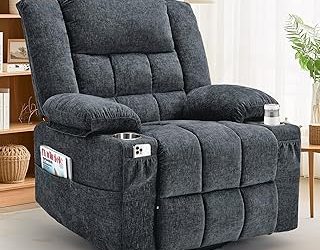
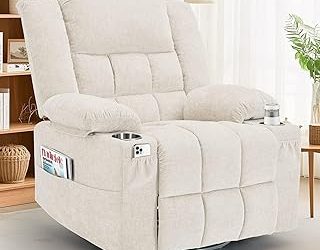
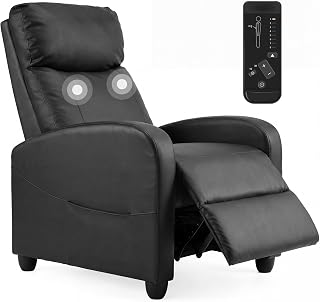
A quietly capable performer with a supportive lumbar shelf and breathable upholstery — the latter matters more than people expect, since trapped heat is a common reason evening dozes turn restless. The fabric finish also reads as living-room furniture rather than medical equipment, which increases the odds you’ll actually use it daily.
Sweetcrispy Massage Recliner
My recommendation for small apartments and bedrooms where footprint is the binding constraint. The compact frame doesn’t skimp on lumbar contouring, and the beige upholstery keeps a tight space feeling open — though taller users above six feet should check the back height before committing.
GarveeHome Power Recliner
The tall back is the standout here, extending support through the thoracic spine and giving your head and neck somewhere to rest without craning forward. Powered adjustment lets you fine-tune the angle in small increments, which is genuinely valuable when you’re hunting for the one position that stops the ache.
LAFWELL Rocking Recliner
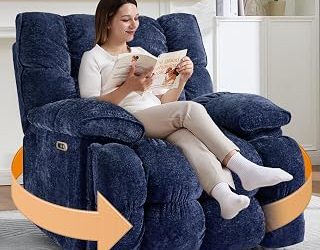
Rocking and 360-degree swivel make this a smart choice for nurseries, RVs, or anyone who finds gentle rhythmic motion calming before sleep. Support is solid rather than clinical, so I’d steer serious chronic-pain cases toward a lift model — but for versatility and soothing movement, it’s hard to beat.
Frequently Asked Questions
Is sleeping in a recliner bad for my back?
Not inherently — some people with disc problems or spinal stenosis genuinely sleep better in a reclined position, and clinicians sometimes recommend it during acute flares. The caveats are circulation and hip flexor tightness, so keep the recline deep rather than half-upright, and don’t let a chair permanently replace a supportive mattress.
Does the massage function actually help pain?
Vibration massage can reduce the sensation of pain and help guarded muscles let go, which is a real benefit for winding down. It won’t resolve a structural issue, so think of it as a relaxation tool rather than a therapeutic one.
Should I choose leather or fabric?
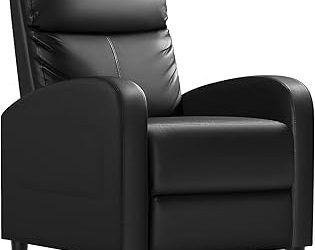
Fabric breathes better and stays more temperature-neutral, which favors long sessions and evening use. Faux leather wipes clean easily and suits households where spills are likely — pick based on your climate and how much you sweat, not on looks alone.
Do I need a power recliner or is manual fine?
If reaching for a side lever aggravates your back, or if you want to adjust position gradually without bracing, power is worth the premium. Manual recliners are perfectly serviceable for mild, intermittent discomfort.
Final Thoughts
If you want one recommendation to act on, the MCombo Power Lift Recliner 7040 is the most complete answer for chronic back pain — the lift base addresses the hardest moment of the day, and the heat and massage help you settle in the evening. For taller frames needing full-spine support, the GarveeHome Power Recliner is the better fit, and in tight rooms the Sweetcrispy Massage Recliner delivers surprising support for its footprint. Whichever you choose, measure your seat depth first; the right chair only helps if your body actually fits it.