Key takeaways
- PSI rating with headroom: Match or exceed your machine’s maximum pressure, then add margin. A 3,100 PSI hose on a 3,000 PSI washer leaves almost nothing in reserve; a 3,600 or 4,000 PSI line ages far more gracefully under repeated pressure cycling.
- Diameter matches your class of machine: 1/4″ is correct for electric and light residential gas units. Step up to 3/8″ for gas washers above roughly 3,000 PSI or whenever you’re running long distances, since the wider bore protects flow and reduces pressure loss.
- Fitting type and thread: M22 comes in two pin sizes — 14mm and 15mm — and they are not interchangeable. Check your existing connection before ordering, and prefer brass or stainless over zinc, which corrodes and seizes.
- Jacket material and cold-weather behavior: Polyurethane stays supple in cool air and won’t scuff paint or decking. Cheap PVC turns board-stiff below about 50°F, which is exactly when kinking becomes constant.
- Honest length, not maximum length: Extra hose is extra weight to drag and extra friction loss. Fifty feet handles most homes; reserve 100-foot runs for long driveways, multi-story siding, or a fixed washer position you’d rather not move.
What's inside
Anyone who has spent a Saturday afternoon washing a driveway knows the real enemy isn’t dirt — it’s the hose. The wand is doing its job, the pump is humming along, and then the line behind you folds into a kink, snags a planter, or stiffens into a coil that refuses to lie flat. You stop. You walk back. You wrestle. Twenty minutes of actual cleaning turns into an hour of aggravation, and the job you meant to finish before dinner is still waiting when the light goes. A flexible, correctly rated hose is the cheapest upgrade in the entire pressure-washing setup, and it’s the one that decides whether cleaning day ends with a sense of completion or with sore shoulders and a half-done patio.
That matters more than it sounds. Physical chores done well are genuinely restorative — steady effort, visible progress, an early finish that leaves the evening free to wind down properly. Chores done badly do the opposite: they keep you outside past dusk, leave your body tense, and hand you a mental to-do list to chew on at 11 p.m. This guide covers the hoses worth buying in 2026, what the specs on the label actually mean, and how to match length, diameter, and fittings to the machine you already own — so the work stays contained to the daylight hours where it belongs.
As an Amazon Associate we earn from qualifying purchases.


🛒 Best Price Today on Amazon
Prime members get fast, free shipping on everything above, plus member-only deals. New members get a 30-day free trial — cancel anytime.
How to Choose a Pressure Washer Hose (2026)
- PSI rating with headroom: Match or exceed your machine’s maximum pressure, then add margin. A 3,100 PSI hose on a 3,000 PSI washer leaves almost nothing in reserve; a 3,600 or 4,000 PSI line ages far more gracefully under repeated pressure cycling.
- Diameter matches your class of machine: 1/4″ is correct for electric and light residential gas units. Step up to 3/8″ for gas washers above roughly 3,000 PSI or whenever you’re running long distances, since the wider bore protects flow and reduces pressure loss.
- Fitting type and thread: M22 comes in two pin sizes — 14mm and 15mm — and they are not interchangeable. Check your existing connection before ordering, and prefer brass or stainless over zinc, which corrodes and seizes.
- Jacket material and cold-weather behavior: Polyurethane stays supple in cool air and won’t scuff paint or decking. Cheap PVC turns board-stiff below about 50°F, which is exactly when kinking becomes constant.
- Honest length, not maximum length: Extra hose is extra weight to drag and extra friction loss. Fifty feet handles most homes; reserve 100-foot runs for long driveways, multi-story siding, or a fixed washer position you’d rather not move.
The Best Pressure Washer Hoses (2026) Reviewed
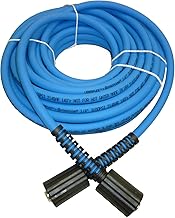
UBERFLEX Kink Resistant Hose, 1/4″ x 50 ft
The most genuinely limp, easy-handling 1/4″ hose in this group — it coils without fighting back and follows you around obstacles instead of catching on them. At 3,100 PSI with two 22mm fittings included and US manufacturing, it’s the pick for anyone whose main complaint is wrestling rather than bursting.
YAMATIC 3/8″ Hose, 4000 PSI x 50 ft
Steel-braided rubber rated for water from 15°F to 212°F, making this the right answer for hot-water units and cold-morning work alike. The 360° swivel quick connect is the standout feature: it unwinds torque as you move, which quietly eliminates a whole category of tangling.
Flexzilla Replacement Hose, 1/4″ x 50 ft
Flexzilla’s hybrid polymer stays flexible in temperatures where competitors go rigid, and at 3,100 PSI with M22 fittings it drops straight onto most consumer washers. It’s noticeably light for its length — a real consideration if you’re working overhead on siding or gutters.
Simpson Monster Cold Water Hose, 3/8″ x 100 ft
Dual-braided steel over polyester, 4,500 PSI, and a non-marring polyurethane jacket put this in professional territory. The 4″ bend protectors at each end address the exact spot where hoses actually fail, and 100 feet means you park the machine once and walk the whole property.
YAMATIC 1/4″ Hose, 3200 PSI, M22-14mm
Purpose-built as a replacement for Ryobi, Greenworks, Troy-Bilt, and Craftsman electrics, with solid brass fittings that outlast the zinc originals. Confirm you need the 14mm pin size and this is a straightforward, well-priced upgrade.
Frequently Asked Questions
How do I know if I need M22-14mm or M22-15mm?
Look at the male fitting on your machine and measure the small pin in the center. Most electric washers use 14mm; larger gas units typically use 15mm. If you’d rather not gamble, a kit like the PWACCS hose ships with five adapters and covers nearly every consumer configuration.
Does a longer hose reduce my pressure?
Slightly, through friction loss. It’s negligible at 50 feet on 1/4″, but at 100 feet you’ll want 3/8″ to keep flow intact — which is why the Simpson Monster comes in that diameter.
Can I connect two hoses together?
Yes, with a proper high-pressure coupler rated at or above your machine’s PSI. Never use a garden-hose fitting — it will fail, and it will fail near your hands.
Why does my hose kink in the same spot every time?
That section has taken a permanent set from being stored tightly coiled. Store hoses in wide loops or on a reel, and drain them after use; the memory that causes kinking is largely a storage problem, not a manufacturing one.
Final Thoughts
For most homeowners with an electric or mid-range gas washer, the UBERFLEX 50-footer is the easiest recommendation — supple, well-fitted, and the least likely to interrupt your rhythm. If you run hot water or a higher-pressure machine, the YAMATIC 3/8″ 4000 PSI hose with its swivel connect earns the upgrade, and anyone cleaning a large property should go straight to the Simpson Monster at 100 feet and stop moving the machine altogether. Buy once, finish early, and give the rest of the evening back to yourself.