Key takeaways
- Match the PSI rating to your machine, with headroom: Pick a hose rated above your washer’s maximum output. A 3,100 PSI hose is fine for most electric units, but gas models pushing 3,500–4,000 PSI need a steel-wire braided hose rated to 4,000 PSI or higher.
- Get the inner diameter right: Most residential washers use 1/4″ ID hose. Step up to 5/16″ or 3/8″ only if your machine’s flow rate calls for it — an oversized hose on a small pump adds weight without adding performance.
- Check the fittings before you buy: M22-14mm is the common residential thread, but some machines use M22-15mm, and many gas units use 3/8″ quick connects. Confirm the thread size and whether you need male, female, or adapters included.
- Prioritize real kink resistance: Look for steel-braid or high-tensile wire reinforcement under a flexible rubber or polyurethane jacket. These stay supple in cool weather, where cheap PVC hoses go rigid and take a set.
- Buy the length you need, not the longest available: Fifty feet covers most driveways and two-story siding. A hundred feet saves you from moving the machine, but adds bulk, storage hassle, and a small pressure drop at the nozzle.
What's inside
Anyone who has spent a Saturday morning wrestling a stiff, coiled hose across a driveway knows the feeling: the wand is ready, the detergent is mixed, and the only thing standing between you and a clean patio is thirty feet of rubber that refuses to lie flat. A pressure washer hose is the most overlooked component in the whole system, yet it dictates how far you can reach, how much you have to drag the machine around, and whether the job ends in satisfaction or a sore back. Cheap hoses kink at the first corner, balloon under load, or split at the fitting after two seasons of sun.
This guide looks at the pressure washer hoses worth owning in 2026, with attention to the details that actually matter in use: internal diameter, working pressure, fitting type, cold-weather flexibility, and how the hose behaves when you are twenty feet from the machine and pulling. We have grouped picks by the jobs most homeowners tackle — decks, siding, fences, vehicles, and the occasional hot-water rinse — so you can match a hose to your washer rather than guessing at a spec sheet.
As an Amazon Associate we earn from qualifying purchases.


🛒 Best Price Today on Amazon
Prime members get fast, free shipping on everything above, plus member-only deals. New members get a 30-day free trial — cancel anytime.
How to Choose a Garden Hose For Pressure Washer (2026)
- Match the PSI rating to your machine, with headroom: Pick a hose rated above your washer’s maximum output. A 3,100 PSI hose is fine for most electric units, but gas models pushing 3,500–4,000 PSI need a steel-wire braided hose rated to 4,000 PSI or higher.
- Get the inner diameter right: Most residential washers use 1/4″ ID hose. Step up to 5/16″ or 3/8″ only if your machine’s flow rate calls for it — an oversized hose on a small pump adds weight without adding performance.
- Check the fittings before you buy: M22-14mm is the common residential thread, but some machines use M22-15mm, and many gas units use 3/8″ quick connects. Confirm the thread size and whether you need male, female, or adapters included.
- Prioritize real kink resistance: Look for steel-braid or high-tensile wire reinforcement under a flexible rubber or polyurethane jacket. These stay supple in cool weather, where cheap PVC hoses go rigid and take a set.
- Buy the length you need, not the longest available: Fifty feet covers most driveways and two-story siding. A hundred feet saves you from moving the machine, but adds bulk, storage hassle, and a small pressure drop at the nozzle.
The Best Garden Hose For Pressure Washer (2026)s Reviewed
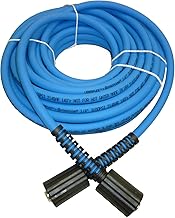
UBERFLEX Kink Resistant Pressure Washer Hose, 50 ft
The UBERFLEX is the one to buy if flexibility is your priority — it lays flat almost immediately and coils back up without fighting you, which makes a real difference on multi-hour jobs. Rated to 3,100 PSI with two 22mm fittings included and made in the USA, it suits electric and mid-range gas washers.
YAMATIC 3/8 in Pressure Washer Hose, 4000 PSI, 50 ft
Built for higher-output gas machines, this steel-braided rubber hose handles up to 4,000 PSI and water from 15°F to 212°F, so it stays workable in early spring and tolerates hot-water rinsing. The 360° swivel quick connect is the standout feature, preventing the twist that normally builds up as you work around a vehicle.
McKillans Pressure Washer Hose, 50 ft
A well-executed 1/4″ ID replacement hose with steel braiding and a stainless steel M22-14mm plug, which resists the corrosion and thread damage that eventually kills brass connectors. It is a sensible, no-drama upgrade over the hose that shipped with most consumer washers.
YAMATIC Steel-Wire Braided Hose, 50 ft, 4000 PSI
This version pairs a 1/4″ ID with a 3/8″ swivel quick connect and includes two M22-14mm adapters, making it one of the most broadly compatible hoses here. The abrasion-resistant rubber jacket shrugs off being dragged across concrete and brick.
YAMATIC 3200 PSI Hose with M22-14mm Females, 50 ft
Purpose-built as a direct replacement for Ryobi, Greenworks, Troy-Bilt, and Craftsman units, with solid brass female fittings on both ends and no adapters to lose. If you simply want your existing electric washer working properly again, start here.
Frequently Asked Questions
Can I use a regular garden hose instead?
No. A garden hose supplies water to the pump inlet at household pressure; the high-pressure hose carries water from the pump to the wand at thousands of PSI. Substituting one for the other is a burst risk.
Is a 100-foot hose worth it?
If you clean long driveways, RVs, or two-story siding, yes — options like the 100 ft high-tensile wire braided hose with 3/8″ quick connects rated to 4,200 PSI save constant repositioning. Expect a marginal pressure loss and heavier handling.
Will a higher-rated hose increase my pressure?
It will not. Output is set by your pump and nozzle. A better hose simply prevents losses, kinks, and failures that reduce real-world performance.
How should I store a pressure washer hose?
Drain it, coil it loosely in wide loops, and keep it out of direct sun and freezing temperatures. Tight coils and UV exposure are the two fastest routes to cracking.
Final Thoughts
For most homeowners, the UBERFLEX 50 ft hose offers the best balance of flexibility and durability, while the YAMATIC 3/8 in 4000 PSI hose is the stronger choice for gas machines and hot-water work. If you are replacing a factory hose on a Ryobi, Craftsman, or Greenworks unit, the YAMATIC 3200 PSI model with brass M22-14mm ends is the simplest drop-in fix.