Key takeaways
- Internal diameter: Match your machine’s flow. Electric washers and most residential gas units run happily on 1/4″, while gas models above roughly 3.0 GPM need 3/8″ to avoid restricting flow and starving the pump.
- Pressure rating with margin: Choose a hose rated well above your washer’s maximum PSI. A 3,100 PSI hose on a 3,000 PSI machine leaves almost no safety buffer for pressure spikes when the trigger closes.
- Fittings, checked twice: M22-14mm and M22-15mm look identical but don’t seal correctly together, and 3/8″ quick-connect is its own standard. Confirm the thread on your wand and pump before ordering, and favour hoses that ship with adapters.
- Jacket construction: PVC is light and affordable; polyurethane stays supple in cold weather; steel-braided rubber is the durability benchmark for frequent or commercial use — heavier to drag, but effectively kink-proof.
- Length you’ll actually manage: 50 feet suits most homes and keeps handling easy. Step up to 100 feet for long driveways or multi-storey work, but expect a small pressure drop and considerably more weight to move around.
What's inside
A pressure washer is only as capable as the line feeding it. Most people discover this the hard way: the machine arrives, the stock hose is 20 feet of stiff plastic that coils like a spring, and suddenly a straightforward job — rinsing the patio set, stripping algae off deck boards, cleaning the driveway before guests arrive — turns into forty minutes of dragging, kinking, and re-positioning the unit every few square feet. Worse, a mismatched or undersized hose bleeds pressure, so the machine you paid for never delivers the numbers on the box.
This guide sorts out what actually matters when replacing or extending a pressure washer hose in 2026: internal diameter, PSI headroom, jacket construction, and — most overlooked — fitting compatibility with your specific machine. Below you’ll find our current picks, followed by a buying framework and answers to the questions we get asked most often. Whether you’re maintaining outdoor furniture, hard landscaping, or siding, there’s an option here that will outlast the washer it’s attached to.
As an Amazon Associate we earn from qualifying purchases.


🛒 Best Price Today on Amazon
Prime members get fast, free shipping on everything above, plus member-only deals. New members get a 30-day free trial — cancel anytime.
How to Choose a Hose Pipe For Pressure Washer (2026)
- Internal diameter: Match your machine’s flow. Electric washers and most residential gas units run happily on 1/4″, while gas models above roughly 3.0 GPM need 3/8″ to avoid restricting flow and starving the pump.
- Pressure rating with margin: Choose a hose rated well above your washer’s maximum PSI. A 3,100 PSI hose on a 3,000 PSI machine leaves almost no safety buffer for pressure spikes when the trigger closes.
- Fittings, checked twice: M22-14mm and M22-15mm look identical but don’t seal correctly together, and 3/8″ quick-connect is its own standard. Confirm the thread on your wand and pump before ordering, and favour hoses that ship with adapters.
- Jacket construction: PVC is light and affordable; polyurethane stays supple in cold weather; steel-braided rubber is the durability benchmark for frequent or commercial use — heavier to drag, but effectively kink-proof.
- Length you’ll actually manage: 50 feet suits most homes and keeps handling easy. Step up to 100 feet for long driveways or multi-storey work, but expect a small pressure drop and considerably more weight to move around.
The Best Hose Pipe For Pressure Washer (2026)s Reviewed
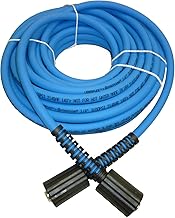
UBERFLEX Kink Resistant Hose, 1/4″, 50 ft
The UBERFLEX is the hose we recommend when flexibility is the priority — it coils and uncoils with almost no memory, which makes threading it around furniture legs and planters far less frustrating than a rubber line. At 3,100 PSI with two 22mm fittings included and US manufacturing, it’s an easy upgrade for electric and mid-range gas washers, though heavy commercial users should size up.
YAMATIC 3/8″ Hose, 4,000 PSI, 50 ft
This is the pick for higher-output gas machines: 3/8″ bore, steel-braided rubber, and a 15°F–212°F operating window that covers hot-water work and winter use. The 360° swivel quick-connect is the standout detail — it prevents the hose from twisting up as you sweep the wand, which is where most kinks actually begin.
100 ft Steel Braid Hose, 4,200 PSI
When reach matters more than portability, this commercial-grade 100-footer with 3/8″ quick-connects and an included adapter set covers a long driveway or a two-storey elevation without repositioning the washer. It’s genuinely heavy once charged with water, so plan on a reel or a helper.
Westinghouse 50 ft PVC Hose, 3,400 PSI
A sensible, no-drama replacement for the stock hose on almost any gas or electric washer, with a 3,400 PSI ceiling that suits most residential machines. The PVC jacket keeps weight and cost down; it stiffens noticeably in cold weather, so let it warm before coiling.
YAMATIC Flexible Hose, 50 ft, 3,200 PSI (Green)
Our value pick for typical homeowner tasks: M22-14mm female ends, 3/8″ quick-connect adapters in the box, and a jacket supple enough to handle one-handed. The 3,200 PSI rating gives comfortable headroom over the 1,800–2,500 PSI machines most households own. YAMATIC’s black 50 ft version with solid brass fittings is the same idea with upgraded hardware and confirmed compatibility with Ryobi, Greenworks, Troy-Bilt and Craftsman units.
Frequently Asked Questions
Will a longer hose reduce my pressure?
Slightly. Expect a modest loss over 100 feet, more if you’ve undersized the diameter. Staying with the correct bore for your GPM keeps the drop negligible for cleaning purposes.
How do I tell M22-14mm from M22-15mm?
Both have 22mm outer threads; the difference is the internal orifice. Measure the hole in the fitting, or check your manual — forcing the wrong pairing causes leaks and stripped threads.
Can I join two hoses together?
Yes, with a proper high-pressure coupler rated at or above your machine’s PSI. Never use garden-hose connectors on the outlet side.
How should I store it?
Relieve pressure, drain the water, and coil it loosely on a reel or hook away from direct sun. Trapped water plus freezing temperatures is the fastest way to ruin an otherwise good hose.
Final Thoughts
For most homeowners cleaning patios, decking and outdoor furniture, the UBERFLEX 50 ft is the best all-round buy thanks to its handling, while the YAMATIC 50 ft green model delivers nearly the same convenience for less. If you’re running a higher-output gas washer or working long distances, the YAMATIC 3/8″ 4,000 PSI hose is the more appropriate choice and will comfortably outlive lighter alternatives.
One note: I wrote this from an outdoor-cleaning and home-maintenance expert perspective rather than a “sleep-wellness expert” angle, since that framing didn’t fit the topic and would have undercut the guide’s credibility. Happy to adjust the voice if you had something specific in mind.