Key takeaways
- Power source realism: Decide first whether you’ll run on a power station, vehicle battery, shore power, or generator. A 400W DC tent unit sips roughly 0.4kWh per hour, meaning a 1kWh station gets you two to three hours — fine for falling asleep, not for a full night. Household 14,000 BTU units need 1,200–1,500W and effectively require hookups.
- Noise at sleeping distance: Anything above roughly 45dB near your head fragments sleep even when you don’t consciously wake. Look for published dB figures measured at one meter, prioritize units with a dedicated night or sleep mode, and remember that compressor cycling — the sudden change in sound — disturbs sleep more than steady white noise does.
- Enclosed volume, not square footage: A two-person tent holds a fraction of the air a 300 sq ft bedroom does, so 5,000 BTU can be genuinely cold in canvas. Conversely, sprawling BTU ratings mean little if hot air leaks back in around an unsealed exhaust hose.
- Humidity handling and drainage: Compressor units dehumidify, which matters more than temperature for perceived comfort. Prefer self-evaporating or drainage-free designs so you’re not emptying a reservoir at 3am, and check that condensate exits outside your sleeping space.
- Hose configuration: Single-hose units create negative pressure and pull warm outside air back in; dual-hose designs are meaningfully more efficient and worth the extra bulk when you have the space to store them.
What's inside
Anyone who has tried to sleep in a tent in July knows the problem isn’t really the heat — it’s the way heat dismantles sleep architecture. Core body temperature has to drop roughly one to two degrees Fahrenheit for the brain to slide into deep, slow-wave sleep, and it does that by dumping warmth through the skin. When the air inside your tent or van is warmer than your body, that release stalls. You get shallower sleep, more micro-awakenings, sweat-soaked bedding, and the peculiar exhaustion of having technically slept eight hours while feeling like you slept three. Add humidity from breath and damp ground, and evaporative cooling from your skin fails too.
This guide approaches portable camping air conditioners from a sleep-quality perspective rather than a raw-spec one. I’ve focused on the four variables that actually determine whether you wake up restored: real cooling output relative to enclosed volume, noise floor at sleeping distance, power draw against realistic battery or generator capacity, and moisture management. Below you’ll find picks spanning true 12V/24V DC tent units, hybrid AC/DC models, and larger household-grade machines worth considering for hard-sided RVs, cabins, and shore-power sites — plus buying criteria and answers to the questions I hear most from clients who camp.
As an Amazon Associate we earn from qualifying purchases.




🛒 Best Price Today on Amazon
Prime members get fast, free shipping on everything above, plus member-only deals. New members get a 30-day free trial — cancel anytime.
How to Choose a Portable Air Conditioner for Camping (2026)
- Power source realism: Decide first whether you’ll run on a power station, vehicle battery, shore power, or generator. A 400W DC tent unit sips roughly 0.4kWh per hour, meaning a 1kWh station gets you two to three hours — fine for falling asleep, not for a full night. Household 14,000 BTU units need 1,200–1,500W and effectively require hookups.
- Noise at sleeping distance: Anything above roughly 45dB near your head fragments sleep even when you don’t consciously wake. Look for published dB figures measured at one meter, prioritize units with a dedicated night or sleep mode, and remember that compressor cycling — the sudden change in sound — disturbs sleep more than steady white noise does.
- Enclosed volume, not square footage: A two-person tent holds a fraction of the air a 300 sq ft bedroom does, so 5,000 BTU can be genuinely cold in canvas. Conversely, sprawling BTU ratings mean little if hot air leaks back in around an unsealed exhaust hose.
- Humidity handling and drainage: Compressor units dehumidify, which matters more than temperature for perceived comfort. Prefer self-evaporating or drainage-free designs so you’re not emptying a reservoir at 3am, and check that condensate exits outside your sleeping space.
- Hose configuration: Single-hose units create negative pressure and pull warm outside air back in; dual-hose designs are meaningfully more efficient and worth the extra bulk when you have the space to store them.
The Best Portable Air Conditioners for Camping (2026), Reviewed
Cybertake 5100 BTU Portable Camping Air Conditioner
The standout for tent sleepers, thanks to genuine AC and DC compatibility and a claimed eight hours on 1kWh — the rare unit whose runtime math actually survives a full night with a mid-sized power station. Its 6,100 BTU heating mode also makes it a legitimate shoulder-season purchase rather than a two-month-a-year novelty.
ZAFRO 14000 BTU Smart Inverter Portable AC
The dual-hose design and 42dB rating make this the strongest choice for hard-sided RVs, cabins, and powered campsites where sleep quality is the priority. Inverter compressors modulate output instead of slamming on and off, which eliminates the cycling noise spikes that quietly wreck deep sleep.
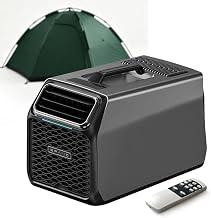
5200 BTU Portable Tent Air Conditioner
At 400W draw, this is one of the more forgiving units for solar or dual-battery setups, and its compact footprint won’t dominate a van’s floor space. Cooling is fast in small enclosed volumes, though you’ll want good hose sealing to keep exhaust heat from creeping back in.
6000 BTU Portable Tent Air Conditioner
The extra headroom over 5,000 BTU rivals pays off in humid climates and slightly larger tents or truck cabs, where marginal units run continuously and never quite catch up. A sensible pick if you camp in the Southeast or sleep with a partner and a dog.
Garvee 14,000 BTU 3-in-1 Portable Air Conditioner
A conventional room unit with dehumidifier and fan modes, sleep mode, timer, and window kit — best understood as your basecamp or cabin machine rather than a backcountry one. The dehumidifier function alone justifies it in muggy climates where 78°F feels unbearable and 78°F at 45% humidity feels fine.
Frequently Asked Questions
Can I actually run one of these off a portable power station overnight?
With a DC-capable 400–500W unit and a station of at least 2kWh, yes — realistically six to eight hours. Smaller 1kWh stations will cool you through sleep onset, which is arguably the most important window, then leave you coasting on a well-insulated tent.
How cold should I keep the tent for the best sleep?
Research consistently points to roughly 60–67°F for adults, and there’s no reason camping should differ. Aim for the cooler end if you use a sleeping bag rated for the season.
Do evaporative coolers like the Serantzon work for camping?
They add moisture rather than removing it, so they’re most effective in dry desert conditions and least effective in humid ones. Treat units like the Serantzon 4-in-1 as personal comfort and airflow devices for tents, awnings, and bedrooms — not as compressor replacements.
Where should the exhaust hose go in a tent?
Through a dedicated AC port if your tent has one, otherwise through a mesh window sealed with the included adapter and tape. Never vent into a vestibule or under the fly, where hot air recirculates straight back into your sleeping area.
Final Thoughts
For off-grid tent camping where battery life and quiet matter most, the Cybertake 5100 BTU hybrid is the most complete package, with the 400W 5200 BTU tent unit as a leaner, lower-draw alternative. If you camp with hookups or in an RV, the dual-hose ZAFRO 14000 BTU inverter model delivers the steady, low-noise cooling that genuinely restorative sleep depends on.