Key takeaways
- Know which technology you’re buying: Compressor units (rated in BTU) remove heat and moisture and can genuinely lower room temperature. Evaporative or “swamp” coolers add moisture and cool only the air passing over their wet media — excellent in dry climates or for a desk, ineffective in humid coastal summers.
- Match capacity to square footage, then subtract: Manufacturer coverage claims assume good insulation and shade. If a unit is rated for 350 sq ft, treat 250 sq ft as the realistic comfort ceiling for a sunny upstairs bedroom.
- Judge noise by texture, not just decibels: A steady, low-frequency hum masks street sounds and often improves sleep. Intermittent compressor cycling and rattling fan housings are what actually wake people. Prioritize models with a dedicated sleep or night mode that lowers fan speed automatically.
- Confirm the venting reality before you buy: Compressor units must exhaust hot air through a window kit — no exceptions. If your window is a casement, slider, or painted shut, verify the kit fits or choose a ventless evaporative model instead.
- Check tank size against your sleep window: Evaporative coolers stop cooling when dry. A 1.5-liter tank may last a few hours; a 2-gallon reservoir is far more likely to carry you from lights-out to sunrise without a refill.
What's inside
Sleep science is unusually clear on one point: core body temperature has to drop about one to two degrees for you to fall asleep and stay there. A bedroom sitting at 78°F fights that biological handoff all night, which is why so many people describe summer sleep as “shallow” — waking at 3 a.m., kicking off sheets, drenched pillowcase. The frustration for most renters and apartment dwellers isn’t a lack of desire to fix it; it’s that whole-home cooling is off the table, and central air either doesn’t exist or costs a small fortune to run overnight.
That’s where a sub-$200 portable unit earns its keep. This guide looks at what that budget actually buys in 2026 — from lightweight evaporative coolers that add a whisper of moving air to compressor-based units that genuinely pull heat and humidity out of a bedroom. I’ve evaluated each pick through a sleep-quality lens: noise character, how it behaves during unattended overnight runs, whether the timer and sleep modes are usable in the dark, and how much floor space it steals from a small room. Below you’ll find the shortlist, a buying framework, and answers to the questions readers ask most.
As an Amazon Associate we earn from qualifying purchases.


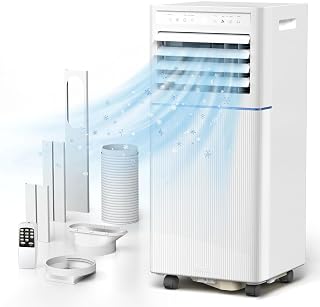

How to Choose a Portable Air Conditioner Under $200 (2026)
- Know which technology you’re buying: Compressor units (rated in BTU) remove heat and moisture and can genuinely lower room temperature. Evaporative or “swamp” coolers add moisture and cool only the air passing over their wet media — excellent in dry climates or for a desk, ineffective in humid coastal summers.
- Match capacity to square footage, then subtract: Manufacturer coverage claims assume good insulation and shade. If a unit is rated for 350 sq ft, treat 250 sq ft as the realistic comfort ceiling for a sunny upstairs bedroom.
- Judge noise by texture, not just decibels: A steady, low-frequency hum masks street sounds and often improves sleep. Intermittent compressor cycling and rattling fan housings are what actually wake people. Prioritize models with a dedicated sleep or night mode that lowers fan speed automatically.
- Confirm the venting reality before you buy: Compressor units must exhaust hot air through a window kit — no exceptions. If your window is a casement, slider, or painted shut, verify the kit fits or choose a ventless evaporative model instead.
- Check tank size against your sleep window: Evaporative coolers stop cooling when dry. A 1.5-liter tank may last a few hours; a 2-gallon reservoir is far more likely to carry you from lights-out to sunrise without a refill.
The Best Portable Air Conditioners Under $200 (2026), Reviewed
Garvee 14,000 BTU 3-in-1 Portable Air Conditioner
The strongest true cooling performance in this price bracket, with dehumidifier and fan modes plus a 24-hour timer and window kit included. The Follow Me function is the sleep-relevant feature here — it reads temperature at the remote rather than the chassis, so the unit responds to conditions at your pillow instead of across the room.
COSTWAY 10,000 BTU Portable Air Conditioner
A well-balanced choice for a standard 300-plus square foot bedroom, pairing dehumidification with a sleep mode that gradually eases fan speed and setpoint as the night progresses. Setup is straightforward and the drying mode is genuinely useful in humid climates where clamminess, not raw heat, is what disrupts sleep.
Antarctic Star 8,000 BTU 4-in-1 AC Unit
Marketed on quiet operation and easy installation, and both claims hold up reasonably well for a compressor unit at this price. It’s the pick for light sleepers who want real heat removal but have historically been driven off by loud cycling.
COSTWAY 8,000 BTU Portable AC Unit
Sized for smaller rooms up to roughly 230 square feet, making it a sensible match for a studio nook, nursery-adjacent guest room, or home office that doubles as a sleeping space. The 24-hour timer and sleep mode cover overnight use without you needing to touch the panel.
24″ Windowless 3-in-1 Portable AC (2-Gal Tank)
For anyone who cannot vent a window, this ventless evaporative tower is the most practical option: a 2-gallon reservoir, 15-hour timer, and 120° oscillation for gentle circulation rather than a fixed cold blast. Expect a modest perceived temperature drop and better results in dry air.
Frequently Asked Questions
What temperature should my bedroom be for good sleep?
Most sleep researchers converge on roughly 60–67°F. If you can’t hit that, aim for steady rather than fluctuating — a room that holds 72°F all night often beats one swinging between 68°F and 78°F.
Do ventless portable air conditioners actually cool a room?
They lower the temperature of air passing through their wet filter, which feels cooling on skin, but they add humidity and don’t remove heat from the space. In dry climates they work well; in humid ones they can make things feel worse.
Is it safe to run a portable AC all night?
Yes, when it’s plugged directly into a grounded wall outlet — never a lightweight extension cord or power strip — and the exhaust hose is kept short and unkinked. Empty condensate tanks as directed to prevent mold.
Will a portable AC raise my electricity bill much?
An 8,000–10,000 BTU unit running eight hours typically costs less than central air cooling an entire house. Using sleep mode and a timer that shuts down before your alarm trims consumption further.
Final Thoughts
If your window will accept a vent kit, the Garvee 14,000 BTU offers the most real cooling power for the money, while the COSTWAY 10,000 BTU is the better-balanced everyday bedroom choice thanks to its sleep mode and dehumidification. Renters who can’t vent at all should look at the 24″ windowless tower with the 2-gallon tank — modest cooling, but enough airflow and night-long runtime to make a warm room noticeably more sleepable.