Key takeaways
- Arm height over everything: Sit down and mime a feed. Your forearms should rest on the arms with shoulders relaxed and dropped — not shrugged up toward your ears. Adjustable or generously padded armrests solve more discomfort than any other single feature, because a shrugged shoulder held for forty minutes is what becomes a knot by morning.
- Full head support, not a headrest suggestion: If the backrest ends at your shoulder blades, your neck has nowhere to go when you doze. Look for a back tall enough that your occiput lands on padding, ideally with independent headrest adjustment so you can angle it forward for reading and back for resting.
- Seat depth matched to your height: Aim for two to three fingers of clearance between the back of your knee and the seat edge. Petite parents are often better served by a “medium” frame than an oversized one, no matter how inviting the oversized version looks in photos.
- Quiet, controlled motion: Test for creak, clunk, and jolt. A smooth glide or a slow power recline protects a light sleeper on your chest; a spring-loaded manual mechanism that snaps back does not. Power models also let you change position without shifting your torso at all.
- Exit strategy and after-life: You need to stand up while holding a baby, so check that the footrest retracts fully and the arms are sturdy enough to push off. Then ask whether the upholstery, colour, and silhouette will still earn its floor space in a living room three years from now.
What's inside
Nobody warns you that the hardest part of the newborn months isn’t the feeding itself — it’s the sitting. A parent nursing or bottle-feeding a baby will spend somewhere between 700 and 1,000 hours in a single chair during the first year, most of it between midnight and 5 a.m., often with one arm supporting a head and the other arm doing nothing useful at all. Sit in the wrong chair for that long and your body keeps a ledger: a stiff neck from a backrest that stops below your skull, a numb shoulder from armrests two inches too low, a low back that aches by week three because the seat is deeper than your thighs are long. And because fragmented sleep already blunts your pain tolerance and your patience, small ergonomic mistakes stop feeling small very quickly.
This guide looks at nursing recliners through a sleep-wellness lens rather than a purely decorative one. That means judging chairs on the things that actually determine whether you drift off mid-feed or wake up wrecked: head and neck support, arm height relative to a feeding position, how quietly a chair glides or reclines, whether you can get out of it one-handed with a sleeping baby, and how gracefully it transitions into a reading chair once the nursing chapter closes. Below are six chairs worth your attention in 2026, plus the criteria I’d apply to any model you’re weighing up.
As an Amazon Associate we earn from qualifying purchases.


🛒 Best Price Today on Amazon
Prime members get fast, free shipping on everything above, plus member-only deals. New members get a 30-day free trial — cancel anytime.
How to Choose a Nursing Chair Recliner (2026)
- Arm height over everything: Sit down and mime a feed. Your forearms should rest on the arms with shoulders relaxed and dropped — not shrugged up toward your ears. Adjustable or generously padded armrests solve more discomfort than any other single feature, because a shrugged shoulder held for forty minutes is what becomes a knot by morning.
- Full head support, not a headrest suggestion: If the backrest ends at your shoulder blades, your neck has nowhere to go when you doze. Look for a back tall enough that your occiput lands on padding, ideally with independent headrest adjustment so you can angle it forward for reading and back for resting.
- Seat depth matched to your height: Aim for two to three fingers of clearance between the back of your knee and the seat edge. Petite parents are often better served by a “medium” frame than an oversized one, no matter how inviting the oversized version looks in photos.
- Quiet, controlled motion: Test for creak, clunk, and jolt. A smooth glide or a slow power recline protects a light sleeper on your chest; a spring-loaded manual mechanism that snaps back does not. Power models also let you change position without shifting your torso at all.
- Exit strategy and after-life: You need to stand up while holding a baby, so check that the footrest retracts fully and the arms are sturdy enough to push off. Then ask whether the upholstery, colour, and silhouette will still earn its floor space in a living room three years from now.
The Best Nursing Chair Recliners (2026) Reviewed
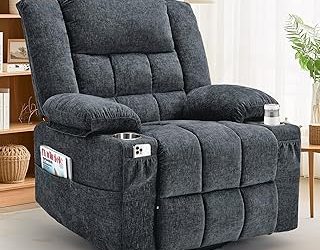
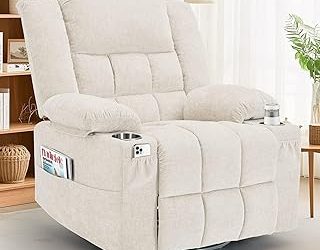
Electric Glider Recliner with Adjustable Armrests, Massage & Heat
This is the most ergonomically adjustable option here, and the adjustable armrests are the reason: being able to tune arm height to your own torso removes the shoulder strain that ruins most feeding chairs. The gentle lumbar heat is genuinely useful for post-partum back tension, though I’d treat the massage motors as a bonus rather than a selling point.
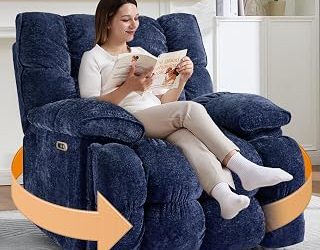
Oversized 360° Swivel Glider Recliner with 2 Pillows
A deep, enveloping chair for taller parents and for anyone who wants room to curl sideways during a long stretch of cluster feeding. The included pillows do real work as lumbar and arm props, but shorter users should check seat depth carefully before committing.
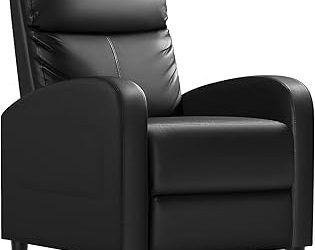
Sweetcrispy Push-Back Recliner with Lumbar Support
The sensible budget choice: no motors, no cords, just a quiet push-back mechanism and firm high-density foam that holds its shape rather than sagging into a hammock by month six. Lack of a wall-plug requirement also means you can place it wherever the nursery layout actually makes sense.
FLEXISPOT XL31 Power Lift Recliner
Marketed for elderly users, but the lift function is quietly brilliant for anyone recovering from a caesarean or a difficult delivery, since it raises you to standing without any abdominal effort. USB and Type-C charging on the side is a small thing that matters at 3 a.m.
CHITA Power Recliner Swivel Nursery Glider
The most polished piece in this group — FSC-certified upholstery, defined lumbar support, and a wipeable faux leather that shrugs off spit-up and leaked milk. Its medium footprint and restrained cognac finish mean it reads as a proper armchair long after the bottles are gone.
Frequently Asked Questions
Do I really need a dedicated nursing chair?
Not strictly, but feeding in bed or on a soft sofa encourages a slumped spine and makes it far easier to fall asleep holding your baby unsupported — a genuine safety concern. A supportive upright-to-reclined chair is the safer default.
Glider, rocker, or recliner?
Gliders move on a fixed horizontal track and are the quietest and most predictable. Rockers soothe some babies more effectively but can drift across the floor. Recline capability is the feature you’ll appreciate most in year two, when the chair becomes a story-time seat.
Is heat and massage worth paying for?
Heat, often yes — mild warmth across the lumbar region eases the muscular tightness that follows carrying a growing baby. Massage motors are pleasant but audible, and most parents switch them off once the baby is drowsy.
Should I choose leather or fabric?
Faux leather wipes clean in seconds, which is a real advantage during the reflux stage. Fabric such as corduroy or performance weave feels warmer against skin during night feeds but wants removable, washable covers to survive the year.
Final Thoughts
If you want one chair to get right, the Electric Glider with Adjustable Armrests offers the most meaningful ergonomic control for the hours you’ll actually spend in it, while the CHITA Power Recliner Glider is the pick for anyone who wants nursery function and long-term living-room looks in the same frame. On a tighter budget, the Sweetcrispy Push-Back Recliner delivers the fundamentals — firm support, quiet motion, no cables — and the Yaheetech Swivel Nursing Chair is a smart compact alternative if floor space is scarce. Choose for your body first; the room can adapt.