Key takeaways
- Slat spacing: Gaps wider than three inches allow foam and hybrid mattresses to bulge downward between supports, creating uneven pressure and premature softening. Closely spaced slats — the IOTXY uses nineteen — give you a near-continuous deck without sacrificing ventilation.
- Deck rigidity and load rating: Look at combined dynamic load, not just static capacity. A queen mattress plus two sleepers plus movement is a moving target, so center rails and enough legs to interrupt long unsupported spans matter more than the headline number.
- Noise behavior: Squeaks almost always originate at metal-to-metal contact points or under-torqued bolts. Frames with welded joints, nylon washers, or felt-capped feet stay quieter over years; plan on re-tightening hardware once a season regardless.
- Height and egress: Aim for a seated mattress-top height near knee level, roughly 22 to 26 inches. A 12-inch frame suits thicker mattresses; a 14-inch steel base pairs better with slimmer foam and opens up storage clearance.
- Materials and airflow: Solid pine breathes and resists the creep that plagues particleboard. Steel is dimensionally stable in humid rooms. Upholstered frames feel warmer and quieter but need vacuuming if you’re managing dust sensitivities.
A mattress can be perfectly matched to your body and still sleep badly if the platform underneath is working against it. Foundations tend to be the last thing buyers think about and the first thing that fails them: a deck that flexes lets a hybrid settle into a shallow trough, a joint that ticks with every turn produces brief arousals you’ll never consciously remember but that still fragment slow-wave sleep, and a frame set at the wrong height makes getting up at 3 a.m. an ordeal instead of a non-event.
This guide evaluates platform beds the way I’d assess any other component of a bedroom sleep environment. Slat spacing and deck rigidity come first, followed by noise behavior, underbed clearance, airflow, and whether assembly is realistic on a weeknight. Below are six frames that hold up under that scrutiny, spanning solid pine construction, upholstered wood, and low-profile steel.
Our top picks



As an Amazon Associate we earn from qualifying purchases at no extra cost to you. Ratings are shown as listed on Amazon.
🛒 Best Price Today on Amazon
Prime members get fast, free shipping on everything above, plus member-only deals. New members get a 30-day free trial — cancel anytime.
How to Choose a Mattress Platform Bed (2026)
- Slat spacing: Gaps wider than three inches allow foam and hybrid mattresses to bulge downward between supports, creating uneven pressure and premature softening. Closely spaced slats — the IOTXY uses nineteen — give you a near-continuous deck without sacrificing ventilation.
- Deck rigidity and load rating: Look at combined dynamic load, not just static capacity. A queen mattress plus two sleepers plus movement is a moving target, so center rails and enough legs to interrupt long unsupported spans matter more than the headline number.
- Noise behavior: Squeaks almost always originate at metal-to-metal contact points or under-torqued bolts. Frames with welded joints, nylon washers, or felt-capped feet stay quieter over years; plan on re-tightening hardware once a season regardless.
- Height and egress: Aim for a seated mattress-top height near knee level, roughly 22 to 26 inches. A 12-inch frame suits thicker mattresses; a 14-inch steel base pairs better with slimmer foam and opens up storage clearance.
- Materials and airflow: Solid pine breathes and resists the creep that plagues particleboard. Steel is dimensionally stable in humid rooms. Upholstered frames feel warmer and quieter but need vacuuming if you’re managing dust sensitivities.
The Best Mattress Platform Beds Reviewed (2026)
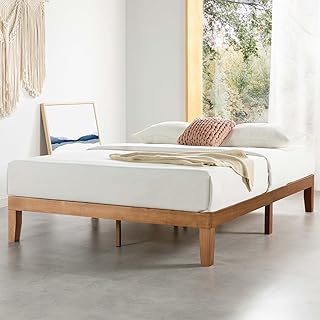
Mellow Naturalista Classic
Twelve inches of solid pine with a slatted deck that lets a mattress breathe from below — meaningful if you sleep warm or live somewhere humid. Assembly is genuinely straightforward, and the untreated wood finish stays acoustically dead in a way tubular steel rarely manages.
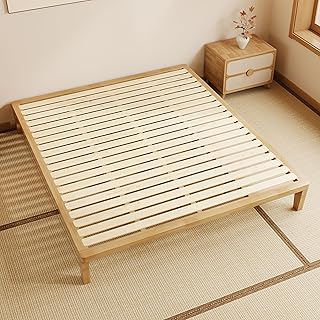
IOTXY Solid Wood Platform Bed
The tatami-inspired build is the most over-engineered deck here: nineteen closely spaced slats, three support bars, thirteen legs, and a 700-pound rating that leaves real headroom for a heavy hybrid plus two adults. Low, quiet, and structurally serious.
Zinus SmartBase
Still the reference point for tool-free steel foundations. It unfolds in minutes, delivers 14 inches of usable underbed clearance, and works equally well as a standalone base or hidden inside an existing headboard setup — an efficient answer for renters and guest rooms.
Zinus Curtis Upholstered
The dark grey upholstery softens both the look and the sound of the room, and the wood slat support handles foam mattresses without a box spring. A sensible pick if you want a finished, headboard-inclusive bed rather than a bare foundation.
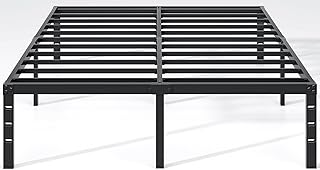
JETO Metal Bed Frame
A heavy-duty 14-inch steel platform built around storage clearance, with enough cross-bracing to stay stable under nightly movement. Assembly is simple, and the black finish keeps it visually recessed under bedding.
Frequently Asked Questions
Do I need a box spring with a platform bed?
No. Every frame here provides its own rigid support surface. Adding a box spring on top raises the sleep height awkwardly and introduces a second layer that can compress unevenly over time.
Will a platform bed void my mattress warranty?
Only if the slat spacing exceeds the manufacturer’s limit, which is typically three inches for foam and hybrid beds. Check your warranty document before buying, and photograph the assembled deck as evidence if you ever file a claim.
Why does my new frame squeak?
Almost always loose hardware or bare metal rubbing metal. Tighten every bolt in a cross pattern, add nylon washers at the contact points, and place felt pads under the feet if you’re on hardwood floors.
How much underbed clearance do I actually need?
Standard storage bins want 12 to 13 inches, so a 14-inch frame is the practical minimum. The Amazon Basics foldable metal frame is a strong small-space option here, since it collapses flat when you move.
Final Thoughts
For most sleepers, the Mellow Naturalista Classic strikes the best balance of solid-wood stability, ventilation, and painless assembly. Choose the IOTXY if you want maximum deck density and load capacity under a heavy hybrid, or the Zinus SmartBase if clearance, portability, and a five-minute setup matter more than materials.