Key takeaways
- Recline angle and lock: Look for a backrest that opens past 135° and locks reliably. A supported reclined position with a footrest unloads the lumbar discs and is the difference between a genuine ten-minute reset and an awkward nap in a tilted chair.
- Lumbar support quality: Vibration motors are secondary to structure. The chair should preserve your natural lower-back curve when upright; adjustable or active lumbar systems suit anyone whose spine doesn’t match a generic foam bump.
- Heat placement and control: Warmth across the lumbar region increases local tissue pliability and feels calming. Insist on an independent heat switch and, ideally, an auto shut-off timer so you’re not sitting in constant low heat for hours.
- Weight capacity and seat width: A 400–500 lb frame with a 21″+ seat isn’t only for larger users — heavier gauge steel and thicker foam resist the sagging that quietly ruins posture in year two.
- Massage intensity and noise: Six-point vibration is best understood as gentle tension relief, not deep-tissue work. If you want real muscle kneading, choose a 3D mechanism, and check that motor noise won’t intrude on calls or focus work.
As someone who spends most of my working life studying how people recover — not just at night, but across the whole 24-hour cycle — I’ve come to a slightly unfashionable conclusion: a lot of bad sleep is manufactured between 9 a.m. and 6 p.m. The person who sits rigid in an unsupportive chair for nine hours arrives at bedtime with a locked-up thoracic spine, shallow breathing mechanics, and a nervous system that never once dropped out of low-grade alert. Then they blame their mattress. The chair you sit in all day is quietly shaping the body that has to lie down at 11 p.m.
That’s the lens I’m using for this guide. A massage office chair won’t replace movement breaks or good sleep hygiene, but the better ones do two useful things: they hold your pelvis and lumbar curve in a position your muscles don’t have to fight, and they give you short windows of heat and vibration that help downshift tension before it accumulates. Below I’ve assessed six of the strongest 2026 options — including heavy-duty 400–500 lb builds, a kneading 3D model, and Sharper Image’s active-lumbar executive chair — with notes on ergonomics, recline geometry, and which features actually earn their keep.
Our top picks




As an Amazon Associate we earn from qualifying purchases at no extra cost to you. Ratings are shown as listed on Amazon.
🛒 Best Price Today on Amazon
Prime members get fast, free shipping on everything above, plus member-only deals. New members get a 30-day free trial — cancel anytime.
How to Choose a Massage Office Chair (2026)
- Recline angle and lock: Look for a backrest that opens past 135° and locks reliably. A supported reclined position with a footrest unloads the lumbar discs and is the difference between a genuine ten-minute reset and an awkward nap in a tilted chair.
- Lumbar support quality: Vibration motors are secondary to structure. The chair should preserve your natural lower-back curve when upright; adjustable or active lumbar systems suit anyone whose spine doesn’t match a generic foam bump.
- Heat placement and control: Warmth across the lumbar region increases local tissue pliability and feels calming. Insist on an independent heat switch and, ideally, an auto shut-off timer so you’re not sitting in constant low heat for hours.
- Weight capacity and seat width: A 400–500 lb frame with a 21″+ seat isn’t only for larger users — heavier gauge steel and thicker foam resist the sagging that quietly ruins posture in year two.
- Massage intensity and noise: Six-point vibration is best understood as gentle tension relief, not deep-tissue work. If you want real muscle kneading, choose a 3D mechanism, and check that motor noise won’t intrude on calls or focus work.
The Best Massage Office Chairs of 2026, Reviewed
3D Kneading Massage Office Chair with Heat (500 lbs)
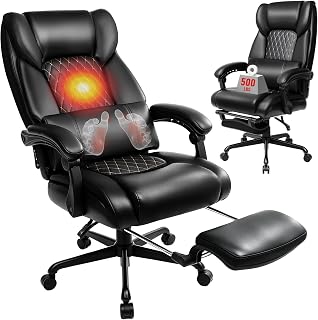
This is the most therapeutically convincing chair in the group, because rolling 3D kneading produces sustained pressure rather than surface buzz — closer to what a massage therapist’s thumb actually does. Combined with heat, a 500 lb frame, and a footrest, it’s my pick for anyone whose tension patterns are stubborn enough to follow them into the evening.
Sharper Image S600 Active Lumbar Executive Massage Chair
The S600’s active lumbar mechanism responds as you shift, which matters more over an eight-hour day than any massage program does. The bonded leather and white/gray finish read as executive rather than gaming, making it the natural choice for a visible home office or a shared video-call space.
500LBS Massage Office Chair with 6-Point Vibration and Heat
A wider, thicker seat and a substantial 500 lb rating give this one the most reassuring sit-and-settle feel of the vibration models, with almost no perceptible flex through the base. The recline-plus-footrest combination is well judged for short midday decompression breaks.
Massage Office Chair with Foot Rest, 500LBS Big and Tall (Dual-Use Pillow)
The dual-use pillow is the detail worth noting: it works as a head cushion when upright and repositions to support the cervical curve when reclined, which is where most chairs let your neck fall into extension. A sensible, well-specified big-and-tall option.
Massage Office Chair, 22.05″ Wide Big and Tall (6-Point Vibration and Heat)
At 22.05 inches across, this offers the roomiest seat here — genuinely useful if you cross your legs, sit sideways, or simply dislike being framed by tight bolsters. Heat and six-point vibration perform on par with its siblings, so choose it primarily for the dimensions.
Frequently Asked Questions
Can a massage chair actually improve my sleep?
Not directly, but it can reduce the daytime muscular tension and postural strain that make it harder to settle at night. Think of it as removing an obstacle to sleep rather than inducing it.
How long should I use the massage function?
Ten to fifteen minutes is plenty, once or twice a day. Longer sessions offer diminishing returns and continuous heat can leave tissue feeling tender.
Is a 400 lb or 500 lb capacity chair overkill for me?
Rarely. Higher ratings signal sturdier frames, denser foam, and better warranties, all of which extend the chair’s usable life regardless of your weight.
Should I nap in a reclining office chair?
A short reclined rest of 10–20 minutes is fine and often refreshing. Longer or later-afternoon naps tend to erode nighttime sleep pressure, so keep them brief and before mid-afternoon.
Final Thoughts
If you want the most substantive recovery from your workday, the 3D Kneading Massage Office Chair with Heat delivers real mechanical relief rather than gentle vibration. For refined ergonomics and a professional look, the Sharper Image S600 with active lumbar support is the smarter long-term seat, while the 500LBS 6-Point Vibration and Heat model is the best-value big-and-tall pick for anyone who simply wants a solid, wide, reclining chair with warmth on demand.