Key takeaways
- Height range, not just adjustability: Check the lowest and highest points against your own body. Seated, you want elbows level with the surface; standing, the same. Many “adjustable” desks bottom out too high for anyone under 5’5″, which quietly forces shoulder elevation for eight hours a day.
- Wobble at full extension: A desk that shimmies when raised discourages you from ever raising it. Look for dual motors, crossbar bracing, and a load rating well above the weight of your actual gear — headroom here translates directly into rigidity.
- Storage that ends the day: Drawers and cabinets aren’t just tidiness features. Being able to physically close your work away is the cleanest ritual available for signaling to your brain that the workday is over.
- Cable and power management: Built-in outlets and USB ports let you charge devices at the desk rather than on the nightstand — a small design choice with an outsized effect on late-night scrolling.
- Corner orientation and reversibility: Measure your room before you buy, and favor reversible designs if you rent or rearrange. Ideally, position the long leg so you aren’t facing a blank wall or staring into a window’s glare all afternoon.
What's inside
Most home-office buyers shop for a desk the same way they shop for a mattress: they focus on the surface and ignore the system. But as someone who spends their days untangling why otherwise healthy people can’t fall asleep, I can tell you that the corner where you work at 4 p.m. has a great deal to do with how you feel at 11 p.m. A cramped desk forces you into a hunched, breath-restricting posture that keeps your nervous system mildly braced all day. Worse, when work has no physical boundary — when the laptop migrates to the couch, then the bed — your brain loses the location cues it uses to separate “on duty” from “off duty.” Sleep researchers call this stimulus control, and it’s one of the most reliable levers we have.
An L-shaped desk solves both problems at once. It gives you enough surface to keep a monitor at eye level and your elbows near 90 degrees, and it creates an unmistakable physical zone that says work happens here and nowhere else. Below, I’ve assessed six of the strongest L-shaped options for 2026, weighing height range, stability, storage, and — the criterion most reviews skip — how well each one helps you shut the day down. Here’s what I’d recommend, followed by the specs that actually matter.
As an Amazon Associate we earn from qualifying purchases.




🛒 Best Price Today on Amazon
Prime members get fast, free shipping on everything above, plus member-only deals. New members get a 30-day free trial — cancel anytime.
How to Choose a/an L-Shaped Desk For Home Office (2026)
- Height range, not just adjustability: Check the lowest and highest points against your own body. Seated, you want elbows level with the surface; standing, the same. Many “adjustable” desks bottom out too high for anyone under 5’5″, which quietly forces shoulder elevation for eight hours a day.
- Wobble at full extension: A desk that shimmies when raised discourages you from ever raising it. Look for dual motors, crossbar bracing, and a load rating well above the weight of your actual gear — headroom here translates directly into rigidity.
- Storage that ends the day: Drawers and cabinets aren’t just tidiness features. Being able to physically close your work away is the cleanest ritual available for signaling to your brain that the workday is over.
- Cable and power management: Built-in outlets and USB ports let you charge devices at the desk rather than on the nightstand — a small design choice with an outsized effect on late-night scrolling.
- Corner orientation and reversibility: Measure your room before you buy, and favor reversible designs if you rent or rearrange. Ideally, position the long leg so you aren’t facing a blank wall or staring into a window’s glare all afternoon.
The Best L-Shaped Desk For Home Office (2026) Reviewed
SIAGO 63×55 L-Shaped Standing Desk with Charging Station
The memory controller is the quiet hero here — four saved presets mean switching between sitting and standing takes a tap instead of a decision, which is exactly how a healthy habit survives a busy week. At 63 by 55 inches with an integrated charging station, it comfortably handles a dual-monitor setup while keeping device chargers out of your bedroom.
YIHAYO 63 x 55 Electric L-Shaped Standing Desk
A well-executed, no-frills electric corner desk with a splice-board top that keeps assembly manageable in tight rooms. If you want dependable powered height adjustment without paying for storage you won’t use, this is the sensible pick.
SEDETA Fluted L-Shaped Executive Desk with 4 Drawers
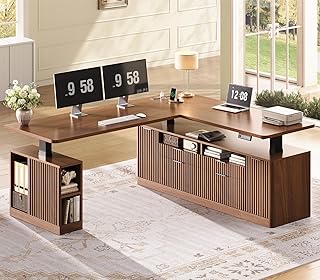
The most complete workstation on this list: 69 by 55 inches, four drawers, shelves, and a power outlet, all wrapped in a fluted front that reads more furniture than office equipment. That matters if your office doubles as a guest room or shares space with your bedroom, where visual calm is part of the sleep environment.
71″ L-Shaped Executive Standing Desk with Privacy Panel
The widest option here, and the privacy panel is a genuinely useful addition in a shared or open-plan home — it reduces peripheral movement, which lowers the low-grade attentional load that leaves you wired by evening. The file cabinet and AC/USB combination make it a true all-in-one command center.
Itaar Farmhouse Executive L-Shaped Desk
A fixed-height desk chosen for warmth rather than mechanics, with a file drawer, storage cabinet, and built-in outlet in a soft white farmhouse finish. Pick this if your priority is a workspace that doesn’t feel clinical — and remember to pair it with a properly height-adjustable chair.
Frequently Asked Questions
Does a standing desk actually improve sleep?
Not directly, but indirectly and meaningfully. Alternating between sitting and standing increases total daily movement and light physical activity, both of which are associated with faster sleep onset and deeper slow-wave sleep. Prolonged uninterrupted sitting has the opposite effect.
Can I put an L-shaped desk in my bedroom?
You can, if you must — but treat orientation seriously. Face the desk away from the bed, choose a model with closable storage, and never work from bed itself. The goal is for your brain to associate the mattress with sleep exclusively.
How much room does an L-shaped desk really need?
Add at least 36 inches of clearance behind your chair to the desk’s footprint. Most models here occupy roughly 5 by 4.5 feet, so plan for about 8 by 7 feet of usable floor area to avoid a cramped, tension-inducing setup.
Should I choose drawers or an open frame?
Drawers, if you work in the same room where you relax. The ability to close down and put work out of sight is one of the most effective end-of-day rituals available, and it costs nothing once the furniture supports it.
Final Thoughts
If you want one desk that handles everything, the SEDETA fluted executive desk offers the best balance of workspace, real storage, and a finish that won’t dominate a shared room. Those needing maximum surface and separation should look at the 71″ executive model with its privacy panel, while the SIAGO remains my recommendation for anyone whose main goal is simply to stand up more often — its memory presets remove the friction that derails most good intentions. Choose the one that lets you close the day cleanly, and you’ll feel the difference long after you’ve logged off.