Key takeaways
- Low-speed airflow, not top-speed CFM: Rated maximum airflow tells you little about overnight comfort. Look for fans with six or more speeds, which gives you a genuinely gentle setting rather than a jump from “barely moving” to “rustling the sheets.”
- DC motor for quiet running: DC-driven fans typically run several decibels quieter than comparable AC units at matched airflow and draw roughly 60–70% less power. In a bedroom, the acoustic difference is the whole point — steady, broadband air noise is tolerable; a motor hum with a pitch to it is not.
- Dimming plus tunable color: A 3CCT fixture that shifts between roughly 3000K and 5000K lets you use cool, bright light during the day and warm, low-output light in the last hour before bed, when bright short-wavelength light is most likely to delay sleep onset.
- Blade span matched to the room: Roughly 42 inches suits bedrooms up to about 150 square feet; 48 to 52 inches suits larger living spaces. Oversizing a fan in a small bedroom forces you to run it slower than its sweet spot, where wobble and motor noise are most audible.
- Memory and control method: Power-off memory restores your last speed and light setting after an outage, which spares you a 2 a.m. troubleshooting session. Decide too whether you want remote-only control, app control, or a pull chain that never needs a battery.
What's inside
Low ceilings create a specific kind of frustration. You want moving air over the bed — the kind that keeps a room from turning stuffy at 3 a.m. — but a standard downrod fan would hang at forehead height, and a wall unit only pushes air across one plane. So the ceiling fan gets skipped, a box fan goes on the dresser, and the room never quite cools down evenly. Anyone who has tracked their own sleep through a warm week knows what happens next: more time awake after lights-out, and a groggier morning.
Hugger fans (also sold as low-profile or flush-mount fans) solve the clearance problem by mounting the motor housing directly against the ceiling, typically leaving blades 8 to 11 inches down instead of 16 or more. From a sleep-quality standpoint, what matters is whether the fan can move usable air at its lowest speed without adding noise, and whether the integrated light can drop to a warm, dim setting late in the evening. This guide looks at six current models through that lens — airflow at low RPM, motor acoustics, light color temperature and dimming range, and how each one behaves the morning after a power blip.
As an Amazon Associate we earn from qualifying purchases.




🛒 Best Price Today on Amazon
Prime members get fast, free shipping on everything above, plus member-only deals. New members get a 30-day free trial — cancel anytime.
How to Choose a Hugger Ceiling Fan With Light (2026)
- Low-speed airflow, not top-speed CFM: Rated maximum airflow tells you little about overnight comfort. Look for fans with six or more speeds, which gives you a genuinely gentle setting rather than a jump from “barely moving” to “rustling the sheets.”
- DC motor for quiet running: DC-driven fans typically run several decibels quieter than comparable AC units at matched airflow and draw roughly 60–70% less power. In a bedroom, the acoustic difference is the whole point — steady, broadband air noise is tolerable; a motor hum with a pitch to it is not.
- Dimming plus tunable color: A 3CCT fixture that shifts between roughly 3000K and 5000K lets you use cool, bright light during the day and warm, low-output light in the last hour before bed, when bright short-wavelength light is most likely to delay sleep onset.
- Blade span matched to the room: Roughly 42 inches suits bedrooms up to about 150 square feet; 48 to 52 inches suits larger living spaces. Oversizing a fan in a small bedroom forces you to run it slower than its sweet spot, where wobble and motor noise are most audible.
- Memory and control method: Power-off memory restores your last speed and light setting after an outage, which spares you a 2 a.m. troubleshooting session. Decide too whether you want remote-only control, app control, or a pull chain that never needs a battery.
The Best Hugger Ceiling Fans With Lights (2026) Reviewed
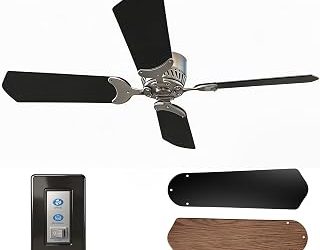
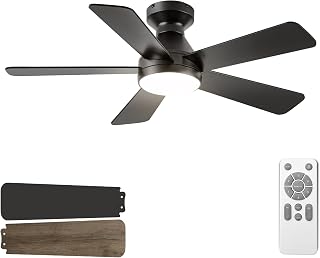
Matte Black 44″ Low Profile 5-Blade Fan
The 44-inch span splits the difference between bedroom and living room duty, and the quiet DC motor holds its composure at the low speeds you’d actually use overnight. The matte black finish and integrated LED panel keep the profile visually flat, which helps in rooms where an eight-foot ceiling already feels close.
42″ Recessed-Mount Fan with App Control
This is the most feature-dense pick here: silent DC motor, reversible operation, 3CCT with dimming, full memory, and phone control. The app matters more than it sounds — being able to nudge brightness and speed down without reaching for a remote in the dark is a small thing that improves a wind-down routine.
42″ Flush Mount Fan with Wood Blades
Wood-look blades and a flush housing make this the least intrusive option for a bedroom you’d rather not see hardware in. Dimmable light, reversible blades for winter recirculation, and power-off memory cover the practical bases, and the DC motor keeps it near-silent at speeds one and two.
42″ Flush Mount 3CCT with 6 Speeds
Six speeds and a noiseless reversible DC motor give you fine control over airflow, and the ETL-listed indoor/outdoor rating extends it to covered patios. The three color temperatures plus dimming make it a sensible single-fixture solution for a room with no other overhead light.
48″ Retractable Fan with 6-Speed Remote
The retracting blades let it read as a flush light fixture when idle, then extend to a full 48-inch span — a useful trick in a low-ceilinged open-plan room. Its industrial black styling and six speeds suit living areas better than bedrooms, where the mechanism’s presence is more noticeable.
Frequently Asked Questions
Does sleeping with a ceiling fan on cause problems?
For most people, no. Direct airflow can dry out sinuses and eyes overnight or aggravate stiffness in the neck and shoulders, so aim for the lowest speed that keeps the room from feeling close, and angle the bed out of the strongest column of air rather than turning the fan off entirely.
How much clearance does a hugger fan need?
Building guidance generally calls for at least seven feet from floor to blade. Flush-mount fans typically drop 8 to 11 inches, which clears comfortably on an eight-foot ceiling and works even on some 7’6″ ceilings.
Are hugger fans less effective than downrod models?
Slightly. Blades close to the ceiling recirculate some air against the surface above them, so a flush mount moves somewhat less air than the same fan on a six-inch downrod. In a bedroom-sized space the difference is rarely noticeable; in a large room, size up.
Which way should the blades turn?
Counterclockwise in warm months, pushing air down for a cooling effect. Clockwise at low speed in winter, pulling air up so warm air near the ceiling circulates without creating a draft. Every reversible model above handles this by remote.
Final Thoughts
For a bedroom where sleep quality is the priority, the 42-inch recessed-mount fan with app control and the 42-inch wood-blade flush mount are the strongest picks — both pair genuinely quiet DC motors with dimmable light you can warm up at night. If you’re covering a larger low-ceilinged living space, step up to the 44-inch matte black low-profile fan for a noticeable gain in airflow without giving up headroom.