Key takeaways
- Size up so you can slow down: Choose a unit rated for roughly twice your bedroom’s area, so its low or mid speed still delivers four to five air changes per hour. Oversizing is a noise strategy, not a vanity spec.
- Judge the second speed, not the first: A 22–24 dB figure describes the quietest setting only. Most bedrooms need speed two overnight, so listen for steady broadband hum rather than motor whine or a rattling pre-filter.
- Demand true darkness: AQI displays help by day and hurt at night. A well-designed sleep mode blacks the panel out completely instead of dimming it to a glow you’ll notice at 3 a.m.
- Washable pre-filter, non-negotiable: Hair and coarse dander clog HEPA media in weeks. A rinseable mesh you vacuum monthly can double the life of the expensive filter behind it.
- Price the filters, not the machine: Pet homes replace HEPA and carbon media every six to nine months. Multiply annual media cost by three before deciding what’s genuinely affordable.
What's inside
Pet dander is a bedroom problem before it is a living-room problem. The proteins that trigger most cat and dog allergies ride on particles light enough to stay airborne for hours, and they concentrate exactly where your animal sleeps: mattresses, duvets, upholstered headboards. Every time you roll over, you resuspend a fresh cloud into the few inches of air you spend a third of your life breathing. The result is rarely a dramatic allergy attack. It’s congestion at 2 a.m., mouth-breathing, a dry throat, and the kind of fragmented sleep that leaves you flat the next day without ever fully waking you.
I evaluate purifiers by a stricter standard than square-footage claims: how much clean air a unit actually delivers on the speed you can tolerate sleeping beside. A machine rated for 1,500 square feet means little if you drop it to whisper mode at bedtime and forfeit two-thirds of its output. The units below were selected for pet households and judged on real-world noise, AHAM-verified airflow, light discipline, pre-filter design for hair, and three-year filter cost.
As an Amazon Associate we earn from qualifying purchases.


🛒 Best Price Today on Amazon
Prime members get fast, free shipping on everything above, plus member-only deals. New members get a 30-day free trial — cancel anytime.
How to Choose a HEPA Air Purifier for Pet Dander (2026)
- Size up so you can slow down: Choose a unit rated for roughly twice your bedroom’s area, so its low or mid speed still delivers four to five air changes per hour. Oversizing is a noise strategy, not a vanity spec.
- Judge the second speed, not the first: A 22–24 dB figure describes the quietest setting only. Most bedrooms need speed two overnight, so listen for steady broadband hum rather than motor whine or a rattling pre-filter.
- Demand true darkness: AQI displays help by day and hurt at night. A well-designed sleep mode blacks the panel out completely instead of dimming it to a glow you’ll notice at 3 a.m.
- Washable pre-filter, non-negotiable: Hair and coarse dander clog HEPA media in weeks. A rinseable mesh you vacuum monthly can double the life of the expensive filter behind it.
- Price the filters, not the machine: Pet homes replace HEPA and carbon media every six to nine months. Multiply annual media cost by three before deciding what’s genuinely affordable.
The Best HEPA Air Purifiers for Pet Dander (2026) Reviewed
KNKA APH4000
Rated to turn over 1,695 square feet in an hour and AHAM verified, this is the pick for open-plan bedrooms or any room whose door stays open to the rest of the house. The dedicated pet mode and washable pre-filter cope with shedding season without smothering the HEPA layer, and the AQI display gives you useful feedback before you switch to sleep mode for the night.
LEVOIT Vital 100S-P
The front-facing intake is the detail that matters: it draws from low, near-floor air where dander settles, rather than from the sides where a cat inevitably parks itself. Smart monitoring and a washable pre-filter make it a low-effort choice for the classic dog-on-the-bed household up to about 1,073 square feet.
LEVOIT Core 300-P
At 24 dB with a footprint that tucks beside a nightstand, the Core 300-P is still the most sleep-friendly small-room purifier available. Its H13 media captures 99.97% of fine dander, and the 360-degree cylindrical intake makes placement forgiving in a cramped bedroom.
PuroAir 240
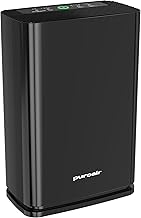
Dander is only half of what a pet home puts into the air; the rest is odor from litter, damp fur, and bedding. PuroAir pairs true HEPA with a serious carbon stage, and its auto mode ramps proportionally instead of surging every time the room stirs.
YARIKI P280
Coverage to 1,500 square feet, an H13 filter, a washable pre-filter, and a 22 dB floor make this the value choice for larger or shared bedrooms. Run it on speed two overnight and you get high clean-air delivery at a volume most sleepers stop registering within a week.
Frequently Asked Questions
Will a HEPA purifier stop my pet allergies at night?
It substantially reduces the airborne load, but it cannot extract dander already embedded in your mattress or bedding. Pair it with weekly hot washes of pillowcases and a barrier mattress encasement — that combination is what changes how you feel by morning.
Where should I position it in the bedroom?
Three to six feet from the head of the bed, with clear space around the intake and nothing obstructing the exhaust. Avoid corners and narrow gaps behind furniture, which starve the fan and let it recirculate the same small pocket of air.
Auto mode or sleep mode overnight?
Sleep mode, in most bedrooms. Auto sensors react to dust spikes with abrupt fan changes, and a change in sound is far more likely to trigger a micro-arousal than a constant, slightly louder hum. Pick a steady speed and leave it alone.
Do I need one in every room?
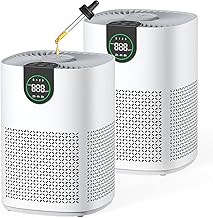
No, though a second compact unit where your pet naps during the day pays dividends, since that room acts as the reservoir feeding the rest of the house. The VOOPNU DH-JH12, with 360-degree intake and a 22 dB quiet setting, suits a home office or hallway alcove well.
Final Thoughts
For most pet owners, the KNKA APH4000 offers the widest margin between rated capacity and bedroom-quiet operation, while the LEVOIT Core 300-P remains the smartest buy for small rooms and light sleepers. If you need to cover more space without overspending, the YARIKI P280 delivers comparable clean-air rates while keeping your bedroom at library volume.