Best Gaming Wrist Rests: Top Picks for 2026
The best gaming wrist rests are usually a medium-height memory-foam or gel model that matches your keyboard’s front edge, stays in place during rapid movement, and has a washable or wipe-clean surface.
A wrist rest is not a universal comfort upgrade: the right choice depends on keyboard height, desk depth, hand size, typing angle, and whether you want support for gaming, office work, or both. The comparisons below focus on the details that matter after the product photographs stop being useful.
Our top picks
 DELTAHUB Carpio 2.0
- Carpio 2.0 is an ergonomic accessory that boosts…
- With a team of medical experts specialising in…
- Silicon pads offer a balance between comfort and…
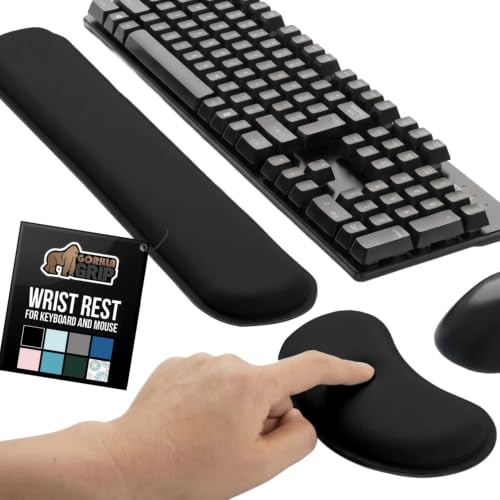 GORILLA GRIP Memory Foam Wrist Rest for
- experience more comfort while you work
- forget sore wrists and fingers when typing and…
- the ultra durable bottom layer of the rests…
 Vaydeer Wrist Rest for Keyboard and Mouse
- 【Softer and More Comfortable】Vaydeer wrist rest has unique…
- 【Ergonomic Wrist Saver】The wrist rests for keyboard and…
- 【Non-Slip Rubber Bottom】Featuring an anti-skid silicone base on…
| Product | Key specs | |
|---|---|---|
| DELTAHUB Carpio 2.0 | Carpio 2.0 is an ergonomic accessory that boosts… With a team of medical experts specialising in… Silicon pads offer a balance between comfort and… | Check price |
| GORILLA GRIP Memory Foam Wrist Rest for | experience more comfort while you work forget sore wrists and fingers when typing and… the ultra durable bottom layer of the rests… | Check price |
| Vaydeer Wrist Rest for Keyboard and Mouse | 【Softer and More Comfortable】Vaydeer wrist rest has unique… 【Ergonomic Wrist Saver】The wrist rests for keyboard and… 【Non-Slip Rubber Bottom】Featuring an anti-skid silicone base on… | Check price |
 Gimars Upgrade Enlarge Silky and Superfine Fabric Gimars Upgrade Enlarge Silky and Superfine Fabric | 【1.2"ULTRA THICK MEMORY FOAM】 Upgraded memory foam is… 【ERGONOMIC DESIGN】 Our wrist rest is ergonomically designed… 【BUILT TO LAST】 The wrist rests features a… | Check price |
As an Amazon Associate we earn from qualifying purchases at no extra cost to you.
Quick Picks by Situation
| Situation | Best wrist-rest type | Recommended dimensions | Why it fits |
|---|---|---|---|
| Low-profile keyboard or laptop-style board | Low, firm foam or thin gel | 10–15 mm high, 60–80 mm deep | Prevents the wrist from being lifted above the keys |
| Standard mechanical keyboard | Medium memory foam | 18–25 mm high, 80–100 mm deep | Supports the heel of the hand without forcing a steep angle |
| Tall mechanical keyboard with wrist-heavy posture | High-density foam or supportive gel | 25–35 mm high, 90–110 mm deep | Bridges the height difference between desk and keycaps |
| Competitive mouse gaming | Separate mouse wrist rest with low-friction fabric | 180–250 mm wide, 80–100 mm deep | Allows the forearm to move without a hard edge |
| Shared desk, children, or pets | Closed-cell gel or coated foam | Any compatible keyboard width | Resists spills and is easier to disinfect |
Best Overall: Medium Memory-Foam Keyboard Wrist Rest
For most full-size and tenkeyless keyboards, a medium memory-foam wrist rest offers the most balanced combination of cushioning, height, and stability. Look for a height of about 20–25 mm at the front edge and a depth of roughly 80–100 mm. That size supports the heel of the palm while leaving enough room to move the fingers freely.
Memory foam is comfortable for long typing sessions because it distributes pressure rather than concentrating it on one point. It also tends to feel warmer and less springy than gel. A dense foam core is preferable to very soft foam, which can compress permanently under the same part of the wrist.
This is the safest choice when your keyboard has ordinary-height keycaps and sits directly on the desk. If your keyboard has tall feet extended, measure the height from the desktop to the front lip of the keyboard before buying. The wrist rest should be close to that height, not dramatically taller.
Best for Heat and Easy Cleaning: Gel Wrist Rest
Gel wrist rests are a strong choice for warm rooms, long gaming sessions, and desks used for snacks or drinks. Gel usually feels cooler than memory foam and recovers its shape quickly after pressure is removed. A polyurethane-coated or other non-porous surface can be wiped with a lightly damp cloth, making it more practical for a shared setup.
The trade-off is support. Soft gel can allow the wrist to sink too far, while very firm gel may feel like a hard ridge under the palm. Choose a model with a broad, gently rounded top rather than a narrow bulge. Gel also becomes less appealing if you prefer a plush, enveloping feel or frequently move the wrist rest between desks.
Cleaning reality
- For fabric covers, remove loose dust with a soft brush or vacuum attachment before spot-cleaning.
- For coated surfaces, use a damp microfiber cloth and mild soap; avoid soaking the seams.
- Do not machine-wash a foam or gel insert unless the manufacturer specifically permits it.
- Dry the wrist rest fully before placing it on a wood or laminate desk.
Best for Low-Profile Keyboards: Thin, Firm Support
A tall wrist rest can make a slim keyboard less ergonomic by bending the wrist upward. For low-profile mechanical keyboards, compact keyboards, and laptop-style boards, choose a support around 10–15 mm high. Thin firm foam, cork, or a shallow gel pad can work well.
The important measurement is not the advertised thickness alone. Check whether the height is measured at the front, center, or highest point. A strongly sloped wrist rest may be listed as 15 mm at the front but feel much higher where the palm rests.
For a 60% keyboard, a wrist rest about 295–305 mm wide will usually align closely with the keyboard. A tenkeyless board generally needs about 355–370 mm, while a full-size board often needs approximately 440–455 mm. A wrist rest that is slightly narrower is fine; one that extends far beyond the keyboard can catch the forearm during mouse movement.
Best for Competitive Gaming: Low-Friction Surface and a Stable Base
Fast games place different demands on a wrist rest than spreadsheet work. You want a smooth surface that does not tug at skin or sleeves, a shallow front profile, and a non-slip underside that keeps the support fixed while the keyboard remains in position.
Fabric can feel comfortable and quiet, but it absorbs sweat and takes longer to dry. Synthetic leather or polyurethane is easier to wipe clean, although it may become sticky in humid conditions and can eventually crack at the front edge. A tightly woven textile is a useful middle ground if you prefer a softer feel but can tolerate occasional spot-cleaning.
For mouse use, avoid relying on a wrist rest that locks the hand into one position. The forearm should still be able to glide across the desk. A broad desk mat can be a better companion to a low mouse wrist rest than a tall, padded design.
Material Comparison: Comfort Versus Maintenance
| Material | Feel | Typical height range | Advantages | Limitations |
|---|---|---|---|---|
| Memory foam | Soft, contouring, warm | 15–35 mm | Excellent pressure distribution and quiet contact | Can retain heat, absorb moisture, and develop a compressed area |
| High-density polyurethane foam | Firm, supportive, quicker rebound | 15–30 mm | Good durability and less sinking during long sessions | May feel too firm for people seeking plush cushioning |
| Gel | Cool, springy, moderately firm | 10–30 mm | Easy to wipe when enclosed in a coated cover | Can feel sticky, overly soft, or cold depending on the room |
| Cork or hard wood | Firm and stable | 10–25 mm | Does not collapse and usually moves little on the desk | Less forgiving under pressure and not ideal for every wrist |
| Fabric cover | Soft and breathable | Varies by core | Comfortable against skin and sleeves | More difficult to clean after spills |
| Coated synthetic cover | Smooth and consistent | Varies by core | Fast wipe-down and good spill resistance | May peel or crack first, especially at folded seams |
How to Check Compatibility Before Buying
1. Measure the keyboard height
With the keyboard on its normal feet, measure from the desktop to the front edge. Pick a wrist rest with a similar height at the point where your palm will land. A difference of a few millimeters is usually manageable; a difference of 10 mm or more can create an uncomfortable slope.
2. Check desk depth
A wrist rest commonly adds 80–110 mm in front of the keyboard. On a desk only 600 mm deep, that extra space can leave less room for the mouse or force the monitor too close. A 700–800 mm deep desk provides more comfortable separation, especially for low-sensitivity mouse users.
3. Check the underside
Rubber feet or a full non-slip base are more reliable than a few small pads. On glass, lacquered wood, and smooth laminate, a textured rubber underside is especially useful. On unfinished wood, check that the base will not mark the surface.
4. Match the width
The wrist rest does not need to be exactly as wide as the keyboard, but it should not force your hands inward. For split or ergonomic keyboards, a single straight rest may be unsuitable; two separate pads or a curved support can preserve the keyboard’s natural hand position.
Durability and Desk-Setup Realities
The first parts to wear are usually the front cover seam, the non-slip underside, and the foam directly beneath the dominant hand. A removable cover helps, but it does not prevent the underlying foam from compressing. If the wrist rest is used eight or more hours a day, a firmer core is often a better long-term choice than an exceptionally soft one.
Moving the wrist rest is simple, but avoid dragging a rubber underside across a dusty wood or glass surface. Lift it instead. If you regularly rearrange a desk, a model weighing roughly 300–700 grams is easier to reposition while still being heavy enough to resist sliding. Extra-wide rests may weigh closer to 1 kilogram and can be awkward in narrow desk drawers.
For a rental or shared workspace, prioritize a wipe-clean cover and a base that will not transfer dye or leave adhesive residue. For homes with children or pets, avoid exposed loose gel, open-cell foam, and delicate stitched fabric unless you are prepared for more frequent cleaning.
Final Buying Recommendation
Choose a medium, firm memory-foam wrist rest around 20–25 mm high for a standard mechanical keyboard. Choose thin firm foam for a low-profile board, gel with a coated cover for heat and spills, and a low-friction surface with a strong rubber base for competitive gaming. Before ordering, measure the keyboard’s front height, confirm the desk has at least 80–110 mm of spare depth, and select a surface you will actually maintain. Those checks matter more than decorative lighting, branding, or an unusually thick cushion.