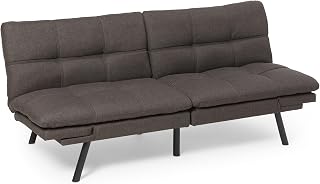
Key takeaways
- Flat-plane continuity: When the piece converts, run your hand along the sleeping surface. Any ridge, gap, or step where the seat meets the back will sit under your hips or shoulders all night and provoke the micro-awakenings that wreck deep sleep. Boneless and modular designs generally win here; hinged metal-frame models vary widely.
- Support over softness: A cushion that swallows you feels great for ten seconds and terrible at 3 a.m. Look for medium-firm, higher-density foam that holds the pelvis level with the shoulders. Sink is the enemy of neutral spinal alignment, especially for side sleepers.
- Backrest adjustability: Multi-position or split backrests are worth paying for. An incline setting supports reflux-prone or congested sleepers, and split designs let two people use the piece differently — one upright reading, one reclined.
- Breathability of the cover: Corduroy and linen-look woven fabrics move heat and moisture far better than faux leather, and core body temperature has to drop for sleep to initiate. Choose leather-look finishes for wipe-clean durability and easy rooms; choose textiles for anywhere someone actually sleeps regularly.
- Real usable length: Advertised width is not sleeping length. A 66-inch loveseat suits sitting, naps, and shorter sleepers; anything approaching 79 inches gives most adults room to stretch out without curling. Measure your tallest likely guest, not the wall.
What's inside
A futon couch asks something unusual of a single piece of furniture: it has to be pleasant to sit on for three hours of television and restorative to sleep on for eight hours straight. Most fail at one of those jobs. Shoppers gravitate toward whatever looks best in a photo, then discover the seam that runs directly under the lumbar spine, the backrest that only locks at two useless angles, or the foam that flattens into a pancake by month four. From a sleep-wellness perspective, that’s not a comfort inconvenience — it’s a recipe for fragmented sleep, morning stiffness, and guests who quietly stop visiting.
This guide approaches futon couches the way I’d approach any sleep surface: by looking at support geometry, surface continuity, pressure distribution, and how the piece behaves overnight rather than in a showroom. Below you’ll find the models worth your attention in 2026, a buying framework built around spinal alignment and thermal comfort, and straight answers to the questions I hear most from clients furnishing small apartments, guest rooms, and home offices that double as crash space.
As an Amazon Associate we earn from qualifying purchases.


How to Choose a Futon Couch (2026)
- Flat-plane continuity: When the piece converts, run your hand along the sleeping surface. Any ridge, gap, or step where the seat meets the back will sit under your hips or shoulders all night and provoke the micro-awakenings that wreck deep sleep. Boneless and modular designs generally win here; hinged metal-frame models vary widely.
- Support over softness: A cushion that swallows you feels great for ten seconds and terrible at 3 a.m. Look for medium-firm, higher-density foam that holds the pelvis level with the shoulders. Sink is the enemy of neutral spinal alignment, especially for side sleepers.
- Backrest adjustability: Multi-position or split backrests are worth paying for. An incline setting supports reflux-prone or congested sleepers, and split designs let two people use the piece differently — one upright reading, one reclined.
- Breathability of the cover: Corduroy and linen-look woven fabrics move heat and moisture far better than faux leather, and core body temperature has to drop for sleep to initiate. Choose leather-look finishes for wipe-clean durability and easy rooms; choose textiles for anywhere someone actually sleeps regularly.
- Real usable length: Advertised width is not sleeping length. A 66-inch loveseat suits sitting, naps, and shorter sleepers; anything approaching 79 inches gives most adults room to stretch out without curling. Measure your tallest likely guest, not the wall.
The Best Futon Couches (2026) Reviewed
79″ Convertible Corduroy Boneless Futon Sofa Bed (Blue)
The boneless construction and fixed-shape frame produce one of the most uninterrupted sleep planes in this category — no central hinge ridge, no pressure point under the lumbar curve. At 79 inches it accommodates most adults full-length, and the breathable corduroy keeps overnight heat buildup in check.
MoonSpeak 78.8″ Corduroy Futon Sofa Bed (Green)
A strong pick for genuine nightly use: the modular sections let you tune firmness placement, and the sleeper surface stays even under load rather than sagging toward the middle. Ships in a box with no assembly, which matters if you’re moving it up stairs alone.
78.8″ Corduroy Boneless Loveseat Sleeper (Taupe)
Essentially the same well-resolved boneless platform in a more neutral palette, with a storage pocket that’s genuinely useful for keeping a sleep mask, earplugs, and phone charger off the floor. Good density that resists the early flattening common at this size and price.
75″ Linen Convertible Sleeper with Split Backrest (Dark Grey)
The split adjustable backrest is the standout feature — two people can use it at different angles, and the incline positions are legitimately helpful for anyone who sleeps better slightly elevated. The linen weave breathes well, though 75 inches means taller sleepers will notice the limit.
Marsail 66″ Corduroy Futon Sofa Bed (Grey)
The right answer for a home office or studio where footprint governs everything: compact, firmer than most, with adjustable backrest and armrests that let it work as a daybed. Best for naps, shorter sleepers, and occasional guests rather than nightly duty.
Frequently Asked Questions
Can a futon couch work as a primary bed?
It can, provided the sleep surface stays flat and the foam is dense enough to hold alignment. Boneless models handle nightly use far better than hinged frames, which develop a bar-shaped depression over time. Rotate and flip the cushions monthly to distribute wear.
Faux leather or fabric?
Faux leather wipes clean and suits high-traffic or pet-heavy rooms, but it traps heat and can feel clammy against skin overnight. If someone will sleep there more than a few nights a month, choose corduroy or linen.
Do I need a topper?
For extended stays, a two-inch topper is the single cheapest upgrade you can make — it softens surface contact without undermining the support underneath. Keep it thin; thick, plush toppers reintroduce the sinking problem.
Why does my back hurt after sleeping on a futon?
Usually one of three causes: a seam or hinge under the lumbar region, foam that’s compressed past its useful life, or a pillow height mismatched to a lower-than-usual sleep surface. Address the pillow first — it’s free to test.
Final Thoughts
For nightly or near-nightly sleeping, the 79″ boneless corduroy sofa bed and the MoonSpeak 78.8″ offer the flattest, most spine-friendly surfaces here. If you need two people to sit comfortably at different angles — or you sleep better slightly inclined — the 75″ linen model with the split backrest is the smarter buy. Tight rooms and occasional guests are well served by the compact Marsail 66″.