Key takeaways
- Thermostat over raw wattage: Nearly every unit tops out at 1,500W, so wattage tells you almost nothing. What separates them is temperature control — a built-in thermostat that holds a set point cycles gently, while a simple high/low switch overshoots by several degrees, then plunges, and that swing is exactly what pulls you out of light sleep.
- Noise floor, not just “quiet”: Fan-forced ceramic models move air audibly; infrared quartz models radiate heat with a slower, softer fan. If the unit will run in the same room where you sleep, prioritize infrared or a low-speed setting, and listen for relay clicks at each cycle — those are more disruptive than steady airflow.
- Controllable glow: Flame beds emit real light, and a bright one at the foot of the bed is a nightly dose of evening illumination your circadian system does not need. Look for dimmable flames, an amber or warm-red palette rather than blue-white, and a heat-only mode so you can kill the visuals entirely at bedtime.
- Humidity management: Any resistive heater lowers relative humidity as it warms the air, and dry airways mean nasal congestion, mouth breathing, and more snoring. Either choose a model with integrated humidification or plan on running a separate humidifier to hold the room near 40–50% RH.
- Unattended-use safety: ETL or UL listing, tip-over cutoff, overheat protection, a cool-touch housing, a child lock, and a timer are non-negotiable for anything running while you sleep. Plug directly into a wall outlet — never a power strip or extension cord.
What's inside
Sleep researchers spend a lot of time talking about darkness and almost none talking about the thermostat, which is strange, because thermal comfort is one of the few sleep variables you can fix in an afternoon. The body has to shed roughly a degree of core temperature to initiate sleep, and it does that by pushing warmth out through the hands and feet — a process that stalls in a room cold enough to make your extremities constrict. That is why a chilly back bedroom, a drafty converted attic, or a den where the furnace never quite reaches leaves you lying awake with cold feet at midnight, and why the standard fix (cranking central heat for the whole house) backfires with roaring ductwork, parched sinuses, and a $300 January bill.
Electric fireplace heaters solve this as zone heaters: 1,500 watts aimed at one room, no combustion, no venting, no carbon monoxide. But the listings blur together fast, and the specs that get advertised — BTUs, flame realism, coverage area — are rarely the specs that determine whether you actually sleep. Below, I’ve assessed the current field against the criteria that matter after 10 p.m.: thermostat precision, fan noise at the sleeping position, light output from the flame bed, effect on indoor humidity, and unattended-operation safety. The picks span freestanding stoves, recessed wall panels, and mantel consoles.
As an Amazon Associate we earn from qualifying purchases.



🛒 Best Price Today on Amazon
Prime members get fast, free shipping on everything above, plus member-only deals. New members get a 30-day free trial — cancel anytime.
How to Choose a Fireplace Heater Electric (2026)
- Thermostat over raw wattage: Nearly every unit tops out at 1,500W, so wattage tells you almost nothing. What separates them is temperature control — a built-in thermostat that holds a set point cycles gently, while a simple high/low switch overshoots by several degrees, then plunges, and that swing is exactly what pulls you out of light sleep.
- Noise floor, not just “quiet”: Fan-forced ceramic models move air audibly; infrared quartz models radiate heat with a slower, softer fan. If the unit will run in the same room where you sleep, prioritize infrared or a low-speed setting, and listen for relay clicks at each cycle — those are more disruptive than steady airflow.
- Controllable glow: Flame beds emit real light, and a bright one at the foot of the bed is a nightly dose of evening illumination your circadian system does not need. Look for dimmable flames, an amber or warm-red palette rather than blue-white, and a heat-only mode so you can kill the visuals entirely at bedtime.
- Humidity management: Any resistive heater lowers relative humidity as it warms the air, and dry airways mean nasal congestion, mouth breathing, and more snoring. Either choose a model with integrated humidification or plan on running a separate humidifier to hold the room near 40–50% RH.
- Unattended-use safety: ETL or UL listing, tip-over cutoff, overheat protection, a cool-touch housing, a child lock, and a timer are non-negotiable for anything running while you sleep. Plug directly into a wall outlet — never a power strip or extension cord.
The Best Fireplace Heater Electric Models Reviewed (2026)
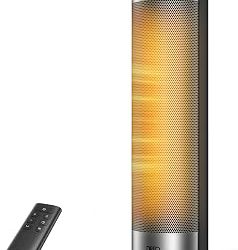
Dr. Infrared Heater DR-991
The only mainstream unit that pairs infrared heat with an onboard humidifier, which addresses the two things that wreck sleep in a heated room simultaneously — cold air and dry air. The remote, timer, and LED readout let you set it from bed, and infrared’s gentler air movement keeps the noise floor low.
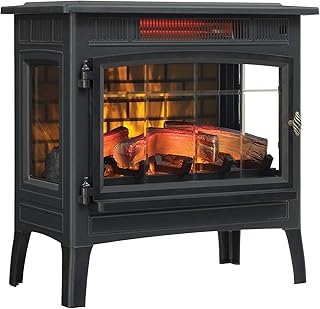
duraflame Freestanding Stove with 3D Flame Effect
duraflame’s 3D flame is the most convincing effect at this price, and the cast-look stove body radiates residual warmth after the element cuts out, smoothing the temperature swings that lighter plastic units produce. Rated for 1,000 sq. ft., it suits an open living area better than a small bedroom.
Tehanld 60″ Ultra-Thin Recessed Wall Fireplace
A recessed installation removes the heater from the floor entirely — no tip-over risk, no furniture crowding, and heat delivered above the cold layer near the ground. The 60–99°F thermostat, 12-hour timer, and child lock make it the most controllable option here for a room used overnight.
R.W.FLAME 43″ Mantel TV Stand Fireplace
For a bedroom or den where the television already lives, this consolidates the media console and the heat source into one footprint with adjustable LED flame levels. Dim the flames to their lowest setting in the last hour before bed, or switch to heat-only.
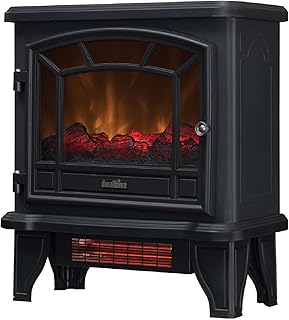
ZAFRO 22″ Electric Fireplace Stove
A compact, honestly priced stove with a built-in thermostat, dual 1000W/1500W output, ETL listing, and overheat protection — the essentials, without the upcharge. The flame-only mode is genuinely useful in shoulder seasons when you want the light and not the heat.
Frequently Asked Questions
Is it safe to run an electric fireplace heater all night?
With an ETL- or UL-listed unit that has tip-over and overheat protection, plugged directly into a wall outlet and kept three feet clear of bedding and curtains, yes. That said, most people sleep better setting a 2–4 hour timer to warm the room at bedtime and letting it drift cool overnight.
Won’t the flame effect keep me awake?
It can. Choose a model with dimmable flames or a heat-only mode, keep the glow out of your direct line of sight, and treat it like any other evening light source — pleasant during wind-down, off once you’re in bed.
What room temperature should I aim for?
Most adults sleep best between 60 and 67°F. The goal isn’t a warm bedroom; it’s warm hands and feet in a cool room, which is why pre-heating before bed and warming your extremities works better than heating the air all night.
What do these cost to run?
At 1,500W and roughly 16 cents per kWh, about 24 cents an hour at full output — but a thermostat-equipped unit idles most of the time once the room is up to temperature, so real-world cost is typically a third of that.
Final Thoughts
If the room you’re heating is the room you sleep in, the Dr. Infrared DR-991 is the most sleep-aware machine on this list — quiet infrared heat plus humidification tackles both halves of the problem. For a permanent, out-of-the-way installation with precise temperature control, the Tehanld 60″ recessed panel is the strongest choice; for evening warmth in a shared living space, the duraflame freestanding stove remains the benchmark for flame quality and steady, radiant heat.