Key takeaways
- Measure clearance, not just the table: You need roughly 30–36 inches behind each chair to sit down and stand up without shoving. Subtract that from your room before you fall in love with a tabletop size.
- Prioritize flexible footprints: Drop-leaf and extendable designs let you eat at 24 inches on a Tuesday and host at 47 or 63 inches on Saturday. This is the single biggest space multiplier available.
- Check base geometry: Pedestal and center-set bases let you tuck extra chairs anywhere; four corner legs lock your seating into fixed positions. Round tops with a single base are the most forgiving in tight corners.
- Consider benches for pushed-in storage: A bench slides fully under the table when not in use, freeing walkway space that chairs permanently occupy — ideal for breakfast nooks and galley-adjacent dining.
- Think about the evening you want: A surface that’s comfortable to linger at for 30 minutes encourages slower eating and an earlier finish. Chair back support matters here more than the finish does.
What's inside
As someone who spends most of my professional life talking to people about sleep, I’ve learned that the bedroom is rarely where the trouble starts. It starts at the dinner table — or, in a lot of small apartments, at the absence of one. When there’s no proper place to sit down and eat, dinner migrates to the couch or the bed, meals get later and more distracted, and the evening loses the clear boundary between “still going” and “winding down.” That boundary matters more than most people realize: a defined, unhurried evening meal is one of the strongest daily cues your circadian system gets, and eating in the same room you sleep in blurs the very signal you want sharpened.
So a compact dining table is a legitimate sleep-hygiene purchase, not just a furniture one. The challenge is that “small-space dining” usually means compromise — wobbly bases, tabletops too narrow for two plates, or something so bulky it makes the room feel like a storage unit. Below I’ve gathered small-footprint dining tables and sets that actually earn their square footage, with notes on what each one does well, how to choose between them, and answers to the questions I hear most from clients trying to carve out a real eating space in 500 square feet.
As an Amazon Associate we earn from qualifying purchases.



🛒 Best Price Today on Amazon
Prime members get fast, free shipping on everything above, plus member-only deals. New members get a 30-day free trial — cancel anytime.
How to Choose a Dining Room Table For Small Space (2026)
- Measure clearance, not just the table: You need roughly 30–36 inches behind each chair to sit down and stand up without shoving. Subtract that from your room before you fall in love with a tabletop size.
- Prioritize flexible footprints: Drop-leaf and extendable designs let you eat at 24 inches on a Tuesday and host at 47 or 63 inches on Saturday. This is the single biggest space multiplier available.
- Check base geometry: Pedestal and center-set bases let you tuck extra chairs anywhere; four corner legs lock your seating into fixed positions. Round tops with a single base are the most forgiving in tight corners.
- Consider benches for pushed-in storage: A bench slides fully under the table when not in use, freeing walkway space that chairs permanently occupy — ideal for breakfast nooks and galley-adjacent dining.
- Think about the evening you want: A surface that’s comfortable to linger at for 30 minutes encourages slower eating and an earlier finish. Chair back support matters here more than the finish does.
The Best Dining Room Table For Small Space (2026)s Reviewed
Hinged Drop Leaf Round Dining Table
Folding from 36 inches down to 22, this dark brown round table is the most adaptable option here — it lives flat against a wall as a console and opens into a genuine two-person dinner spot in seconds. The sturdy central base means no leg-dodging, which is exactly what you want when a table doubles as a walkway obstacle.
Solid Wood Expandable Table for 2–6
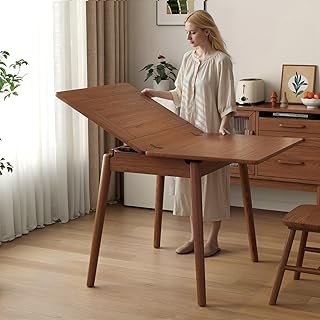
The 23.6–47.2 inch expansion range is remarkable for a table this slim, and the solid wood construction gives it a reassuring heft that MDF alternatives can’t match. My pick for anyone who eats alone on weeknights but refuses to give up hosting entirely.
Gizoon 5-Piece Set with Upholstered Chairs
A complete four-seat solution in one purchase, with a black wood top and padded chairs that are comfortable enough to encourage sitting through a full meal rather than eating standing at the counter. Sensible choice for a first apartment where matching pieces separately isn’t worth the effort.
Modern 47.2″–63″ Extendable Rectangular Table
The removable leaf takes this from an everyday four-seater to an eight-guest table, and the walnut finish reads far more expensive than it is. Best suited to small dining rooms rather than truly tiny nooks — measure carefully at the 47-inch setting.
Tatub 3-Piece Set with Two Benches
Benches are the quiet hero of small-space dining, and this brown three-piece set uses them well: both slide completely under the table, reclaiming floor space the moment the meal ends. Excellent for narrow breakfast nooks and households with kids.
Frequently Asked Questions
What is the smallest table size that works for two people?
Around 24 to 30 inches across is workable for two if you’re comfortable sitting close. Below that, plates and glasses start competing for space, which tends to rush the meal.
Round or rectangular for a small room?
Round almost always wins in tight or square rooms — no sharp corners to navigate, and seating is flexible. Rectangular suits narrow rooms and against-the-wall placements.
Does eating at a table really affect sleep?
Indirectly but meaningfully. A defined meal location supports consistent, earlier dinner timing and keeps eating out of the bedroom, both of which help reinforce a clear day-to-night rhythm.
Are extendable tables stable enough for daily use?
Good ones are. Look for solid wood or thick engineered tops with locking leaf mechanisms, and check that the base sits under the table’s compact configuration, not just its extended one.
Final Thoughts
If you want maximum flexibility in minimum space, the Hinged Drop Leaf Round Table is the easiest recommendation — it disappears when you need the floor back. For households that host, the Solid Wood Expandable Table for 2–6 offers the best range-to-footprint ratio at a serious quality level, while the Tatub 3-Piece Bench Set is the smartest pick for nooks where chairs simply won’t fit. Any of the three will give your evenings the anchor they’ve been missing.