Key takeaways
- Match pints to real conditions, not square footage alone: A 200-pint or 260-pint rating assumes saturated, warm air. For a merely damp 3,000 sq ft basement, a 110-pint unit often holds 45–50% RH more efficiently and cycles less.
- Insist on continuous drainage: An internal pump lets you push condensate up into a sink or window; a gravity hose needs a floor drain below the unit. Emptying a bucket twice a night defeats the purpose entirely.
- Check auto-defrost before you buy for a basement: Below about 65°F, compressor coils ice over and output collapses. Auto-defrost cycles the coil clear so the machine keeps working through a cold January crawlspace.
- Treat decibels as a sleep spec: Anything near a bedroom should sit in the low 40s dB with a sleep or night mode that dims indicator LEDs. Light at night is as disruptive as sound for melatonin timing.
- Weigh energy draw and humidistat accuracy: These units run for months. Energy Star certification plus a true auto humidity target — rather than a fixed on/off timer — is the difference between a modest and an alarming utility bill.
What's inside
Most people blame a bad night’s sleep on caffeine, screens, or stress. As someone who spends their days looking at sleep environments, I’d point somewhere less glamorous: the air. Humidity above roughly 60% keeps your body from shedding heat through evaporation, which is exactly the mechanism your core temperature relies on to drop at bedtime. The result is that familiar half-awake stickiness at 3 a.m. — plus the dust mites and mold spores that thrive in damp air and quietly inflame the airways of anyone with allergies or asthma. In a large home, a finished basement bedroom, or a converted warehouse loft, a standard bedroom unit simply cannot move enough moisture to matter.
That’s where commercial-grade capacity earns its keep. This guide covers what actually separates a heavy-duty unit from an oversized consumer one — pint ratings and how they’re measured in 2026, pump versus gravity drainage, auto-defrost for cold basements, and the noise floor you can live with a few feet from a pillow. Below you’ll find the models worth your attention, from 260-pint restoration workhorses down to quiet smart units sized for a large room, along with honest notes on where each one belongs.
As an Amazon Associate we earn from qualifying purchases.


🛒 Best Price Today on Amazon
Prime members get fast, free shipping on everything above, plus member-only deals. New members get a 30-day free trial — cancel anytime.
How to Choose a Commercial Dehumidifier (2026)
- Match pints to real conditions, not square footage alone: A 200-pint or 260-pint rating assumes saturated, warm air. For a merely damp 3,000 sq ft basement, a 110-pint unit often holds 45–50% RH more efficiently and cycles less.
- Insist on continuous drainage: An internal pump lets you push condensate up into a sink or window; a gravity hose needs a floor drain below the unit. Emptying a bucket twice a night defeats the purpose entirely.
- Check auto-defrost before you buy for a basement: Below about 65°F, compressor coils ice over and output collapses. Auto-defrost cycles the coil clear so the machine keeps working through a cold January crawlspace.
- Treat decibels as a sleep spec: Anything near a bedroom should sit in the low 40s dB with a sleep or night mode that dims indicator LEDs. Light at night is as disruptive as sound for melatonin timing.
- Weigh energy draw and humidistat accuracy: These units run for months. Energy Star certification plus a true auto humidity target — rather than a fixed on/off timer — is the difference between a modest and an alarming utility bill.
The Best Commercial Dehumidifiers (2026) Reviewed
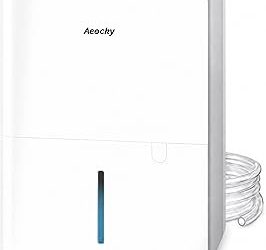
260 Pints Commercial Dehumidifier with Pump
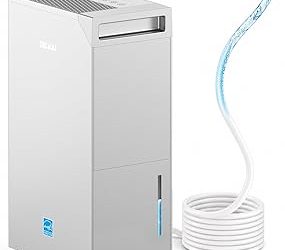
This is the unit I’d point a restoration crew or a warehouse manager toward: enormous extraction capacity, a built-in pump for vertical drainage, and auto-defrost that keeps it productive in unheated space. Overkill for a bedroom, but unmatched when you’re drying out structural moisture after a flood.
200 Pints Commercial Dehumidifier with Pump for Basements
Nearly the same industrial platform in a slightly more manageable package, and the sweet spot for large, persistently wet basements or workshops. Run it with the drain hose to a floor drain, set a 50% target, and it will quietly transform the air quality of the rooms above it.
DREO 110-Pint Smart Dehumidifier (711S)
My general recommendation for whole-home dry-down in a residential setting — coverage claimed to 4,500 sq ft, three genuinely useful modes, and app control so you can verify humidity without walking downstairs. Comfort mode is the one to use if the unit shares a floor with a bedroom.
DREO Energy Star 73-Pint Smart Dehumidifier
At around 41 dB, this is the largest unit I’d comfortably place in a sleeping space, and Energy Star certification keeps the round-the-clock running cost sane. Auto humidity control holds a target tightly, which matters more for sleep comfort than raw pint capacity does.
Midea Cube 20 Pint Dehumidifier
The Cube’s collapsible reservoir design solves the storage problem that plagues most seasonal units, and Wi-Fi with Alexa support lets you fold it into an existing bedtime routine. Best suited to a single damp room rather than a genuinely wet basement.
Frequently Asked Questions
What humidity level is best for sleep?
Aim for 40–50% relative humidity. Below 30% you’ll wake with a dry throat and irritated sinuses; above 60% you lose evaporative cooling and invite dust mites, which peak in exactly that range.
Can I run a commercial dehumidifier in a bedroom?
You can, but you probably shouldn’t. Industrial units prioritize output over acoustics. Place them in the basement or an adjacent utility space and let dried air migrate, or choose a 41 dB residential model like the DREO 73-pint instead.
Do I really need the pump?
Only if the drain point sits above the machine. With a floor drain nearby, gravity through the included hose is quieter, simpler, and has nothing to fail.
Will it help with allergies and asthma?
Often, yes. Sustained control below 50% suppresses dust mite reproduction and mold growth, which are two of the most common nighttime respiratory triggers — though a dehumidifier complements rather than replaces medical guidance.
Final Thoughts
For serious water intrusion or warehouse-scale space, the 260 Pints Commercial Dehumidifier with pump is the definitive choice. For most homes with a large damp basement, the DREO 110-Pint (711S) delivers commercial-adjacent capacity with far better livability — and if the unit will share air with a bedroom, the quiet 73-pint DREO Energy Star model is the one that protects your sleep as well as your drywall.