Key takeaways
- Moisture rating: Damp-rated fans suit deep, fully covered porches shielded from blowing rain. If your porch catches spray, snow, or direct weather at any angle, insist on wet-rated or IP65-certified construction—the difference shows up within two winters.
- Motor technology: DC and BLDC motors draw markedly less power, run cooler, and stay quieter than traditional AC units. For anywhere you intend to relax or sleep, the reduced mechanical noise floor is worth the modest price premium on its own.
- Airflow versus span: Match blade diameter to your porch footprint—roughly 44 inches for spaces under 100 square feet, 52 inches beyond that. Then check CFM rather than assuming size alone guarantees a usable breeze.
- Mounting and clearance: Measure ceiling height before anything else. You want at least seven feet of clearance beneath the blades, and sloped or beadboard ceilings may require a downrod or angled mount kit not included in the box.
- Control method: Remote and app control let you adjust speed without leaving your chair, which matters more than it sounds when you’re settled in. Pull chains remain genuinely reliable, though, and eliminate one more thing to lose or recharge.
What's inside
Porches occupy a strange middle ground in the home: half room, half weather. Anyone who has tried to nap in a hammock or linger over coffee on a humid August evening knows the specific frustration—the air simply stops moving, and with it goes any chance of feeling rested. As someone who spends a great deal of time thinking about how environments shape rest and recovery, I’ve come to see moving air as one of the most underrated comfort tools available. A steady breeze across the skin lowers perceived temperature by several degrees, discourages mosquitoes from settling, and produces the kind of low, even sound that the nervous system reads as safe rather than intrusive. The wrong fan, by contrast, gives you a wobble, a hum, and rust streaks by the second season.
The complication is that outdoor fans are not simply indoor fans painted black. Moisture ratings, motor type, blade material, and mounting depth all behave differently once you leave conditioned air behind. This guide walks through the models worth your attention in 2026, from full-size wet-rated units for covered verandas to compact plug-in options for pergolas and screened corners where hardwiring isn’t realistic. I’ve weighted airflow, acoustic behavior, and long-term durability most heavily, because those are the three variables that determine whether a porch fan becomes a fixture you love or a chore you resent.
As an Amazon Associate we earn from qualifying purchases.


🛒 Best Price Today on Amazon
Prime members get fast, free shipping on everything above, plus member-only deals. New members get a 30-day free trial — cancel anytime.
How to Choose a Ceiling Fan For Porch (2026)
- Moisture rating: Damp-rated fans suit deep, fully covered porches shielded from blowing rain. If your porch catches spray, snow, or direct weather at any angle, insist on wet-rated or IP65-certified construction—the difference shows up within two winters.
- Motor technology: DC and BLDC motors draw markedly less power, run cooler, and stay quieter than traditional AC units. For anywhere you intend to relax or sleep, the reduced mechanical noise floor is worth the modest price premium on its own.
- Airflow versus span: Match blade diameter to your porch footprint—roughly 44 inches for spaces under 100 square feet, 52 inches beyond that. Then check CFM rather than assuming size alone guarantees a usable breeze.
- Mounting and clearance: Measure ceiling height before anything else. You want at least seven feet of clearance beneath the blades, and sloped or beadboard ceilings may require a downrod or angled mount kit not included in the box.
- Control method: Remote and app control let you adjust speed without leaving your chair, which matters more than it sounds when you’re settled in. Pull chains remain genuinely reliable, though, and eliminate one more thing to lose or recharge.
The Best Ceiling Fan For Porch (2026)s Reviewed
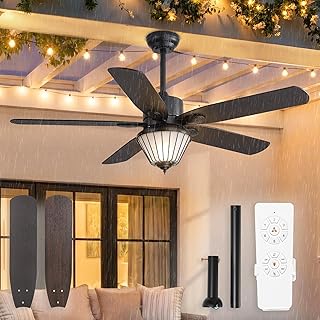
52″ Outdoor Ceiling Fan with Lights, IP65 Waterproof
This is the most complete package here for an exposed or semi-exposed porch: genuine wet rating, IP65 sealing, a reversible DC motor, and six speeds that let you dial airflow down to a barely-there drift for evening lounging. The dual-finish farmhouse blades read as intentional design rather than utility hardware, and the integrated light spares you a separate fixture.
52 Inch Solid Wood Ceiling Fan, No Light, Dark Walnut
The combination of a quiet high-CFM BLDC motor and three solid wood propeller blades produces the most pleasant acoustic signature of any fan on this list—broad air movement with almost no motor whine, which is precisely what you want overhead when you’re trying to unwind. Note the damp rating: reserve this one for well-protected porches.
ABZ 52″ Solid Wood Ceiling Fan, Walnut
A handsome, restrained three-blade design in real walnut that suits porches doing double duty as extended living space. Water-resistant rather than fully wet-rated, remote-operated, and light-free, it’s the choice for buyers who want the fan to disappear visually and audibly.
Hunter Cassius 44″ Matte Black
Hunter’s reputation for balanced, wobble-free assembly is well earned, and the compact 44-inch span fits smaller porches, side entries, and garages where a 52-inch fan would overwhelm. Pull-chain operation keeps the mechanism simple and long-lived, though you’ll want the switch within comfortable reach.
Orison 24″ Weatherproof Gazebo Fan
For pergolas, canopies, and rentals where hardwiring is off the table, this caged plug-in unit hangs from a hook and runs off standard power. The 3CCT dimmable light is the standout feature—shifting to a warm, low output in the evening supports the natural wind-down your body is already trying to begin.
Frequently Asked Questions
Can I use an indoor ceiling fan on a covered porch?
It’s not advisable. Indoor fans lack sealed motor housings and corrosion-resistant hardware, so humidity alone will eventually cause rust, bearing noise, and blade warping—even under full cover.
What’s the difference between damp-rated and wet-rated?
Damp-rated fans tolerate ambient humidity but no direct water contact. Wet-rated fans withstand rain and snow reaching the fixture directly, making them the safer default for anything less than a deeply recessed porch.
Do porch fans actually deter mosquitoes?
Yes, meaningfully. Mosquitoes are weak fliers and struggle in sustained airflow, and moving air also disperses the carbon dioxide plume they use to locate you.
Which direction should the blades turn outdoors?
Counterclockwise in warm weather, which pushes air downward and creates the cooling wind-chill effect. The clockwise setting is largely irrelevant on an unheated porch.
Final Thoughts
If your porch sees any real weather, the 52″ IP65 Waterproof fan is the safest long-term investment, pairing genuine wet-rated construction with a light and a whisper-quiet DC motor. For sheltered porches where sound quality matters most, the 52 Inch Solid Wood BLDC fan is difficult to beat. And where hardwiring isn’t an option, the Orison 24″ plug-in delivers proper airflow and warm, dimmable light with nothing more than a hook and an outlet.