
If your knees complain, a yoga mat stops being an accessory and becomes the piece of equipment that decides whether you train at all. The pressure on a kneecap during a low lunge is concentrated over a very small area, and thin foam on a hard floor does not spread it — it just puts a thin layer between bone and tile. The same applies to elbows in forearm plank, hip bones in side-lying work, and the tailbone in any seated position held longer than a minute.
What actually relieves that pressure is a combination of depth and density, and people usually buy only the first. Soft thick foam feels wonderful for ten seconds and then bottoms out, leaving your knee resting on the floor through a compressed layer. Dense foam of the same thickness keeps distributing load for the whole pose. There is also a rebound question: a mat that stays permanently dented has stopped protecting the exact spots you use most. The options below are judged on joint protection specifically.
Our top picks


As an Amazon Associate we earn from qualifying purchases at no extra cost to you.
Quick Comparison
| Product | Best For | Standout Feature | Watch Out For |
|---|---|---|---|
| KEEP Extra Thick NBR Mat, 10mm | Painful knees on hard floors | 10mm depth across a 72 by 24 inch surface | Too soft for any standing balance work |
| Fitvids 1/2-Inch Extra Thick Mat | Sustained pressure without bottoming out | High density that keeps spreading load | Firmer initial feel than plush foam |
| CAP Barbell 1/2-Inch High Density Mat | Knees plus some standing work | Half an inch of dense, resilient foam | Bulky roll to store |
| Amazon Basics Extra Thick Exercise Mat | Immediate comfort on a budget | Noticeable cushioning at low cost | Soft foam compresses under sustained load |
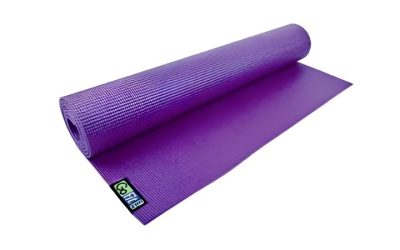
| Gaiam Thick NBR Yoga Mat | General joint comfort | Cushioned NBR with an easy-cinch strap | Dents can persist at high-contact points |
| CAP Non-Slip Yoga Mat | Practice on carpet | Grip without adding another soft layer | Offers little protection on hard floors |
How to Choose
- Press with a knuckle: Push hard into the mat. If you feel the floor through it, your kneecap will too. That test predicts comfort better than any thickness figure.
- Check the rebound: Press and release. Foam that stays dented will be permanently flattened where you kneel most, exactly where you need it.
- Depth plus density: Look for both. Thick and soft bottoms out; thin and dense has nowhere to spread the load. The combination is what works.
- Map your contact points: Knees, elbows, hips and tailbone. Whichever hurts now is the one to buy for, since a mat that fixes it will fix the others.
- Consider a doubled zone: Folding the mat under a knee gives you double thickness exactly where it matters, which can outperform buying a thicker mat overall.
Top Picks Reviewed
Most Cushioning: KEEP Extra Thick NBR Mat
Ten millimetres is the most padding in this group, and on tile or concrete it is transformative for kneeling poses, forearm work and long seated holds. The 72 by 24 inch surface also means you are not falling off the padded area when you move, which matters more than it sounds during floor sequences.
The compromise is total on standing work. This much soft foam makes single-leg balance genuinely unsteady, so if your routine includes standing sequences you will want a firmer surface for that portion of the session.
Best Sustained Support: Fitvids 1/2-Inch Extra Thick Mat
What separates this from cheaper thick mats is that it keeps spreading load through a long hold rather than compressing flat in the first ten seconds. For anyone whose knee pain arrives partway through a pose rather than immediately, that is the specification that solves it.
Dense foam feels firmer under your hand than plush foam, and people shopping by first impression often reject it for that reason. The firmness is precisely why it still protects you at the two-minute mark.
Best Balance of Protection and Stability: CAP Barbell 1/2-Inch High Density Mat
Half an inch of dense foam gives real protection for knees and elbows while remaining stable enough that standing poses do not become a separate challenge. For a mixed practice with sore joints, this is the most workable single-mat answer here.
The roll is chunky and does not compress much, so storage needs a proper gap rather than a narrow slot. The strap makes carrying it easy but does not make it smaller.
Best Budget Relief: Amazon Basics Extra Thick Exercise Mat
If the goal is simply to make floor work bearable without spending much, extra thickness at a low price delivers immediate improvement over a thin mat, and the carrying strap deals with the extra bulk.
Softer foam does compress under sustained pressure, so the relief fades during long holds and the mat tends to develop persistent dents where your knees land. Rotating the mat end to end periodically spreads that wear.
Frequently Asked Questions
What thickness do I need for knee pain?
On hard floors, generally 8mm or more, or half an inch of dense foam. Below that, most people with sensitive knees still feel the floor during kneeling poses.
Is a thicker mat always better for joints?
Not if it is soft. Thick soft foam bottoms out under concentrated pressure and offers less protection at the two-minute mark than a firmer mat half its depth.
Can I use a folded towel instead?
For a specific pose, yes, and it is a good stopgap. It is less practical for a flowing sequence where you move constantly, since the towel shifts and needs repositioning.
Should I use knee pads as well?
Dedicated knee pads work well on top of a thinner mat and let you keep the stability of a firm surface for standing work. It is a legitimate alternative to buying a very thick mat.
Final Thoughts
Protect the joint that currently hurts and the rest of the practice follows. The KEEP 10mm mat delivers the most cushioning for floor-based routines, the Fitvids and CAP Barbell half-inch mats give dense support that lasts through long holds, and the Amazon Basics option is the affordable improvement over a thin mat. Test any candidate by pressing a knuckle into it — if you can feel the floor, so will your knee.


Write Your Review
No reviews yet. Be the first to share your experience!