Key takeaways
- Dimming floor, not just “dimmable”: A fixture that bottoms out at 20% is nearly useless for evening use. Look for drivers rated to 10% or lower, and confirm compatibility with your specific dimmer — TRIAC and ELV dimmers behave very differently with low-voltage LED drivers, and a mismatch shows up as flicker or dropout at exactly the low settings you want most.
- Selectable CCT with a genuinely warm bottom end: Anything that starts at 3000K is still fairly alerting. Fixtures offering 2700K give you a meaningfully gentler evening option, and 5CCT models let you fine-tune between morning task light and nighttime ambience without rewiring.
- Color rendering above CRI 90, with R9 called out: R9 measures deep red rendering, the value most budget LEDs quietly fail. High R9 makes raw meat, produce, and skin tones read accurately — a food-safety point as much as an aesthetic one. Fixtures publishing R9>90 are signaling real phosphor quality.
- Linkability and length planning: Measure each cabinet run individually before buying. A single 36-inch bar beats three stubby fixtures for uniformity, but multipacks of 12-inch units linked end to end handle irregular layouts better. Confirm how many fixtures one circuit and one dimmer can carry.
- Certification and installation reality: ETL or UL listing is non-negotiable for anything wired into permanent branch circuits, and California installations need Title 24 compliance. Check whether the junction box is integrated and whether the fixture accepts direct-wire without an adapter — that detail determines whether this is a one-hour job or an electrician’s visit.
What's inside
Most kitchen lighting advice stops at brightness, but as a sleep-wellness practitioner I spend my days untangling why otherwise healthy people lie awake at midnight. A surprising culprit sits above the countertop. Overhead ceiling fixtures blast cool, high-intensity light directly into the upper visual field — precisely the angle your retinal ganglion cells monitor to decide whether it’s still daytime. Loading the dishwasher at 9:30 p.m. under 5000K downlights sends your circadian system a message it takes roughly two hours to walk back.
Hardwired, dimmable under cabinet lighting solves this in a way plug-in strips and puck lights rarely manage. Because the light source sits below eye level and aims at the work surface, it illuminates the task without flooding your upper field of view. Add true dimming and selectable color temperature, and a single fixture run can deliver crisp 4000K light for morning prep and a warm, low-output glow for the evening wind-down. This guide covers what actually matters in a 2026 hardwired fixture — dimming floor, CCT range, color rendering, and driver quality — plus honest assessments of six fixtures I’ve evaluated against those criteria.
As an Amazon Associate we earn from qualifying purchases.


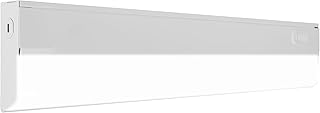


How to Choose a Under Cabinet Lighting Hardwired Dimmable (2026)
- Dimming floor, not just “dimmable”: A fixture that bottoms out at 20% is nearly useless for evening use. Look for drivers rated to 10% or lower, and confirm compatibility with your specific dimmer — TRIAC and ELV dimmers behave very differently with low-voltage LED drivers, and a mismatch shows up as flicker or dropout at exactly the low settings you want most.
- Selectable CCT with a genuinely warm bottom end: Anything that starts at 3000K is still fairly alerting. Fixtures offering 2700K give you a meaningfully gentler evening option, and 5CCT models let you fine-tune between morning task light and nighttime ambience without rewiring.
- Color rendering above CRI 90, with R9 called out: R9 measures deep red rendering, the value most budget LEDs quietly fail. High R9 makes raw meat, produce, and skin tones read accurately — a food-safety point as much as an aesthetic one. Fixtures publishing R9>90 are signaling real phosphor quality.
- Linkability and length planning: Measure each cabinet run individually before buying. A single 36-inch bar beats three stubby fixtures for uniformity, but multipacks of 12-inch units linked end to end handle irregular layouts better. Confirm how many fixtures one circuit and one dimmer can carry.
- Certification and installation reality: ETL or UL listing is non-negotiable for anything wired into permanent branch circuits, and California installations need Title 24 compliance. Check whether the junction box is integrated and whether the fixture accepts direct-wire without an adapter — that detail determines whether this is a one-hour job or an electrician’s visit.
The Best Under Cabinet Lighting Hardwired Dimmable (2026)s Reviewed
GETINLIGHT 12-Inch 3-CCT Hardwired
A dependable, no-drama fixture with a low-profile matte white housing that disappears under most cabinet lips, and ETL listing that keeps inspectors happy. Its 3000K setting is the practical floor here, so it suits kitchens where evening use is brief rather than households chasing the warmest possible late-night glow.
12-Inch 10W 666LM 5CCT 4-Pack
This is the value pick for circadian-aware kitchens: 2700K at the bottom of the range, CRI>92 with R9>90, and enough output at 666 lumens to handle real prep work when dialed up. Four linkable units cover a typical galley run, and the wide CCT spread means one purchase serves both morning and evening needs.
36-Inch 22W Hardwired Bar
For long uninterrupted cabinet runs, a single 36-inch bar delivers noticeably more even coverage than chained shorter fixtures — fewer scallops, fewer shadow bands, one wiring point. The same excellent 2700K–5000K range and R9>90 rendering apply, making this my default recommendation for wider kitchens.
NICOR 18″ UCB Series Direct Wire
NICOR builds for the trades, and it shows in the driver quality and dimming stability at low output — where cheaper fixtures stutter, this one holds steady. The 18-inch length splits the difference nicely for medium cabinet spans, and selectable 2700K–5000K keeps evening flexibility intact.
TORCHSTAR 4-Pack 12 Inch 5CCT Aluminum
The aluminum housing is the differentiator: better thermal management means slower lumen depreciation and less color shift across the fixture’s life. Five CCT options, ETL and Title 24 compliance, and both hardwired and plug-in flexibility make this the most adaptable multipack on the list.
Frequently Asked Questions
What color temperature should I use at night?
Set 2700K and dim to roughly 20–30% output for any kitchen activity after your target bedtime minus two hours. That combination keeps melanopic stimulation low while leaving plenty of light to see by safely.
Do I need an electrician to install hardwired under cabinet lights?
If you’re tapping an existing switched circuit and comfortable working with the breaker off, many homeowners handle it. New circuits, permit-required work, or anything involving unclear existing wiring should go to a licensed electrician.
Why do my LED lights flicker when dimmed low?
Almost always a dimmer–driver mismatch. Check the manufacturer’s compatibility list and confirm your dimmer’s minimum load rating, since a small LED run often falls below what older dimmers need to operate cleanly.
Is warm light actually better, or is that marketing?
The mechanism is well established: short-wavelength-rich light suppresses melatonin more strongly than warm light at equal intensity. Intensity and viewing angle matter as much as color temperature, which is why a dimmed, downward-aimed under cabinet fixture beats a warm ceiling light.
Final Thoughts
If you want one fixture that handles both bright morning prep and a genuinely gentle evening setting, the 12-Inch 10W 5CCT 4-pack offers the best balance of 2700K warmth, R9>90 rendering, and price. For long cabinet spans, the 36-Inch 22W bar gives cleaner, more uniform coverage with a single wiring point, while the TORCHSTAR aluminum 4-pack is the pick if long-term color stability and installation flexibility matter most to you.