Key takeaways
- Sone rating over decibels: Sones are scaled to how loudly humans actually perceive sound. Anything at or below 1.0 sone reads as background hush and won’t fragment sleep in an adjoining bedroom; 1.5 sones is acceptable for a guest bath or a home with thick doors. Above 2.0, expect complaints.
- Selectable color temperature: A fixture offering 2700K through 5000K lets you run warm, amber-leaning light at night and neutral daylight for shaving or makeup. If you can only have one feature from this list, make it this one — nighttime light exposure is the single biggest sleep variable in a bathroom.
- CFM matched to room volume: A rough rule is 1 CFM per square foot for baths under 100 sq ft, then add 50 CFM per shower and 100 for a jetted tub. Undersized fans run longer and louder to do the same work.
- Humidity sensing and delay-off: Automatic operation clears steam after you’ve left and shuts down on its own. It protects drywall and grout, and it removes the decision-making that wakes people up.
- Installation reality: Retractable mounting brackets and no-attic-access designs matter enormously in condos, second-floor baths, and finished ceilings. Check duct diameter (4″ vs 6″) before you buy, not after.
What's inside
Most people shop for a bathroom fan the same way they shop for a fuse: only after something has gone wrong. A ceiling stained the color of weak tea, a mirror that never fully clears, a faint mildew smell that returns every February. What rarely enters the conversation is sleep — and yet the bathroom sits a few feet from where you spend a third of your life. A fan that rattles at 4 sones will pull you out of light sleep when someone else in the house takes a shower. A fixture whose light is stuck at 5000K will flood your retinas with blue-heavy light during a 2 a.m. trip down the hall, suppressing melatonin and stretching a two-minute interruption into forty minutes of staring at the ceiling.
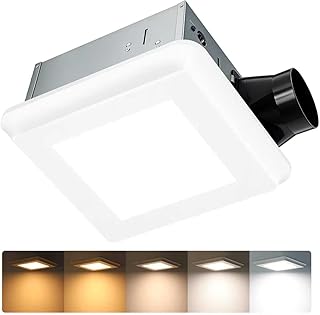
So this guide grades bathroom ceiling fans on two axes at once: how well they move humid air, and how gently they treat a sleeping household. That means paying close attention to sone ratings, to selectable color temperature (5CCT and 3CCT models let you drop to 2700K or lower for evening use), to dimmability, and to humidity sensors that run the fan on their own so nobody has to fumble for a switch in the dark. Below are the models worth your money in 2026, followed by a short buying framework and answers to the questions readers ask most.
As an Amazon Associate we earn from qualifying purchases.


How to Choose a Bathroom Ceiling Fans With Light (2026)
- Sone rating over decibels: Sones are scaled to how loudly humans actually perceive sound. Anything at or below 1.0 sone reads as background hush and won’t fragment sleep in an adjoining bedroom; 1.5 sones is acceptable for a guest bath or a home with thick doors. Above 2.0, expect complaints.
- Selectable color temperature: A fixture offering 2700K through 5000K lets you run warm, amber-leaning light at night and neutral daylight for shaving or makeup. If you can only have one feature from this list, make it this one — nighttime light exposure is the single biggest sleep variable in a bathroom.
- CFM matched to room volume: A rough rule is 1 CFM per square foot for baths under 100 sq ft, then add 50 CFM per shower and 100 for a jetted tub. Undersized fans run longer and louder to do the same work.
- Humidity sensing and delay-off: Automatic operation clears steam after you’ve left and shuts down on its own. It protects drywall and grout, and it removes the decision-making that wakes people up.
- Installation reality: Retractable mounting brackets and no-attic-access designs matter enormously in condos, second-floor baths, and finished ceilings. Check duct diameter (4″ vs 6″) before you buy, not after.
The Best Bathroom Ceiling Fans With Light (2026) Reviewed
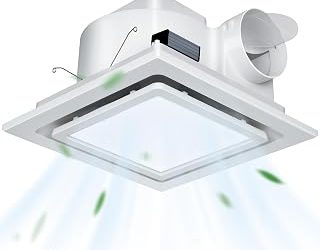
130 CFM Bathroom Exhaust Fan with Light & Humidity Sensor (5CCT)
This is the most complete sleep-conscious package here: 130 CFM of real extraction at just 1.0 sone, five selectable color temperatures, and a humidity sensor that handles the fan without human input. For a shared bath adjoining a bedroom, the combination of high airflow and near-silence is genuinely hard to beat.
Panasonic WhisperFit FV-0511VFL1
Panasonic’s low-profile WhisperFit remains the engineering benchmark, with a Pick-A-Flow selector spanning 50, 80, and 110 CFM and a dimmable LED that can be dialed down to a soft glow after dark. It costs more than the field, and it is the one on this list I’d install and forget about for fifteen years.
AUPU 3CCT Bathroom Exhaust Fan with Humidity Sensor
Energy Star and HVI certified at 0.8 sone, the AUPU is the quietest unit reviewed here, and its retractable bracket makes it forgiving to install in awkward joist spacing. Three color temperatures cover the practical range, and the humidity sensor is well calibrated rather than hair-trigger.
AHAWILL 8″ Ultra Quiet Fan with 5CCT Dimmable Light
At 80 CFM and 1.0 sone, this suits small to mid-size baths, and its 1000-lumen dimmable 5CCT light is the standout: true dimming plus warm settings means you can navigate a night visit without a melatonin penalty.
Fitop 110 CFM Ceiling Fan with Light (1.0 Sones)
Fitop’s 110 CFM model delivers 1200 lumens at 43W and requires no attic access, making it the pragmatic pick for apartments and finished ceilings. Choose the brand’s 130 CFM sibling only if you have a large or heavily used bath and can live with 1.5 sones.
Frequently Asked Questions
How long should a bathroom fan run after a shower?
Twenty minutes is the working standard. A humidity sensor or timer switch does this reliably, and it’s the difference between grout that lasts a decade and grout that darkens in two years.
Does fan noise really affect sleep?
Intermittent, variable noise is far more disruptive than steady noise. A 3-sone fan cycling on at odd hours produces exactly the kind of unpredictable sound that triggers cortical arousals, even when you don’t fully wake.
What color temperature is best for a bathroom at night?
Stay at or below 2700K after sunset, dimmed as far as the fixture allows. Reserve 4000–5000K for daytime grooming tasks where color accuracy matters.
Can I replace an old fan without attic access?
Yes — several models here, including both Fitop units, are designed for retrofit from below and reuse existing 4″ ducting. Confirm your duct size and ceiling opening first.
Final Thoughts
If you want one fan that solves ventilation and nighttime light exposure together, the 130 CFM 5CCT model with humidity sensor is the smartest all-round buy. Spend up for the Panasonic WhisperFit FV-0511VFL1 if longevity and dimming quality matter most, or choose the AUPU 3CCT at 0.8 sone when the bathroom shares a wall with a bedroom and silence is the priority.