Key takeaways
- Match thickness to sleeper weight: A 6-inch pad handles occasional guests and lighter sleepers well, but anyone over roughly 200 pounds — or a dedicated side sleeper, who loads the hip and shoulder hard — should start at 8 inches to avoid compressing through to the floor or slats.
- Prioritize foam density over loft: High-density or high-resilience foam recovers its shape night after night; low-density fill feels plush in week one and develops body impressions by week twelve. Layer count is marketing; resilience is engineering.
- Decide floor, frame, or both: Floor futons need a breathable surface underneath and regular airing to prevent moisture buildup. Frame sets need a mattress cut for hinge folding, so don’t mix a rigid foam slab with a bi-fold frame.
- Check the cover, not just the core: A removable, machine-washable cover matters more than most buyers expect — futons collect skin cells and humidity faster than raised mattresses because airflow underneath is limited.
- Plan for storage and handling: A queen futon is a genuinely large object. Storage straps, tri-fold geometry, and honest weight figures determine whether you’ll actually put it away or resign yourself to leaving it out.
What's inside
Queen-size futons occupy an odd niche in the sleep world: they’re asked to perform as furniture by day and as a legitimate mattress by night, and most of them are honest about only one of those jobs. As someone who spends a lot of time looking at how surfaces affect spinal alignment and sleep continuity, I see the same pattern in reviews again and again — a futon that looked great in the living room turned out to bottom out under a 180-pound side sleeper by month three. The culprit is usually foam density, not thickness, and that number is almost never printed on the box.
This guide sorts queen futons by what they’re actually built to do. Some are floor-first Japanese-style shikibutons meant for firm, low-profile sleeping. Others are tri-folding foam units that double as a compact couch. A couple are traditional frame-and-mattress sets that live in a guest room full-time. Below you’ll find the models worth considering in 2026, what each one does well, and the specs that predict whether a futon will still support you properly a year from now.
As an Amazon Associate we earn from qualifying purchases.


How to Choose a Queen Size Futon (2026)
- Match thickness to sleeper weight: A 6-inch pad handles occasional guests and lighter sleepers well, but anyone over roughly 200 pounds — or a dedicated side sleeper, who loads the hip and shoulder hard — should start at 8 inches to avoid compressing through to the floor or slats.
- Prioritize foam density over loft: High-density or high-resilience foam recovers its shape night after night; low-density fill feels plush in week one and develops body impressions by week twelve. Layer count is marketing; resilience is engineering.
- Decide floor, frame, or both: Floor futons need a breathable surface underneath and regular airing to prevent moisture buildup. Frame sets need a mattress cut for hinge folding, so don’t mix a rigid foam slab with a bi-fold frame.
- Check the cover, not just the core: A removable, machine-washable cover matters more than most buyers expect — futons collect skin cells and humidity faster than raised mattresses because airflow underneath is limited.
- Plan for storage and handling: A queen futon is a genuinely large object. Storage straps, tri-fold geometry, and honest weight figures determine whether you’ll actually put it away or resign yourself to leaving it out.
The Best Queen Size Futons (2026) Reviewed
8 Inch Corduroy Futon Mattress, Queen
The most complete all-rounder here: eight inches of high-resilience foam gives side sleepers enough room to sink the shoulder without hitting the floor, and the corduroy shell adds grip so the mattress doesn’t creep across hardwood. The included storage straps are a small touch that makes the difference between daily use and permanent semi-deployment.
6th Generation Japanese Floor Futon Mattress
This is the pick for anyone who genuinely prefers a firm, close-to-the-floor sleep surface rather than a couch that converts. The nine-layer high-density construction stays flat and even — no sag pockets — which suits back sleepers and people managing lower-back stiffness, though newcomers to shikibuton sleeping should expect a two-week adjustment period.
Stanford Futon Set, Queen
A traditional frame-and-mattress package that behaves like real furniture, with an 8-inch mattress and durable twill cover suited to a guest room in constant rotation. Choose this when the futon needs to look intentional in a shared living space rather than disappear into a closet.
Kodiak Monterey Queen Futon Set
The espresso hardwood frame is the strongest structural option in this lineup, and the suede-finish mattress reads as a sofa first, bed second. Worth the footprint if the piece will be sat on daily for years — that’s where cheap frames fail first, at the hinge and the arm joints.
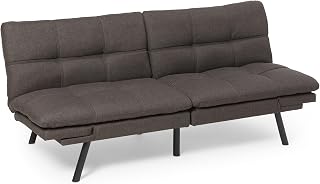
JUIKURY 6 Inch Tri-Fold Memory Foam Futon
The best compact convertible of the group: memory foam contours nicely for shorter guest stays, the washable cover is easy to maintain, and the five-position fold makes it genuinely useful in a small apartment. Treat it as a guest and occasional-use surface rather than a primary bed.
Frequently Asked Questions
Can a queen futon work as a permanent bed?
Yes, provided you choose 8 inches or more with high-density foam and air it regularly. Thin, low-density pads used nightly tend to develop impressions within months, which undermines alignment.
How firm should a queen futon feel?
Firmer than a spring mattress but not unyielding. Back and stomach sleepers usually do well on traditional Japanese-style futons; side sleepers need extra thickness to let the shoulder and hip settle.
Do futons cause moisture or mildew problems?
They can, because airflow underneath is restricted. Fold or stand the futon a few times a week, use a breathable base if it sits directly on the floor, and wash the cover monthly.
Tri-fold or bi-fold — which is better?
Tri-fold designs store more compactly and convert into seating easily. Bi-fold mattresses paired with a wooden frame give a flatter, more mattress-like sleep surface.
Final Thoughts
For most buyers, the 8 Inch Corduroy Futon Mattress offers the best balance of support, grip, and storability at queen size. Firm-surface sleepers and minimalists should look at the 6th Generation Japanese Floor Futon, while anyone who needs a futon that reads as real living-room furniture will get more years out of the Kodiak Monterey set.