Key takeaways
- Cushion depth and density: Shin pads take real pressure, so look for moulded foam at roughly 3–4 inches. Thin padding compresses within weeks and turns a posture aid into a pressure point that will keep you shifting all afternoon.
- Height and angle adjustment: Your knees should sit slightly below hip level with the seat angled around 20–30 degrees. Chairs with independent seat and shin-rest adjustment let you dial in that geometry instead of hoping the fixed preset matches your femur length.
- Backrest or open design: An open kneeler recruits your core and suits shorter focused sessions. A backrest with lumbar support is the smarter pick for full workdays or for anyone rehabbing an existing back complaint who needs somewhere to rest.
- Base type — casters or rockers: Locking brake casters give you desk mobility on hard floors; a curved wood rocker base encourages micro-movement that keeps circulation going and prevents the static loading that leaves legs heavy at night.
- Weight capacity and frame material: Confirm the stated limit (250 lb is common) and favour steel or solid hardwood over particleboard. A frame that creaks under load undermines the confidence you need to actually relax into the posture.
What's inside
Most people hunting for a kneeling chair aren’t shopping for furniture — they’re shopping for relief. They’ve spent eight hours folded into a conventional office chair, felt the slow ache creep across the lower back and between the shoulder blades, and then noticed something stranger: the discomfort doesn’t clock out at five. It follows them into bed, where it turns into restless repositioning, a pillow that never feels right, and a 3 a.m. wake-up that has nothing to do with stress. As someone who spends most of my working life on sleep quality, I can tell you that daytime posture is one of the most underrated variables in nighttime recovery. Compressed hip flexors, a flattened lumbar curve, and a forward-drifting head all keep the postural muscles quietly firing long after you lie down, and muscles that won’t let go make deep sleep harder to reach.
A kneeling chair works by opening the hip angle and tipping the pelvis forward, which lets the spine stack more naturally instead of collapsing into a C-shape. That means less residual tension to unwind at bedtime. This guide covers what actually matters when choosing one in 2026 — cushion depth, adjustment range, whether you want a backrest or a rocking base — and reviews the models worth your money, including options for taller users, small home offices, and anyone easing in slowly after years of conventional seating.
As an Amazon Associate we earn from qualifying purchases.


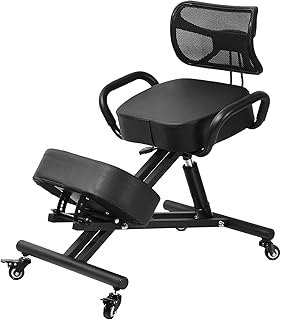
How to Choose a/an Office Kneeling Chair (2026)
- Cushion depth and density: Shin pads take real pressure, so look for moulded foam at roughly 3–4 inches. Thin padding compresses within weeks and turns a posture aid into a pressure point that will keep you shifting all afternoon.
- Height and angle adjustment: Your knees should sit slightly below hip level with the seat angled around 20–30 degrees. Chairs with independent seat and shin-rest adjustment let you dial in that geometry instead of hoping the fixed preset matches your femur length.
- Backrest or open design: An open kneeler recruits your core and suits shorter focused sessions. A backrest with lumbar support is the smarter pick for full workdays or for anyone rehabbing an existing back complaint who needs somewhere to rest.
- Base type — casters or rockers: Locking brake casters give you desk mobility on hard floors; a curved wood rocker base encourages micro-movement that keeps circulation going and prevents the static loading that leaves legs heavy at night.
- Weight capacity and frame material: Confirm the stated limit (250 lb is common) and favour steel or solid hardwood over particleboard. A frame that creaks under load undermines the confidence you need to actually relax into the posture.
The Best Office Kneeling Chairs Reviewed (2026)
Ergonomic Kneeling Chair with Angled Seat and Brake Casters
This is the most straightforward entry point: thick moulded foam cushions, a genuinely useful height range, and brake casters that let you roll to a filing cabinet then lock down for typing. Best for people testing whether kneeling suits them before committing to something more elaborate.
Kneeling Chair with Backrest and Linen Upholstery
The linen finish reads more like living-room furniture than office equipment, which matters if your desk shares space with the rest of your home. The backrest is the real draw — it lets you decompress between tasks without abandoning the open hip angle that makes the chair worth using.
Ergonomic Kneeling Chair with Adjustable Seats and Rocking Stool Base
The rocking action here is the standout feature: subtle continuous movement that keeps blood moving through the legs and stops the lower back from locking into one position. The five-year warranty and 250-pound capacity signal a manufacturer confident in the frame.
Easyego Kneeling Chair in Gray
A wood-framed rocker with soft padding and a restrained grey palette — the pick for anyone who wants ergonomics that don’t announce themselves. The natural rocking motion suits long reading or drafting sessions where you’re settled in for hours.
Kneeling Chair with Back Support and 4″ Cushion
The thickest cushion in this lineup, paired with dedicated lumbar support and adjustable height, makes this the most forgiving option for extended use. Worth considering if shin pressure has been your reason for giving up on kneeling chairs before.
Frequently Asked Questions
Can a kneeling chair really affect how well I sleep?
Indirectly, yes. Reducing the muscular tension and joint stiffness you accumulate during the day means less to unwind at bedtime, and less pain-driven repositioning once you’re asleep. It won’t fix insomnia, but it removes a common physical obstacle to settling.
How long should I sit in one each day?
Start with 20–30 minute blocks and build gradually over two or three weeks. Your calves, shins, and core need time to adapt, and pushing through early soreness usually ends with the chair in a cupboard.
Do I still need a regular chair?
Most people do best alternating. Rotating between a kneeler, a conventional chair, and standing distributes load across different tissues rather than concentrating it in one posture all day.
Are kneeling chairs suitable if I have knee problems?
Approach with caution and check with a clinician first. The design places load on the shins rather than the kneecaps, but existing joint conditions vary too much for a blanket recommendation.
Final Thoughts
For most home-office setups, the Kneeling Chair with Back Support and 4″ Cushion offers the best balance of comfort and all-day usability, while the Ergonomic Kneeling Chair with Adjustable Seats earns its place for anyone who wants the circulation benefits of a rocking base plus a five-year warranty behind it. If aesthetics matter as much as ergonomics, the Easyego Kneeling Chair in gray is the one you won’t mind seeing in the corner of the room — and the one whose benefits you’ll notice most clearly around midnight.