Key takeaways
- Depth before anything else: Recliner backrests curve away far more than office chairs, so measure the gap behind your lower back while seated. Anything under about four inches of loft will disappear into that hollow and do nothing; five inches is the sweet spot for most full-size recliners.
- Surface area over a narrow bolster: Wide cushions in the 18–20 inch range spread load across the whole lumbar region rather than pressing a single band into your spine. Narrow travel-style rolls create a pressure point that many people mistake for support.
- Foam resilience, not softness: Look for high-density memory foam that rebounds slowly and holds its shape after months of nightly use. Cheap shredded or polyfill inserts compress permanently within weeks and quietly stop working.
- An anchoring system that survives reclining: Adjustable dual straps, a tension band, or a textured non-slip backing will keep the cushion positioned as the chair moves. Without one, you’ll spend the evening reaching behind you to reset it.
- Breathable, washable covers: Skin warmth against a dense foam block traps heat, and elevated core temperature is one of the more reliable ways to delay sleep onset. Mesh, corduroy, or a knit cover with a removable machine-washable zip is worth prioritising if you recline in the evening.
What's inside
Recliners are engineered for lounging, not for spinal alignment. Most models are built with a generous curve through the backrest that leaves a hollow gap right where your lumbar spine needs contact — and when that gap goes unfilled, your pelvis rolls backward, your lower back flattens, and the discs at L4 and L5 absorb pressure they were never meant to hold for two hours of television. People notice it as stiffness when they stand up, or a dull ache that shows up around 9pm and follows them to bed. As someone who spends their working life on sleep quality and recovery posture, I see this pattern constantly: the chair people relax in is quietly undermining the rest they get later.
A well-shaped lumbar cushion solves this cheaply and immediately, but recliners are demanding. They need more depth and more surface area than a desk chair pillow provides, and the cushion has to stay put as the backrest tilts through its range. Below I’ve assessed the strongest options available in 2026 — comparing foam density, fill height, strap systems, and cover breathability — with practical notes on which body types and chair styles each one suits.
As an Amazon Associate we earn from qualifying purchases.


How to Choose a Lumbar Support Cushion For Recliner Chair (2026)
- Depth before anything else: Recliner backrests curve away far more than office chairs, so measure the gap behind your lower back while seated. Anything under about four inches of loft will disappear into that hollow and do nothing; five inches is the sweet spot for most full-size recliners.
- Surface area over a narrow bolster: Wide cushions in the 18–20 inch range spread load across the whole lumbar region rather than pressing a single band into your spine. Narrow travel-style rolls create a pressure point that many people mistake for support.
- Foam resilience, not softness: Look for high-density memory foam that rebounds slowly and holds its shape after months of nightly use. Cheap shredded or polyfill inserts compress permanently within weeks and quietly stop working.
- An anchoring system that survives reclining: Adjustable dual straps, a tension band, or a textured non-slip backing will keep the cushion positioned as the chair moves. Without one, you’ll spend the evening reaching behind you to reset it.
- Breathable, washable covers: Skin warmth against a dense foam block traps heat, and elevated core temperature is one of the more reliable ways to delay sleep onset. Mesh, corduroy, or a knit cover with a removable machine-washable zip is worth prioritising if you recline in the evening.
The Best Lumbar Support Cushion For Recliner Chair (2026)s Reviewed
HOMBYS Extra Large Lumbar Support Pillow
At 20″ x 13.5″ x 5″, this is the most convincingly recliner-specific cushion here — the extra loft actually fills the backrest hollow instead of hovering in front of it, and the broad footprint distributes pressure well for larger frames. It’s my default recommendation for older adults who need help maintaining an upright pelvis without effort.
Large Memory Foam Back Support Cushion for Recliner & Sofa
A close rival to the HOMBYS with a slightly firmer core and a machine-washable cover that makes it the more practical pick for daily evening use or households with pets. The ergonomic contour tracks the natural lumbar curve accurately rather than simply pushing forward.
HIGOGOGO Tufted Corduroy Back Support Cushion
The tufted corduroy shell breathes noticeably better than smooth polyester, which matters if you tend to warm up during long reading sessions. Support is moderate rather than aggressive, making it the right choice for people who find dense foam cushions intrusive.
Everlasting Comfort Original Lumbar Support Pillow
The benchmark ergonomic cushion, with an accurate contour and reliable foam quality that has earned its reputation. It’s shallower than the recliner-specific options, so it performs best in shallower recliners, on sofas, or when moved between chair and car.
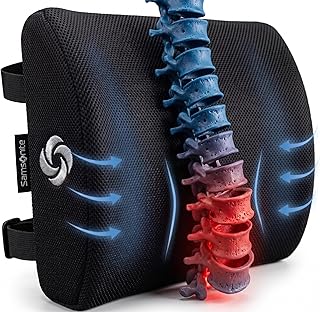
Samsonite Lumbar Support Pillow
Well-constructed memory foam with a clean profile and secure strap system, ideal if the cushion needs to move between a recliner, a desk chair, and a car seat. Consider it the versatile all-rounder rather than the deep-support specialist.
Frequently Asked Questions
Where exactly should the cushion sit?
Position it so the thickest point meets the inward curve just above your beltline, roughly level with the top of your pelvis. Placed too high it pushes your mid-back forward; too low it tips your pelvis and worsens the problem.
Will a lumbar cushion help me sleep better?
Indirectly, yes. Slumped evening posture leaves the lumbar muscles and joints irritated, and that low-grade discomfort is a common cause of difficulty settling and mid-night waking. Reducing it before bed removes one obstacle to continuous sleep.
Can I use an office chair cushion in a recliner?
You can, but expect reduced benefit. Office cushions are typically three to four inches deep because desk chairs have flatter backs; recliners usually need closer to five inches to make meaningful contact.
Should the cushion feel firm or soft?
Firm enough to hold your spine’s curve after twenty minutes, soft enough that you’re not aware of it. If you feel a distinct pressure line against your back, the cushion is too narrow or too dense for you.
Final Thoughts
For most recliner owners the HOMBYS Extra Large is the safest investment — it has the depth and width the job genuinely requires. Choose the Large Memory Foam Recliner Cushion if a washable cover and firmer core appeal, the HIGOGOGO Tufted Corduroy if breathability and a gentler feel matter more, and the Everlasting Comfort Original if you want one proven cushion that moves with you between chair, sofa, and car.