Key takeaways
- Flat-open length, not folded width: Measure the sleeping surface, then add 5–6 inches to the tallest sleeper’s height. A 59-inch loveseat that opens to roughly 71 inches suits adults up to about 5’6″ comfortably; taller guests will want a full 72-inch-plus footprint or should plan on diagonal sleeping.
- Hinge and seam placement: Fold-flat designs create a seam somewhere along the body. Boneless or single-cushion constructions eliminate that ridge entirely, which matters most for side sleepers whose hips and shoulders bear concentrated load.
- Fill behavior over time: Memory foam contours well but traps heat and softens in warm rooms; high-resilience foam and pocketed-fill hybrids hold their shape longer under nightly use. If the futon is a primary bed rather than an occasional one, prioritize resilience over initial plushness.
- Cover breathability: Linen-weave and corduroy covers move air and wick moisture, keeping surface temperature closer to the 60–68°F range that supports uninterrupted sleep. Faux leather wipes clean and resists spills but insulates, so plan on a cotton or bamboo topper.
- Seat height and transfer ease: Low-profile floor models around 12 inches feel airy and visually enlarge a room, but anyone with knee, hip, or mobility considerations will sleep and rise better on a standard 15–18 inch frame.
What's inside
Square footage is the constraint, but sleep quality is the cost. In studios, guest rooms that double as offices, and apartments where the sofa is also the spare bed, most buyers end up choosing on footprint alone — then discover six months later that the surface they picked sags at the hips, runs hot, or folds into a ridge exactly where a shoulder needs to rest. A futon in a small space does double duty, which means it has to satisfy two different bodies: the one sitting upright at 9 p.m. and the one lying flat at 1 a.m.
This guide evaluates convertible futons through a sleep-wellness lens: spinal alignment when flat, thermal behavior under a sleeping body, seam and hinge placement relative to pressure points, and how honestly each model’s stated dimensions translate into usable sleep length. Below are six space-conscious options worth considering in 2026, followed by the selection criteria that actually predict a good night rather than a good showroom impression.
As an Amazon Associate we earn from qualifying purchases.




How to Choose a Futon For Small Spaces (2026)
- Flat-open length, not folded width: Measure the sleeping surface, then add 5–6 inches to the tallest sleeper’s height. A 59-inch loveseat that opens to roughly 71 inches suits adults up to about 5’6″ comfortably; taller guests will want a full 72-inch-plus footprint or should plan on diagonal sleeping.
- Hinge and seam placement: Fold-flat designs create a seam somewhere along the body. Boneless or single-cushion constructions eliminate that ridge entirely, which matters most for side sleepers whose hips and shoulders bear concentrated load.
- Fill behavior over time: Memory foam contours well but traps heat and softens in warm rooms; high-resilience foam and pocketed-fill hybrids hold their shape longer under nightly use. If the futon is a primary bed rather than an occasional one, prioritize resilience over initial plushness.
- Cover breathability: Linen-weave and corduroy covers move air and wick moisture, keeping surface temperature closer to the 60–68°F range that supports uninterrupted sleep. Faux leather wipes clean and resists spills but insulates, so plan on a cotton or bamboo topper.
- Seat height and transfer ease: Low-profile floor models around 12 inches feel airy and visually enlarge a room, but anyone with knee, hip, or mobility considerations will sleep and rise better on a standard 15–18 inch frame.
The Best Futon For Small Spaces (2026)s Reviewed
COMHOMA 72″ Convertible Futon Sofa Bed
At 72 inches, this is the most accommodating option here for average-height adults, and the multi-angle backrest lets you fine-tune a reading incline rather than choosing between bolt-upright and fully flat. The breathable woven cover is the standout feature for anyone who sleeps warm and has been burned by a sealed-surface sleeper.
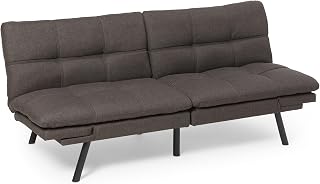
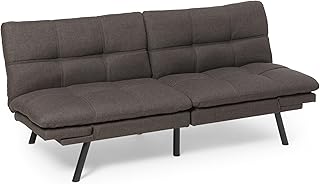
Grey Linen Futon Sofa Bed with Memory Foam
The memory-foam layer gives noticeably better shoulder and hip contouring than the polyfill common at this size, making it a sound choice for side sleepers in tight quarters. Adjustable armrests are the practical touch — dropping them flat recovers several inches of usable sleep width.
MeMoreCool 59″ Boneless Couch Bed
The boneless build is its real advantage: no internal frame means no fold seam and no hardware to press against the body, so the 59 × 71-inch surface sleeps more evenly than its compact footprint suggests. The corduroy cover breathes well and the 700-pound capacity signals foam density that should resist early sagging.
Amazon Basics Convertible Futon Sofa Bed
A restrained, low-risk pick for occasional-guest duty, with a memory-foam surface and multiple recline positions in a genuinely small-room footprint. Firmness runs moderate rather than plush, which favors back sleepers and shorter stays over nightly long-term use.
Flamaker Faux Leather Convertible Futon
Best suited to rooms where spill resistance and easy wipe-down matter more than surface breathability — the removable armrests and cup holders make it a capable lounge piece as well as a bed. Add a cotton or bamboo topper before overnight guests arrive, since faux leather retains body heat.
Frequently Asked Questions
Can a futon serve as a full-time bed?
Yes, provided the fill is dense enough to keep your spine neutral and the surface has no fold seam under your torso. Boneless and single-cushion designs hold up best to nightly use; thin fold-flat models with hollow-fiber fill are better reserved for guests.
Do I need a mattress topper?
A 2–3 inch topper is worth adding to any futon under about 6 inches of total thickness, and to any faux-leather model regardless of thickness. Choose cotton, wool, or bamboo over foam so you improve cushioning without compounding heat retention.
How do I keep a futon from getting hot overnight?
Layer for airflow rather than insulation: breathable cover, natural-fiber topper, and lightweight bedding. Leaving the futon unfolded during the day also lets trapped moisture dissipate, which prevents the clammy feeling common in memory-foam sleepers.
What size futon fits a small studio?
A 59-inch loveseat frame is the practical ceiling for most studios and opens to roughly 71 inches of sleep length. Step up to 72 inches only if a sleeper over 5’8″ uses it regularly, and measure the fully reclined depth — not just the folded depth — against your walkway.
Final Thoughts
For nightly sleep in a genuinely small room, the MeMoreCool 59″ Boneless Couch Bed is the strongest all-around choice thanks to its seamless surface and breathable corduroy cover. Taller sleepers should default to the COMHOMA 72″ for its extra length and adjustable recline, while the Grey Linen memory-foam sleeper is the better fit for side sleepers who want contouring in a compact frame.