Key takeaways
- Material compatibility: Vinyl reacts badly to plasticizers and adhesives. Look for natural felt paired with either EVA or genuinely inert, non-adhesive rubber. Avoid cheap PVC mesh, latex-coated netting, and anything with a tacky, glue-like feel — these are the pads that leave permanent discoloration on LVP.
- Grip mechanism: There are two honest approaches: mechanical friction (textured EVA, silicone dots, dense rubber) or sheer mass (thick felt that simply won’t budge). Suction-style pads that claim to bond to the floor are the ones most likely to cause trouble.
- Thickness versus clearance: A 1/2″ felt pad feels luxurious beside a bed, but measure your door swing and any transition strips first. For hallways, entryways, and under furniture legs, 1/8″ to 1/4″ is the practical ceiling.
- Acoustic performance: This is the sleep angle people miss. Vinyl plank over a subfloor amplifies footfall and echo. Dense felt is the single best absorber in this category — if your bedroom sounds hollow, prioritize felt thickness over grip.
- Breathability and moisture: Vinyl doesn’t breathe, so trapped humidity has nowhere to go. Open-structure felt and rubber pads let air move; fully sealed waterproof films are useful under dining areas but should be lifted and aired periodically.
What's inside
As a sleep-wellness consultant, I spend most of my time talking about mattresses and light exposure — but a surprising number of my clients trace their 3 a.m. wakeups to something far more mundane: the floor. Luxury vinyl plank is quiet underfoot until a rug starts sliding, and then every trip to the bathroom becomes a shuffle-and-catch that spikes your heart rate right when your nervous system is trying to stay in low gear. Worse, the wrong pad can chemically bond to LVP’s wear layer, leaving a sticky amber haze that no cleaner will lift. Vinyl is softer and more reactive than hardwood, and it punishes shortcuts.
This guide covers the rug pads I actually recommend for vinyl plank in 2026 — what makes a pad LVP-safe rather than merely “floor-safe,” how thickness affects both cushioning and door clearance, and which materials to avoid entirely if your planks sit over radiant heat. I’ve focused on options that hold a rug still in high-traffic bedrooms and hallways without staining, off-gassing, or telegraphing texture through a low-pile rug.
As an Amazon Associate we earn from qualifying purchases.


How to Choose a Rug Pad For Vinyl Plank Floors (2026)
- Material compatibility: Vinyl reacts badly to plasticizers and adhesives. Look for natural felt paired with either EVA or genuinely inert, non-adhesive rubber. Avoid cheap PVC mesh, latex-coated netting, and anything with a tacky, glue-like feel — these are the pads that leave permanent discoloration on LVP.
- Grip mechanism: There are two honest approaches: mechanical friction (textured EVA, silicone dots, dense rubber) or sheer mass (thick felt that simply won’t budge). Suction-style pads that claim to bond to the floor are the ones most likely to cause trouble.
- Thickness versus clearance: A 1/2″ felt pad feels luxurious beside a bed, but measure your door swing and any transition strips first. For hallways, entryways, and under furniture legs, 1/8″ to 1/4″ is the practical ceiling.
- Acoustic performance: This is the sleep angle people miss. Vinyl plank over a subfloor amplifies footfall and echo. Dense felt is the single best absorber in this category — if your bedroom sounds hollow, prioritize felt thickness over grip.
- Breathability and moisture: Vinyl doesn’t breathe, so trapped humidity has nowhere to go. Open-structure felt and rubber pads let air move; fully sealed waterproof films are useful under dining areas but should be lifted and aired periodically.
The Best Rug Pad For Vinyl Plank Floors (2026)s Reviewed
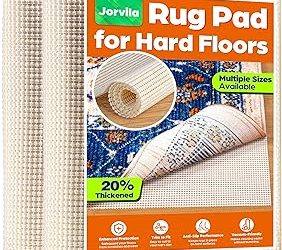
RUGPADUSA Vinyl Lock (Felt + EVA)
This is the only pad here engineered specifically for LVP, and the EVA layer grips through friction rather than chemical tack — exactly what you want on a wear layer you’d like to keep pristine. The 2’x3′ size makes it ideal for bedside runners and bath-adjacent spots where a slip at night is most likely.
RUGPADUSA Basics 1/2″ Felt
Pure felt with no backing, which sounds like a compromise until you feel how little a half-inch of dense fiber moves under a large rug. For bedrooms it’s my top acoustic pick: it deadens footfall, softens the hollow ring of floating vinyl, and eliminates any staining risk outright.
RUGPADUSA Dual Surface 1/4″
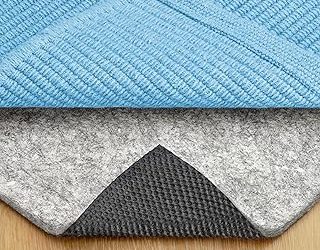
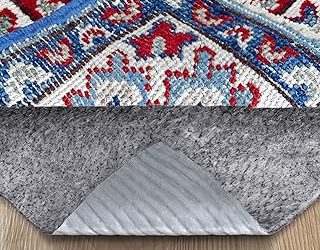
The felt-and-rubber sandwich remains the most reliable all-rounder — enough plush to protect planks from furniture compression, enough rubber to lock an 8’x10′ rug in place. At 1/4″ it clears most interior doors without shimming.
1/8″ Felt Rubber Dual Surface, Waterproof
The waterproof membrane earns its place under kids’ rooms, pet zones, and anywhere a spilled glass of water could otherwise wick into a plank seam. At 1/8″ it’s the low-profile choice for entryways and under doors, with grip that outperforms its thickness.
Veken Cushioned Pad (Felt + Silicone)
The dotted silicone backing is a smart middle path: hundreds of small contact points create real hold without a continuous sealed film against the vinyl. It’s the best value in this lineup for a large living-room rug, though I’d choose felt-and-rubber for anything that gets daily furniture loading.
Frequently Asked Questions
Will a rug pad discolor my vinyl plank floor?
It can, if the pad uses plasticizers, adhesives, or low-grade PVC. Natural felt, EVA, and quality rubber formulated for LVP are safe. When in doubt, test in a closet for two weeks before laying a full rug.
How thick should a bedroom rug pad be?
Between 1/4″ and 1/2″. Thicker felt absorbs footfall and room echo, which genuinely helps light sleepers and anyone sharing a wall with a hallway.
Can I use these over radiant-heated vinyl?
Thin felt-and-rubber pads at 1/8″ are the safest choice, since thick felt insulates and reduces heat transfer. Check your flooring manufacturer’s R-value limit first.
Do I need a pad if my rug is heavy?
Yes. Weight prevents sliding but not abrasion — grit trapped between a heavy rug and vinyl acts like sandpaper on the wear layer.
Final Thoughts
If your floors are LVP and you want zero guesswork, start with the RUGPADUSA Vinyl Lock, which was purpose-built for this surface. For a bedroom where quiet matters as much as grip, the Basics 1/2″ felt is the better sleep investment, and the Dual Surface 1/4″ remains the most versatile pick for large living-area rugs.