Key takeaways
- Motion quality over motion range: A glider should travel in a smooth, ball-bearing arc with no audible tick at the end of its sweep. Rhythmic, silent movement at roughly one cycle per two seconds mirrors the slow rocking that reliably shortens sleep latency; a jerky mechanism does the opposite.
- Recline geometry: Look for a backrest that opens past 130 degrees with the legs supported, which reduces spinal load and encourages diaphragmatic breathing. Anything that tops out near vertical will keep your neck flexed and your airway compressed.
- Lumbar and head support that adapts: A fixed foam block in the lower back suits one body shape only. Detachable lumbar cushions and adjustable headrests let you dial in neutral alignment, which matters enormously if you drift off in the chair.
- Thermal behaviour of the upholstery: Core body temperature has to fall for sleep to begin. Boucle, chenille and corduroy breathe and wick better than sealed vinyl-style coatings; genuine leather sits in between but conducts heat away efficiently once warmed.
- Footprint and exit path: Measure the depth needed at full recline, not just the closed dimensions, and confirm at least four inches of clearance behind. A chair you have to fight your way out of at night is a chair that will wake you fully.
What's inside
Most people shopping for a swivel glider are not really shopping for furniture — they are shopping for sleep. Whether it is a parent feeding a newborn at 3 a.m., a shift worker unwinding before a daytime nap, or someone with restless legs who cannot settle straight into bed, the chair becomes part of a nightly ritual. The trouble is that a poorly chosen glider actively works against rest: a seat that is too shallow forces the pelvis to tip and the lower back to brace, a rocking mechanism that clicks or shudders yanks a drowsy nervous system back to alert, and a reclining angle that stops short of about 130 degrees never lets the chest and shoulders release. From a sleep-wellness standpoint, those are not minor annoyances — they are arousal triggers, and arousal is the enemy of sleep onset.
This guide evaluates the current crop of swivel glider recliners through that lens. Rather than tallying features, I have weighted the things that measurably influence whether a body can downshift: motion quality and noise, lumbar and cervical support, recline depth, upholstery breathability and thermal behaviour, and how gracefully the chair lets you stand up again without fully waking. Below are the models worth your attention in 2026, along with the specifications I would check before committing.
As an Amazon Associate we earn from qualifying purchases.


How to Choose a Chair Swivel Glider (2026)
- Motion quality over motion range: A glider should travel in a smooth, ball-bearing arc with no audible tick at the end of its sweep. Rhythmic, silent movement at roughly one cycle per two seconds mirrors the slow rocking that reliably shortens sleep latency; a jerky mechanism does the opposite.
- Recline geometry: Look for a backrest that opens past 130 degrees with the legs supported, which reduces spinal load and encourages diaphragmatic breathing. Anything that tops out near vertical will keep your neck flexed and your airway compressed.
- Lumbar and head support that adapts: A fixed foam block in the lower back suits one body shape only. Detachable lumbar cushions and adjustable headrests let you dial in neutral alignment, which matters enormously if you drift off in the chair.
- Thermal behaviour of the upholstery: Core body temperature has to fall for sleep to begin. Boucle, chenille and corduroy breathe and wick better than sealed vinyl-style coatings; genuine leather sits in between but conducts heat away efficiently once warmed.
- Footprint and exit path: Measure the depth needed at full recline, not just the closed dimensions, and confirm at least four inches of clearance behind. A chair you have to fight your way out of at night is a chair that will wake you fully.
The Best Chair Swivel Gliders of 2026, Reviewed
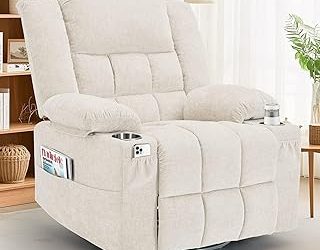
Boucle Power Recliner Swivel Glider with USB (Cream)
The strongest all-round choice for night-time use: motorised recline means you change position without engaging your core or breaking a drowsy state, and the USB port keeps a phone or white-noise machine within reach instead of across the room. The boucle is genuinely breathable, and the included lumbar pillow makes the generous seat depth workable for shorter frames.
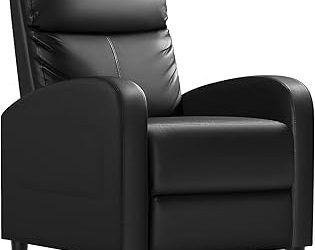
CHITA Genuine Leather Power Recliner Swivel Glider
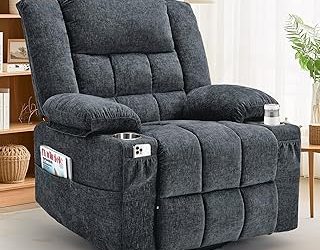
My pick where longevity and easy cleaning matter, particularly in a nursery. The adjustable manual headrest is the standout detail — it lets you support the cervical spine rather than pushing your chin toward your chest, which is the single most common cause of neck stiffness after dozing in a recliner.
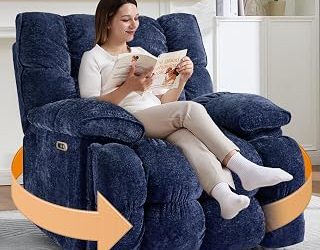
LINSY 360 Swivel Recliner Nursery Glider
Best suited to small bedrooms and apartments, where a full-size recliner would block the walking path you need at 3 a.m. The corduroy runs cool, the high back genuinely supports the head, and the two supplied pillows let you fine-tune lumbar height without buying extras.
Harkawon Swivel Rocker Recliner (Beige)
A deep, high-backed seat that suits taller users who usually find gliders cramped through the shoulders. Manual operation keeps the price sensible and the mechanism quiet, though you will want a footstool if you plan to fully stretch out.
Korser Swivel Rocking Recliner (Chenille, Beige)
The smartest compact option, with sculpted armrests that support the forearms at feeding or reading height instead of forcing the shoulders to shrug. Chenille is forgiving of overnight body heat and hides wear well in a room that doubles as a nursery.
Frequently Asked Questions
Is sleeping in a swivel glider bad for me?
Occasional dozing in a well-reclined chair is generally harmless and, for people with reflux or congestion, sometimes more comfortable than lying flat. Habitual full nights in a chair are a different matter, as they restrict position changes and can promote fluid pooling in the lower legs.
Does rocking actually help you fall asleep?
Slow, continuous rocking has been shown to shorten the time it takes to fall asleep and to consolidate lighter sleep stages, likely through vestibular stimulation entraining brain rhythms. The effect depends on the motion being steady and gentle rather than fast.
Should I choose power or manual recline?
Choose power if you will be using the chair while holding a baby, recovering from surgery, or half asleep, since it removes the physical effort of the lever. Manual is quieter, needs no outlet, and has fewer components that can fail.
How do I stop the chair from squeaking over time?
Most noise comes from dry pivot points rather than structural failure. Retighten the base bolts after the first month and apply a lithium or silicone lubricant to the glider bearings annually — a squeak-free chair is not a luxury when someone is trying to sleep in the next room.
Final Thoughts
If you want one chair to serve a full night-time routine, the boucle power recliner glider with USB offers the best combination of breathable fabric, effortless recline and bedside convenience. Choose the CHITA leather power recliner if you value an adjustable headrest and a surface that wipes clean for years, or the LINSY 360 swivel recliner if floor space is tight and you need a cool, high-backed seat that still leaves room to walk a baby around at 3 a.m.