Key takeaways
- Support geometry over softness: Press along the center of any convertible futon where the seat meets the back. If you feel a hard gap or ridge there, that line will sit under your hips or lower back all night. Split-back designs with independently adjustable halves usually distribute weight better than single-hinge folding frames.
- Loft that survives compression: High-density foam holds its thickness far longer than shredded fill or thin polyester batting. For floor futons, roughly 3 inches is the practical minimum for a side sleeper on hard tile or laminate; back sleepers can go thinner. Multi-layer builds distribute pressure more evenly than a single foam slab of the same depth.
- Verify the footprint twice: Measure your room’s usable floor space, then measure again with the futon in its flat position. A 70-inch loveseat that extends to a 70-inch bed is generous seating but short for anyone over 5’8″ — check sleeping length, not just sofa width, and confirm the door swing still clears.
- Assembly and move-out realism: You will disassemble this twice a year, possibly alone, possibly up three flights. Tool-free or single-Allen-key assembly, removable armrests, and modular sections matter more in a dorm than anywhere else. Foldable floor futons win outright here — they stow in a closet all summer.
- Breathability and moisture: Faux leather wipes clean after spills but traps heat, which fragments sleep in a room you can’t thermostat. Chenille and corduroy breathe better. Floor futons need airing every week or two; moisture migrates downward and mildew follows.
What's inside
Dorm rooms ask a single piece of furniture to do the work of three: sofa by day, guest bed on weekends, and — more often than students admit — the primary sleep surface once the university-issued mattress proves unbearable. That double duty is where most purchases go wrong. Buyers shop for the sofa and inherit the bed, discovering around week three that a convertible frame with a hinge running across the lumbar region is not something a spine forgives. Sleep quality in shared, noisy, light-polluted housing is already fragile; a poor sleep surface removes the one variable a student can actually control.
This guide approaches dorm futons from a sleep-wellness perspective first and a décor perspective second. Below you’ll find two distinct categories — Western-style convertible sofa beds for rooms that need seating, and Japanese-style floor futon mattresses for lofted-bed setups, guest sleeping, or replacing an unsupportive dorm mattress outright — plus the selection criteria that separate a futon you’ll keep for four years from one that goes to the curb in October.
As an Amazon Associate we earn from qualifying purchases.


How to Choose a Futon for Your Dorm (2026)
- Support geometry over softness: Press along the center of any convertible futon where the seat meets the back. If you feel a hard gap or ridge there, that line will sit under your hips or lower back all night. Split-back designs with independently adjustable halves usually distribute weight better than single-hinge folding frames.
- Loft that survives compression: High-density foam holds its thickness far longer than shredded fill or thin polyester batting. For floor futons, roughly 3 inches is the practical minimum for a side sleeper on hard tile or laminate; back sleepers can go thinner. Multi-layer builds distribute pressure more evenly than a single foam slab of the same depth.
- Verify the footprint twice: Measure your room’s usable floor space, then measure again with the futon in its flat position. A 70-inch loveseat that extends to a 70-inch bed is generous seating but short for anyone over 5’8″ — check sleeping length, not just sofa width, and confirm the door swing still clears.
- Assembly and move-out realism: You will disassemble this twice a year, possibly alone, possibly up three flights. Tool-free or single-Allen-key assembly, removable armrests, and modular sections matter more in a dorm than anywhere else. Foldable floor futons win outright here — they stow in a closet all summer.
- Breathability and moisture: Faux leather wipes clean after spills but traps heat, which fragments sleep in a room you can’t thermostat. Chenille and corduroy breathe better. Floor futons need airing every week or two; moisture migrates downward and mildew follows.
The Best Futons for Dorms (2026), Reviewed
Flamaker Convertible Futon Sofa Bed
The faux leather and integrated cup holders make this the most “lounge-first” option here, and removable armrests genuinely help in tight rooms. Just plan on a mattress topper if you’ll sleep on it nightly — the surface is firm and the material runs warm.
6th Generation Japanese Floor Futon Mattress
The strongest sleep surface in this roundup: nine layers of high-density foam at extra-thick loft, sized to standard twin, with no hinge or frame gap anywhere. It’s my default recommendation for students with lofted beds or an unbearable university mattress, since it can sit directly on top of one.
LINSY HOME 70″ Chenille Futon Sofa Bed
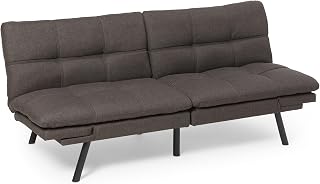
The adjustable backrest and armrests let you fine-tune from upright study posture to a genuinely reclined position, and chenille breathes noticeably better than vinyl. A well-balanced 3-in-1 pick for rooms that need real seating without sacrificing overnight comfort.
Ribilake 70″ 4-in-1 Futon Sofa Bed
The most configurable frame of the convertibles, with multiple backrest angles that make it easy to find a supported neutral spine while reading or working. The neutral beige upholstery also survives roommate turnover and mismatched décor better than bolder colors.
Modular Corduroy Fold-Out Floor Sofa
A frameless modular design that opens to a wide, completely flat sleeping area — ideal for hosting visiting friends or family without an air mattress. Removable backrest cushions and corduroy give it a soft, dorm-appropriate look, though it sits low and demands floor space.
Frequently Asked Questions
Can I sleep on a dorm futon every night?
On a quality floor futon, yes — that’s their traditional purpose. On a convertible sofa bed, it’s workable if the frame is split-back rather than single-hinge, and better still with a 2-inch topper bridging the seam.
Do floor futons need a mat underneath?
On carpet, no. On tile, laminate, or concrete, a breathable rug or slatted mat helps with both insulation and airflow, which reduces trapped moisture underneath.
Will a futon fit through a standard dorm doorway?
Flat-packed convertibles almost always do since they ship unassembled. Floor futons roll or fold and pose no issue at all.
How firm should a dorm futon be?
Firm enough that your hips don’t sink below your shoulders, soft enough that a side sleeper’s shoulder can settle in. Medium-firm suits most people; strict side sleepers should add a thin topper.
Final Thoughts
For pure sleep quality — and especially for anyone facing a lofted bed or a punishing institutional mattress — the 6th Generation Japanese Floor Futon is the pick, offering uninterrupted high-density support that no hinged frame can match. If your room needs to function as a living space, the LINSY HOME chenille sofa bed offers the best balance of breathability, adjustability, and overnight comfort, with the Ribilake 4-in-1 a close second for its wider range of backrest positions.