Key takeaways
- Center support, not just corner legs: The float effect relies on inset legs, so look for a reinforced center rail with at least one dedicated middle leg. This is the single biggest predictor of whether the frame stays silent in year two.
- Slat spacing under 3 inches: Wider gaps let foam and hybrid mattresses sag between slats, creating pressure points along the hips and lumbar spine. Solid wood slats outperform thin bent-ply on long-term deflection.
- Real clearance figures: Advertised height often measures the frame top, not the usable gap beneath. If under-bed storage matters, target 9 inches or more of true clearance and check that the center leg doesn’t block bin access.
- Mattress retention: Frameless platforms with no headboard-side lip or slide stopper will let an all-foam mattress migrate. A built-in stopper strip or slight slat lip solves this permanently.
- Lighting you can dim to warm: Under-bed LEDs are excellent as low-level night navigation, but cool white or blue light near bedtime suppresses melatonin. Prioritize frames whose app or remote allows warm tones and low brightness rather than color-cycling gimmicks.
What's inside
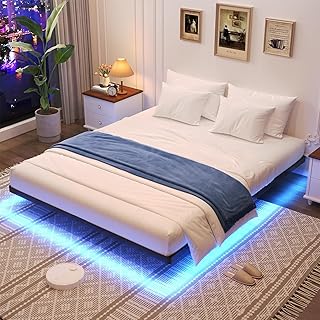
A floating bed frame promises something unusual: the visual weightlessness of a platform that seems to hover an inch or two above the floor, without the bulk of a traditional base. The catch is that the illusion depends entirely on engineering. The recessed center legs that create the “float” also concentrate load in a narrow footprint, which is why some budget frames creak within weeks, drift out of square, or let a mattress slide toward the foot of the bed every night. From a sleep-wellness standpoint that matters more than aesthetics — micro-movements and low-frequency noise are among the most common causes of fragmented sleep that people never connect to their bed.
This guide evaluates the 2026 crop of queen floating frames on the criteria that actually affect rest: joint rigidity and noise under motion, slat spacing and mattress support, usable under-bed clearance, and whether the integrated LED and charging features are genuinely useful or simply decorative. Below you’ll find current picks, followed by a buying framework and answers to the questions readers ask most.
As an Amazon Associate we earn from qualifying purchases.




🛒 Best Price Today on Amazon
Prime members get fast, free shipping on everything above, plus member-only deals. New members get a 30-day free trial — cancel anytime.
How to Choose a Floating Bed Frame (2026)
- Center support, not just corner legs: The float effect relies on inset legs, so look for a reinforced center rail with at least one dedicated middle leg. This is the single biggest predictor of whether the frame stays silent in year two.
- Slat spacing under 3 inches: Wider gaps let foam and hybrid mattresses sag between slats, creating pressure points along the hips and lumbar spine. Solid wood slats outperform thin bent-ply on long-term deflection.
- Real clearance figures: Advertised height often measures the frame top, not the usable gap beneath. If under-bed storage matters, target 9 inches or more of true clearance and check that the center leg doesn’t block bin access.
- Mattress retention: Frameless platforms with no headboard-side lip or slide stopper will let an all-foam mattress migrate. A built-in stopper strip or slight slat lip solves this permanently.
- Lighting you can dim to warm: Under-bed LEDs are excellent as low-level night navigation, but cool white or blue light near bedtime suppresses melatonin. Prioritize frames whose app or remote allows warm tones and low brightness rather than color-cycling gimmicks.
The Best Floating Bed Frames (2026) Reviewed
OLEVS Queen Floating Bed Frame with Smart LED and Charging Station
OLEVS strikes the most balanced compromise in this category: a welded steel platform with dense slat coverage, app-controlled lighting that dims properly for nighttime use, and a headboard-mounted charging port placed where you can actually reach it lying down. Assembly is genuinely quick, and the frame stays quiet under partner movement — the practical test that separates competent floating frames from decorative ones.
Evermagin Oak Queen Floating Bed with Fluted Headboard
The best-looking option here by a comfortable margin, with a warm oak finish and vertical fluting that reads as a boho or Scandinavian-leaning bedroom rather than a gaming setup. Its heavier construction gives it a reassuringly solid feel, though the extra mass makes this a two-person assembly and a poor choice if you rearrange furniture often.
DICTAC Queen Floating Bed with LED and Storage Headboard
DICTAC’s storage headboard is the standout feature — deep enough for a book, glasses, and a water glass, which removes the need for a nightstand in tight rooms and supports a cleaner wind-down routine. Structurally it’s stable and well-braced, and its metal frame runs lighter than the wood-clad competition without feeling flimsy.
IMMERSTABLE Upholstered Queen Floating Bed Frame
The only upholstered pick, and the right call if you read or work in bed, since the padded headboard makes sitting upright genuinely comfortable rather than merely possible. Solid wood slats and a full 11 inches of storage clearance make it the most functional frame here for smaller bedrooms.
Queen Floating Bed Frame with 9.45″ Clearance and Slide Stopper
A quietly smart design: the integrated mattress slide stopper eliminates the nightly creep that plagues all-foam mattresses on flat platforms, and the frame lives up to its noise-free claim thanks to generous rubber contact padding at the joints. Choose this one if silence and stability outrank visual drama.
Frequently Asked Questions
Do floating bed frames actually feel stable?
A well-built one does. Stability comes from the center support rail and how tightly the bolts seat, not from where the legs sit visually. Retighten every fastener after the first two weeks — settling is normal, and it’s when most creaking begins.
Can I use a floating frame without a box spring?
Yes, and you generally should. These frames use closely spaced slats designed as the complete support system; adding a box spring raises the sleep surface awkwardly and defeats the low-profile look entirely.
Are the built-in LED lights bad for sleep?
Only if used carelessly. Set them to a warm, dim setting and treat them as floor-level path lighting rather than room lighting. Low, warm light near the ground is far less disruptive to melatonin than switching on an overhead fixture at 3 a.m.
Which mattress types work best?
Memory foam, latex, and hybrids all perform well on slatted platforms. Very heavy hybrids over 100 pounds benefit from frames with solid wood slats and a second center leg, and any all-foam mattress pairs best with a frame that includes a slide stopper.
Final Thoughts
For most buyers the OLEVS floating frame is the sensible default — quiet, quick to build, and sensibly specified for the price. Choose the Evermagin oak model if the bedroom’s design carries real weight for you, or the IMMERSTABLE upholstered frame if you want a comfortable headboard and the deepest under-bed clearance of the group.