Key takeaways
- Sphere diameter: Match the ball to the glass. A 2.4–2.5″ sphere suits a standard rocks glass and melts slowest; 2.0–2.1″ fits narrower tumblers and coupes and works better if you serve two drinks side by side.
- Throughput versus footprint: A unit producing 144 pieces a day is overkill for two people and will occupy real estate on your counter permanently. Solo sippers are better served by a slim single-cavity machine; hosts should prioritize batch output.
- Acoustics and placement: Compressor machines hum and periodically drop ice with an audible clatter. If the unit lives in a room adjoining a bedroom, look for enhanced insulation, a delay timer you can set for daytime cycles, or skip the machine entirely in favor of a mold.
- Maintenance reality: Self-cleaning cycles reduce scale buildup but don’t eliminate descaling. Filtered water extends the interval significantly and improves clarity, since dissolved solids are what cloud the core.
- Passive molds as an alternative: Insulated stainless or silicone directional-freeze molds cost a fraction of a machine, make no noise, and produce comparable clarity — they simply require 18–24 hours of patience and freezer space.
What's inside
The sphere of ice in a whiskey glass is doing more work than most people realize. A 2.4-inch clear ball has roughly a third less surface area per unit volume than the same amount of cracked cubes, which means slower dilution, steadier temperature, and a drink that tastes the same at minute twelve as it did at minute one. For anyone who treats the last hour of the evening as a deliberate wind-down rather than an afterthought, that consistency matters. A slow-melting sphere encourages sipping over the course of a single measured pour instead of topping up a watery glass twice — and pacing, more than almost anything else, determines whether a nightcap leaves you rested or wrecked at 3 a.m.
The frustration is that clarity is genuinely hard to achieve at home. Freezer trays trap dissolved gas and minerals in the center, producing that familiar cloudy core that fractures and melts fast. Countertop machines solve it with directional freezing, but they vary enormously in cycle time, daily yield, footprint, and — crucially for a bedroom-adjacent bar cart or a living-room credenza — how much noise the compressor makes at 10 p.m. Below, we compare the leading 2026 options across both categories, from self-cleaning countertop units to passive insulated molds, with notes on where each one earns its place in a home.
As an Amazon Associate we earn from qualifying purchases.




How to Choose a Clear Ice Ball Maker (2026)
- Sphere diameter: Match the ball to the glass. A 2.4–2.5″ sphere suits a standard rocks glass and melts slowest; 2.0–2.1″ fits narrower tumblers and coupes and works better if you serve two drinks side by side.
- Throughput versus footprint: A unit producing 144 pieces a day is overkill for two people and will occupy real estate on your counter permanently. Solo sippers are better served by a slim single-cavity machine; hosts should prioritize batch output.
- Acoustics and placement: Compressor machines hum and periodically drop ice with an audible clatter. If the unit lives in a room adjoining a bedroom, look for enhanced insulation, a delay timer you can set for daytime cycles, or skip the machine entirely in favor of a mold.
- Maintenance reality: Self-cleaning cycles reduce scale buildup but don’t eliminate descaling. Filtered water extends the interval significantly and improves clarity, since dissolved solids are what cloud the core.
- Passive molds as an alternative: Insulated stainless or silicone directional-freeze molds cost a fraction of a machine, make no noise, and produce comparable clarity — they simply require 18–24 hours of patience and freezer space.
The Best Clear Ice Ball Makers (2026) Reviewed
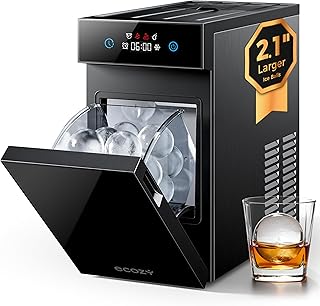
ecozy 2.4″ Clear Ice Ball Maker
The most convincing all-rounder: a genuinely narrow chassis, an 8-hour timer that lets you schedule cycles well before evening, and CrystalFlux directional freezing that yields a properly transparent 2.4″ sphere in about 40 minutes. Best suited to households serving one or two considered drinks a night rather than a crowd.
Silonn 2.4″ Sphere Ice Maker
Three spheres per 40-minute cycle and up to 100 a day make this the entertainer’s pick, and clarity holds up well across the batch. It is larger and more audible than the single-cavity ecozy, so give it a spot in a kitchen or bar area rather than beside a bedroom wall.
ecozy 2″ Ice Ball Maker with Auto Water Supply
Four spheres per cycle, 144 a day, auto water supply, and upgraded insulation that keeps finished ice solid longer between servings. The 2″ size is the most versatile for cocktails, and the improved insulation also translates to slightly quieter, less frequent compressor activity.
2.5″ Stainless Clear Ice Ball Mold (2-Pack)
Two insulated stainless molds, a storage box, and tongs — completely silent, nothing to descale, and the 2.5″ output is the slowest-melting sphere here. The trade-off is a full overnight freeze and dedicated freezer real estate; it is also the most giftable option on this list.
Crystal Clear 4-Cavity Ice Ball Tray
Four 2.5″ spheres per freeze at the lowest cost of entry, using the same insulated directional-freeze principle. Clarity is very good if you use filtered water and resist rushing the cycle, making it the sensible first purchase before committing to a machine.
Frequently Asked Questions
Why does clear ice melt more slowly?
Clarity indicates dense, gas-free ice with few internal fractures, and a sphere minimizes surface area relative to volume. Together these slow heat transfer, so your pour dilutes gradually rather than all at once.
Will a countertop machine keep me awake?
Most run between roughly 40 and 50 dB — comparable to a quiet refrigerator — with intermittent noise as ice releases. Use the timer to complete cycles hours before bed, or choose an insulated mold for silent operation.
Is filtered water necessary?
Not strictly, but it helps twice over: fewer dissolved minerals mean clearer cores, and less scale means longer intervals between descaling and a longer service life.
Does a slower-melting sphere make a nightcap healthier?
It supports better pacing, which is worthwhile — but alcohol still fragments sleep architecture and suppresses REM regardless of temperature. Treat these tools as a way to drink more deliberately and less often, ideally finishing three or more hours before bed.
Final Thoughts
For most homes, the ecozy 2.4″ is the balanced choice: compact, schedulable, and reliably clear. Frequent hosts should step up to the Silonn 2.4″ for its three-sphere cycles, while anyone prioritizing silence, low cost, or a gift will be well served by the 2.5″ stainless mold set.