Key takeaways
- Backrest height: Measure from your seated tailbone to the top of your head, then look for a back at least that tall. Anything shorter turns the headrest into a shoulder rest and forces your neck forward — a reliable recipe for waking up stiff.
- Seat depth and footrest reach: You want at least 21 inches of seat depth so your thighs are supported to within a few inches of the knee, and a footrest that extends far enough to cradle your calves and heels. Dangling feet cause pooling, tingling, and restless legs.
- Recline range: Three-position chairs are fine for reading. If you plan to actually sleep in the chair, prioritize dual- or triple-motor designs that lay flat or reach a zero-gravity angle, where the knees sit above the heart and spinal compression drops significantly.
- Weight capacity and frame build: Taller bodies apply leverage that shorter ones don’t. Look for a rated capacity of 350–400 lbs and a steel lift mechanism, even if you’re well under that number — it’s a proxy for overall frame rigidity.
- Heat, massage, and upholstery: Lumbar heat is genuinely useful for pre-sleep muscle release. Fabric breathes better for long sessions; faux leather wipes clean more easily. Choose based on whether you overheat at night.
What's inside
If you’re over six feet tall, you’ve probably learned to distrust recliners. The headrest lands between your shoulder blades instead of behind your skull. The footrest stops somewhere around your ankles, leaving your heels dangling in mid-air. And the seat itself is often too shallow, so your knees hang past the cushion and your thighs get no support at all. From a sleep-wellness standpoint, this matters more than comfort alone: a chair that breaks your spine into unnatural angles will keep your nervous system in a low-grade state of alert, which is exactly the opposite of what you want during an evening wind-down or an afternoon nap.
A recliner built for a taller frame does something specific — it keeps your head, neck, and lumbar curve stacked in one continuous line while your legs stay level with or slightly above your heart. That combination is what allows breathing to slow and muscles to release. This guide focuses on power lift recliners with the seat depth, back height, and footrest extension that longer bodies actually need, plus the heat and massage features that help tight hips and hamstrings let go at the end of the day. Below are the models worth your attention in 2026.
As an Amazon Associate we earn from qualifying purchases.


How to Choose a Recliner For Tall People (2026)
- Backrest height: Measure from your seated tailbone to the top of your head, then look for a back at least that tall. Anything shorter turns the headrest into a shoulder rest and forces your neck forward — a reliable recipe for waking up stiff.
- Seat depth and footrest reach: You want at least 21 inches of seat depth so your thighs are supported to within a few inches of the knee, and a footrest that extends far enough to cradle your calves and heels. Dangling feet cause pooling, tingling, and restless legs.
- Recline range: Three-position chairs are fine for reading. If you plan to actually sleep in the chair, prioritize dual- or triple-motor designs that lay flat or reach a zero-gravity angle, where the knees sit above the heart and spinal compression drops significantly.
- Weight capacity and frame build: Taller bodies apply leverage that shorter ones don’t. Look for a rated capacity of 350–400 lbs and a steel lift mechanism, even if you’re well under that number — it’s a proxy for overall frame rigidity.
- Heat, massage, and upholstery: Lumbar heat is genuinely useful for pre-sleep muscle release. Fabric breathes better for long sessions; faux leather wipes clean more easily. Choose based on whether you overheat at night.
The Best Recliners For Tall People (2026) Reviewed
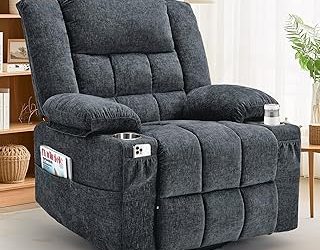
MCombo Oversized Power Lift Recliner R7891 (Large-Wide, Dark Gray)
This is the most complete option here for genuinely tall and broad users: a dual-motor design that separates back and footrest control, a lay-flat position deep enough for real napping, and a generous seat that stops your knees from overhanging. The fabric upholstery breathes well during long evening sessions, and the lumbar heat is placed high enough to reach the mid-back where tall users tend to hold tension.
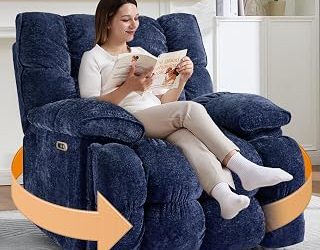
MCombo Triple Motor Power Lift Recliner 7661 (Navy Blue)
The standout feature is the adjustable headrest, which lets you dial in neck support independently of the backrest angle — the single most valuable adjustment a tall person can have. With infinite positioning and a 4.7-inch extending footrest, it’s the most customizable chair on this list and the one I’d recommend to anyone with a stubborn neck or upper-back complaint.
Oversized Power Recliner for Big and Tall, 400 LBS
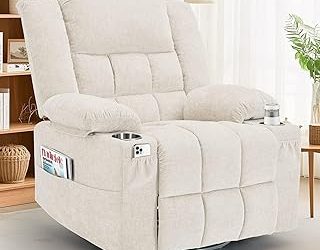
Built around a 25.5-inch extra-wide seat and a 400-pound capacity, this one prioritizes structural confidence over gadgetry, though it still includes heat, massage, and a dual-motor 180-degree lay-flat recline. The PU leather is easy to maintain, but consider a fabric alternative if you tend to sleep warm.
MCombo Oversized Lift Recliner R7891 (Large-Wide, Navy Blue)
Mechanically identical to the dark gray R7891 but in a softer navy that reads less clinical in a living room — worth choosing purely on décor grounds. Same lay-flat range, same dual-motor independence, same forgiving seat width.
MCombo Electric Power Lift Recliner 7040 (Light Brown, Medium)
The value pick, and the right call if you’re tall but slim and mainly want assisted standing plus a comfortable reading recline. Its three-position mechanism won’t lay flat, so treat it as an evening chair rather than a sleep surface.
Frequently Asked Questions
What backrest height do I need if I’m 6’4″?
Aim for a backrest of roughly 28 inches or more measured from the seat cushion. That typically places the headrest behind your occiput rather than your shoulders, keeping the cervical curve neutral.
Is it healthy to sleep in a recliner overnight?
Occasionally, yes — and for people with reflux, sleep apnea, or post-surgical restrictions, an inclined position can be preferable. Choose a lay-flat or zero-gravity model, support your calves fully, and check with your clinician before making it a nightly habit.
Do I need a dual or triple motor chair?
Dual motor lets you recline the back without raising the footrest, which matters if you want your legs down while reading. Triple motor adds independent headrest control — the upgrade most tall users notice immediately.
How much wall clearance should I plan for?
Most lift recliners need 4 to 12 inches behind them at full recline, though lay-flat models with longer backs sit at the higher end. Measure before committing to a tight corner.
Final Thoughts
For most tall buyers, the MCombo Oversized R7891 in Large-Wide is the safest, most comfortable choice, offering the seat depth and lay-flat range that longer frames require. If you want maximum control over neck and head position, step up to the Triple Motor 7661, and if your priority is a heavy-duty frame with extra width, the 400-pound-rated oversized big-and-tall recliner is the one to beat.