Key takeaways
- Seat-to-floor height: Aim for 16–18 inches. Sit down and check that both heels rest flat with your knees at roughly 90 degrees. Anything taller and your legs hang, which compresses the back of your thighs and slows circulation during long sits.
- Seat depth: Look for 18–20 inches. A deeper seat forces you to perch forward, which cancels out lumbar support entirely. Two to three fingers should fit between the seat edge and the back of your knee.
- Headrest and back height: Petite-scaled backs place the lumbar curve and neck support where a shorter torso actually needs them. Power-adjustable headrests are the safest bet — they let you fine-tune neck angle instead of accepting a fixed one.
- Motor count and recline path: Single-motor chairs move the back and footrest together on one arc. Dual and triple motors separate them, so you can drop the back for rest while keeping legs slightly elevated — the position most associated with easier sleep onset.
- Footrest extension: Extended or added footrest length is not a short-person concern in reverse — many petite chairs shorten the footrest so it doesn’t overshoot. Check that the pad supports your heels rather than ending under your calves.
What's inside
Most recliners are engineered around a mythical average body — roughly 5’9″ with a 19-inch seat-to-floor height and a 21-inch seat depth. If you’re 5’4″ or under, that geometry works against you every time you sit down. Your feet dangle, so your thighs carry pressure they were never meant to hold. The seat back pushes your head forward instead of cradling your neck. The footrest lands mid-calf rather than under your heels. From a sleep-wellness standpoint, this matters more than comfort: a chair that leaves your legs unsupported and your cervical spine flexed forward will interrupt the slow drift into deep rest that makes an evening recliner worth owning in the first place.
This guide approaches the problem the way a sleep clinician would approach a mattress fitting — starting with body dimensions, then working outward to features. Below you’ll find petite-scaled lift recliners, compact massage chairs, and infinite-position models that lay genuinely flat, along with the measurements and mechanisms that actually determine whether a chair fits a shorter frame. Every pick was evaluated for seat height, seat depth, lumbar contact point, and headrest position relative to a 4’11″–5’5″ user.
As an Amazon Associate we earn from qualifying purchases.


How to Choose a Recliner for Short People (2026)
- Seat-to-floor height: Aim for 16–18 inches. Sit down and check that both heels rest flat with your knees at roughly 90 degrees. Anything taller and your legs hang, which compresses the back of your thighs and slows circulation during long sits.
- Seat depth: Look for 18–20 inches. A deeper seat forces you to perch forward, which cancels out lumbar support entirely. Two to three fingers should fit between the seat edge and the back of your knee.
- Headrest and back height: Petite-scaled backs place the lumbar curve and neck support where a shorter torso actually needs them. Power-adjustable headrests are the safest bet — they let you fine-tune neck angle instead of accepting a fixed one.
- Motor count and recline path: Single-motor chairs move the back and footrest together on one arc. Dual and triple motors separate them, so you can drop the back for rest while keeping legs slightly elevated — the position most associated with easier sleep onset.
- Footrest extension: Extended or added footrest length is not a short-person concern in reverse — many petite chairs shorten the footrest so it doesn’t overshoot. Check that the pad supports your heels rather than ending under your calves.
The Best Recliners for Short People (2026), Reviewed
MCombo Small Power Lift Recliner 7141 (Admiral, Small)
The Small configuration is the standout here: a lowered seat and shortened back put the lumbar pad exactly where a 5’0″–5’4″ spine curves. Breathable fabric and gentle heat make it an easy chair to doze in, and the USB-C port means your phone charges without you reaching across the room.
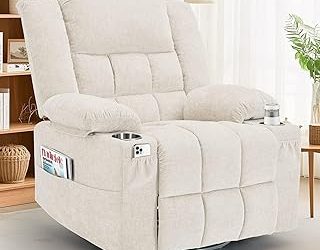
MCombo Dual Motor Lift Recliner 7893 (Petite, Cream White)
Dual motors let you set back angle and leg elevation independently, which is how you reach a true zero-gravity position rather than an approximation of one. Legs slightly above heart level reduces lower-back load and is a genuinely restorative position for evening wind-down.
MCombo 3 Motor Small Lift Recliner 7631 (Grey)
The power headrest is what earns this chair its place — shorter users are usually the ones stuck with a headrest that pushes the skull forward, and independent adjustment solves it outright. Lay-flat capability plus a 4.7-inch footrest extension makes it the most nap-capable option on this list.
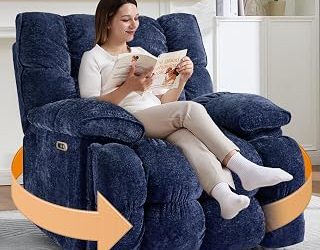
MCombo Triple Motor Lift Recliner 7661 (Navy Blue, Medium)
Choose this one if you’re at the taller end of “short” — roughly 5’4″–5’6″ — where petite scaling starts to feel cramped. Three motors, an adjustable headrest, and infinite positioning give you the widest range of supported postures of any model here.
Sweetcrispy Massage Recliner Chair
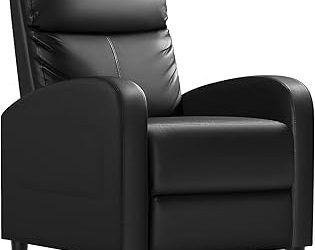
A compact, non-lift option for smaller rooms and smaller budgets, with a lower seat height than most theater-style seating and genuinely useful lumbar contour. It won’t help you stand up, so it’s best for buyers who want fit and support without a lift mechanism.
Frequently Asked Questions
What seat height should a 5-foot-tall person look for?
Roughly 16–17 inches from floor to the top of the compressed cushion. Manufacturer specs often list uncompressed height, so subtract an inch or two for foam give.
Are lift recliners only for elderly users?
No. Lift mechanisms reduce the strain of standing from a low seat, which benefits anyone with knee, hip, or lower-back sensitivity regardless of age.
Is it safe to sleep in a recliner overnight?
Occasional nights are fine, and some people with reflux or sleep apnea find a slight incline helpful. Habitual recliner sleeping can encourage lower-limb swelling and stiffness, so a proper flat surface should remain your primary sleep setup.
Do massage and heat features actually help sleep?
Indirectly, yes. Gentle warmth and low-intensity vibration support parasympathetic activation and muscle release before bed. Use them as a wind-down cue, then switch them off — motor noise and heat during sleep tend to fragment rest.
Final Thoughts
For most shorter buyers, the MCombo 7141 in its Small size is the most sensible starting point — correctly scaled, well-appointed, and reasonably priced. If you want independent leg and back control for genuine zero-gravity rest, step up to the MCombo 7893, and if a power headrest is non-negotiable for your neck, the MCombo 7631 is the one to buy.