Key takeaways
- Armrest height and support: Your elbows should rest at roughly breast height without shrugging. Armrests that sit too low force the shoulders to hold the baby’s weight, which is the single most common source of nursing neck and upper-back pain. Adjustable or padded, contoured arms are worth paying for.
- Recline range, not just “reclines”: Look for a chair that reaches a relaxed 130–150 degree position with an independent headrest. A partial recline that leaves your chin tucked forward encourages airway compression and micro-awakenings if you doze; a supported neutral neck does the opposite.
- Motion quality and noise: A smooth, long-arc glide or 360° swivel-rock soothes an infant’s vestibular system and helps a parent downshift too. Test or research the noise level — creaks and motor whine in a dark nursery undo the calm you’re trying to build.
- Seat depth and floor contact: Shorter parents should confirm they can plant both feet flat with about two fingers of clearance behind the knees. Feet dangling off the front edge cuts circulation and makes standing up with a sleeping baby genuinely risky.
- Fabric, cleanability, and cables: Spit-up, leaks, and lanolin happen. Choose tight-weave velvet, corduroy, or a skin-friendly technical fabric you can spot-clean, and prioritize built-in USB or dual charging ports plus a side pocket so your phone, water, and burp cloths stay within arm’s reach instead of across the room.
What's inside
Feeding a newborn at 2 a.m. is, biologically speaking, a sleep-fragmentation event — and the chair you sit in decides whether it stays a brief interruption or turns into an hour of aching shoulders and stalled wakefulness. Most new parents shop for a nursery rocker the way they shop for an accent chair: by color and price. Then they discover that a seat too deep to reach the floor, armrests two inches too low, or a recline that stops short of neutral spine can quietly sabotage the one thing they need most in the first year, which is efficient, low-friction rest between feeds.
This guide looks at rocking recliners for nursing through a sleep-wellness lens rather than a décor one. We assessed how each chair supports the head and lumbar curve during long feeds, how quietly it glides in a dark room, whether the recline can be adjusted one-handed while holding a baby, and how easily a parent can drift off and then get up again safely. Below are six models worth your attention in 2026, followed by the criteria that actually matter and answers to the questions we hear most.
As an Amazon Associate we earn from qualifying purchases.


How to Choose a Rocking Recliner For Nursing (2026)
- Armrest height and support: Your elbows should rest at roughly breast height without shrugging. Armrests that sit too low force the shoulders to hold the baby’s weight, which is the single most common source of nursing neck and upper-back pain. Adjustable or padded, contoured arms are worth paying for.
- Recline range, not just “reclines”: Look for a chair that reaches a relaxed 130–150 degree position with an independent headrest. A partial recline that leaves your chin tucked forward encourages airway compression and micro-awakenings if you doze; a supported neutral neck does the opposite.
- Motion quality and noise: A smooth, long-arc glide or 360° swivel-rock soothes an infant’s vestibular system and helps a parent downshift too. Test or research the noise level — creaks and motor whine in a dark nursery undo the calm you’re trying to build.
- Seat depth and floor contact: Shorter parents should confirm they can plant both feet flat with about two fingers of clearance behind the knees. Feet dangling off the front edge cuts circulation and makes standing up with a sleeping baby genuinely risky.
- Fabric, cleanability, and cables: Spit-up, leaks, and lanolin happen. Choose tight-weave velvet, corduroy, or a skin-friendly technical fabric you can spot-clean, and prioritize built-in USB or dual charging ports plus a side pocket so your phone, water, and burp cloths stay within arm’s reach instead of across the room.
The Best Rocking Recliner For Nursing (2026)s Reviewed
MAMAZING Lullapod Power Nursery Rocking Chair
The Lullapod is the most thoughtfully engineered option here for parents who expect to feed and sometimes sleep in the chair: triple-motor control means the headrest, backrest, and footrest move independently, so you can find true neutral spine instead of accepting a fixed recline curve. The HugAssist armrests, near-silent rocking, 270° swivel, dual charging ports, and built-in storage make one-handed nighttime feeds genuinely manageable.
Rocking Chair Nursery with Adjustable Armrests (Electric Glider Recliner)
Adjustable armrests are rare and disproportionately valuable, because arm height is the variable most responsible for nursing shoulder strain — and here you can dial it in rather than stacking pillows. Add an adjustable headrest, gentle massage and heat for postpartum lower-back tension, and FSC-certified construction, and it’s the best fit for parents with a nonstandard torso length.
Korser Rocker Recliner with Massage and Heating
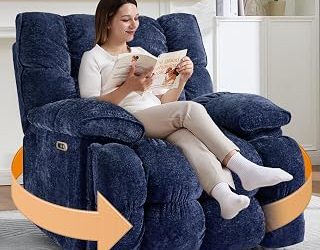
Korser’s 360° swivel makes it easy to pivot toward a bassinet or changing table without standing, which matters more at 3 a.m. than any spec sheet suggests. The heat function is a quiet standout for anyone recovering from a C-section or dealing with lumbar stiffness, and onboard storage plus USB charging keep the surrounding floor clear.
Power Recliner Chair Swivel Glider with Waist Pillow
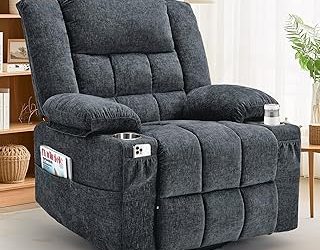
This one earns its place on lumbar support: the included waist pillow fills the gap most nursing parents pad out with a rolled towel, encouraging an upright pelvis instead of a slumped sacral tuck. Power recline plus USB charging keeps operation to a single button when both hands are occupied, and the skin-friendly upholstery suits warm rooms and bare arms.
LINSY 360 Swivel Recliner Chair with 2 Pillows
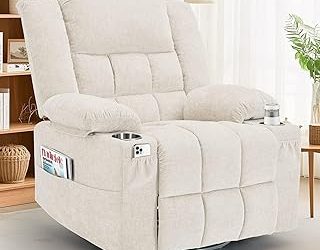
For nurseries where floor space is genuinely tight, LINSY’s compact footprint and high back deliver full head-and-neck support without the visual bulk of a traditional recliner. The corduroy is grippy enough that you won’t slide forward as you relax, and the two included pillows let you customize head and lumbar positioning from day one.
Frequently Asked Questions
Is it safe to fall asleep in a nursing recliner while holding my baby?
No — sleep guidance is consistent that dozing on a chair, recliner, or sofa with an infant carries a higher risk than a firm, flat crib surface, because of entrapment and positional airway risk. Choose a chair comfortable enough to keep you calm but plan to return your baby to their own sleep space before you drift off, and keep the room dim and quiet so you can do it without fully waking either of you.
Does a power recliner or a manual rocker make more sense?
Power wins for nursing specifically. Manual mechanisms usually require a lever or a body-weight push you can’t produce while cradling a baby, whereas a button lets you adjust mid-feed. The trade-off is a cord or battery pack and slightly higher cost.
Will massage and heat features actually help?
They’re supportive rather than therapeutic. Gentle heat can ease postpartum lumbar and pelvic-floor tension and helps the nervous system settle before a return to bed; vibration massage is more of a comfort feature. Neither replaces physiotherapy if you have persistent pain.
Will the chair still be useful once nursing ends?
Almost certainly, which is why we favored adult-scaled models with real recline range. The chairs above transition well into reading, bedtime-story, or living-room seating — so consider how the fabric and silhouette will look outside the nursery when you pick a color.
Final Thoughts
If you want the most capable nursing chair available in 2026, the MAMAZING Lullapod’s independent triple-motor adjustment and near-silent rocking make it the strongest all-around choice for parents facing months of night feeds. The Rocking Chair Nursery with Adjustable Armrests is the smarter pick if arm height has been your pain point, and the LINSY 360 Swivel Recliner delivers proper high-back support in small nurseries where a full-size recliner simply won’t fit.