Key takeaways
- Height relationship: Aim for a tabletop within an inch or two of your sofa’s seat height. Reaching down too far to set a drink or a book creates dozens of small postural interruptions across an evening, and lift-top designs solve this properly by rising to a comfortable working or dining level when needed.
- Closed storage over open: Visible clutter registers as unfinished business, which is unhelpful in the last hour before bed. Drawers and hidden compartments let you clear remotes, chargers, and screens out of sight in seconds — the single most useful evening habit a coffee table can support.
- Edge profile and traffic paths: Rounded, oval, and chamfered edges are worth prioritizing in rooms you cross in low light. Sharp corners on a rectangular table sitting in a walkway are a recurring hazard for anyone who gets up at 2 a.m.
- Finish and reflectivity: Matte and lightly oiled finishes diffuse lamp and candlelight rather than throwing glare upward. If you rely on dim, warm lighting in the evening — and you should — a satin oak or dark walnut surface will feel considerably calmer than a polished one.
- Stability and adaptability: Check for cross-bracing, thick legs, and a top that doesn’t flex. Then consider whether extendable or two-tier designs suit your space; small apartments benefit enormously from a table that expands for guests and shrinks back to a quiet footprint afterward.
What's inside
Most people shop for a coffee table with their eyes: they picture how it will look under a lamp, in a photo, in a room that finally feels finished. As someone who spends their working life studying how homes affect rest, I’d argue the living room deserves the same scrutiny we give bedrooms. The hours between dinner and bedtime are when your body decides how easily it will fall asleep — and the surface at the center of that room quietly shapes those hours. A table that forces you to hunch over a laptop, that sits too low for a cup of chamomile, or that hides a jumble of clutter in plain sight keeps the nervous system faintly busy when it should be winding down.
This guide looks at solid and engineered wooden coffee tables through that lens. Wood earns its place here for practical reasons as well as aesthetic ones: it doesn’t bounce harsh lamplight into your eyes the way glass and high-gloss lacquer do, it holds warmth under the hand, and it ages into something you stop noticing — which is precisely the point in a room meant for decompression. Below, you’ll find the models I’d recommend in 2026, the specifications that actually matter, and answers to the questions I hear most often from clients redesigning their evenings.
As an Amazon Associate we earn from qualifying purchases.




How to Choose a Wooden Coffee Table (2026)
- Height relationship: Aim for a tabletop within an inch or two of your sofa’s seat height. Reaching down too far to set a drink or a book creates dozens of small postural interruptions across an evening, and lift-top designs solve this properly by rising to a comfortable working or dining level when needed.
- Closed storage over open: Visible clutter registers as unfinished business, which is unhelpful in the last hour before bed. Drawers and hidden compartments let you clear remotes, chargers, and screens out of sight in seconds — the single most useful evening habit a coffee table can support.
- Edge profile and traffic paths: Rounded, oval, and chamfered edges are worth prioritizing in rooms you cross in low light. Sharp corners on a rectangular table sitting in a walkway are a recurring hazard for anyone who gets up at 2 a.m.
- Finish and reflectivity: Matte and lightly oiled finishes diffuse lamp and candlelight rather than throwing glare upward. If you rely on dim, warm lighting in the evening — and you should — a satin oak or dark walnut surface will feel considerably calmer than a polished one.
- Stability and adaptability: Check for cross-bracing, thick legs, and a top that doesn’t flex. Then consider whether extendable or two-tier designs suit your space; small apartments benefit enormously from a table that expands for guests and shrinks back to a quiet footprint afterward.
The Best Wooden Coffee Tables (2026) Reviewed
Miereirl 42″–65″ Extendable Coffee Table
The sliding tabletop makes this the most genuinely flexible option here, expanding for a full table of guests and retracting to keep floor space open on ordinary nights. Two drawers plus an open shelf give you a place for both the things you want reachable and the things you’d rather not look at after 9 p.m.
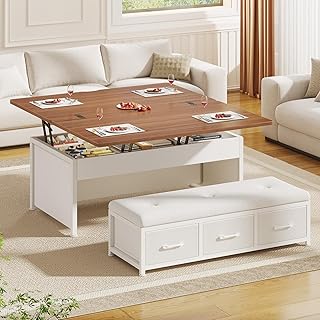
Itaar 43″ Lift Top Coffee Table Set
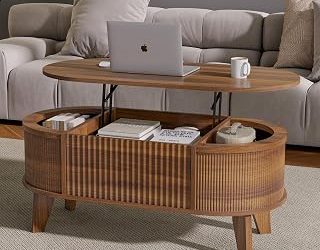
The lift mechanism raises the surface to a workable height for laptops, puzzles, or a bowl of soup, which spares your neck and lower back the slump that a standard-height table encourages. The hidden compartment and included ottoman bench make it the strongest choice for anyone whose living room doubles as an office.
IFGET 48″ Modern Coffee Table, Natural Oak
A curved profile and thick natural oak top give this table real visual weight without sharp corners, and the lower shelf is sized well for books rather than becoming a dumping ground. The pale matte finish is particularly forgiving in rooms lit by a single warm lamp.
Solid Wood 47″ Farmhouse Coffee Table
Solid construction and a dark brown finish make this the most durable and least reflective option in the roundup — a good match for households with children or a dog that treats furniture as an obstacle course. The two-tier layout offers ample storage while keeping the silhouette grounded and quiet.
Honyee 47.2″ Oval Coffee Table
The oval top and rounded edges are a deliberate safety advantage in narrow or dimly lit living rooms, and the veneered solid wood legs keep it feeling light in a small apartment. Assembly is straightforward, and the natural finish stays neutral against almost any sofa.
Frequently Asked Questions
Does a coffee table really affect sleep?
Not directly, but it shapes the environment where you spend your pre-sleep hours. Comfortable posture, low glare, and a tidy surface all reduce the low-grade stimulation that makes winding down harder than it needs to be.
How much space should I leave around it?
Keep 16 to 18 inches between the table and your sofa, and at least 30 inches for any main walking path. Generous clearance matters most for the trips you make in the dark.
Is solid wood worth the extra cost over veneer?
Solid wood resists dents and can be sanded and refinished, which matters on a surface used daily for a decade or more. A quality veneer over engineered core is perfectly serviceable, and often more stable in rooms with swinging humidity.
Round or rectangular for a small living room?
Round and oval tables win in tight rooms because they let you move diagonally around them and eliminate corner collisions. Rectangular tables use space more efficiently along a long sofa.
Final Thoughts
If you want one table to handle guests, work, and quiet evenings, the Itaar lift top offers the best ergonomics and the cleanest way to hide screens before bed, while the Miereirl extendable model is the smartest pick for apartments that need to change shape depending on the night. For a small or dimly lit room where you’d rather not think about the furniture at all, the Honyee oval remains the safest and most restful choice.