Key takeaways
- Unbox in the room where it will live — an expanded queen is unwieldy through doorways and up stairs.
- Air the mattress out for a few hours before dressing it; light off-gassing odor is normal and dissipates quickly.
- Verify your foundation. Slats should be no more than 3 inches apart, or foam will sag prematurely and may void the warranty.
- Rotate head-to-foot every three to six months. Never flip a single-sided mattress — the comfort layers only work in one orientation.
What's inside
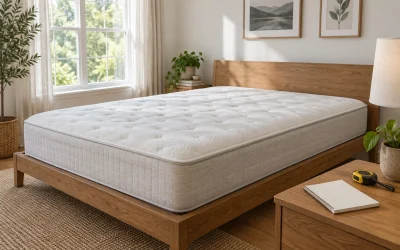
A mattress is the only piece of furniture you use for roughly a third of your life, and yet most people spend more time researching a phone upgrade than the surface that governs their spinal alignment, thermal comfort, and sleep continuity. The compressed, shipped-to-your-door category — mattress in a box — has quietly become the most sensible way to buy, not because it’s cheaper (though it usually is), but because it removes the showroom problem: no salesperson, no fifteen-minute test lie under fluorescent lights, and in most cases a multi-month home trial that lets your nervous system deliver the verdict instead of your first impression.
What follows is a practical framework I use with clients who are troubleshooting poor sleep. You’ll learn how to translate “firmness” into something meaningful for your body, when foam beats a hybrid and vice versa, how to read heat-management claims without being sold a story, what certifications actually protect you, and how to properly break in and evaluate a new bed during the trial window. I’ve flagged a handful of well-specified 2026 options along the way — all queen size, all fiberglass-free, all CertiPUR-US certified — as concrete reference points rather than a leaderboard.
As an Amazon Associate we earn from qualifying purchases.


🛒 Best Price Today on Amazon
Prime members get fast, free shipping on everything above, plus member-only deals. New members get a 30-day free trial — cancel anytime.
Start With Sleep Position, Not Firmness Labels
“Medium firm” is a marketing descriptor, not a measurement, and it varies wildly between brands. A far more reliable starting point is your habitual sleep position, because that determines where your body needs to sink and where it needs to be held up. Side sleepers load the shoulder and hip, so they need enough surface give to let those joints settle in and keep the lumbar spine neutral — usually a softer-to-medium feel. Back sleepers need consistent support under the lumbar curve with minimal hip drop. Stomach sleepers, who are the most vulnerable to lower-back strain, generally do best on a firmer surface that prevents the pelvis from sagging. Combination sleepers should prioritize responsiveness, so they aren’t fighting a foam crater every time they turn. The Sleepmax 14-inch hybrid is explicitly tuned for back and side sleepers, which makes it a reasonable default for couples who split between those two positions.
All-Foam Versus Hybrid: A Genuine Trade-Off
All-foam beds, like the EGOHOME 10-inch and the Novilla 12-inch, excel at pressure redistribution and motion damping. You feel cradled, and your partner’s movement mostly disappears. The trade-offs are a slightly slower response when you change position and, historically, more heat retention. Hybrids place pocketed coils under the comfort foam — see the 12-inch pocket-spring models above — which adds edge stability, easier mobility, a springier surface, and vertical airflow through the coil layer. Pocketed (as opposed to interconnected) coils are the key detail: each one compresses independently, so you keep most of the motion isolation that draws people to foam. My general guidance: choose foam if you sleep lightly and value stillness; choose a hybrid if you’re heavier, sleep hot, sit on the edge of the bed, or want a more buoyant feel.
Read Cooling Claims Like a Skeptic
Sleep onset depends on a drop in core body temperature, so heat retention isn’t a comfort quibble — it’s a mechanism for fragmented sleep. That said, cooling features are not equally meaningful. Gel infusions and green-tea gel (as in the EGOHOME) add thermal mass, which delays heat buildup rather than eliminating it. Open-cell and convoluted foam layers improve airflow within the comfort layer. Coil units, found in the hybrids, do the most for genuine convection. Breathable knit covers help at the surface. Realistically, a gel foam bed will sleep cooler than dense traditional memory foam but warmer than a coil hybrid — and your sheets, mattress protector, and bedroom temperature can easily outweigh the mattress itself.
Certifications, Covers, and Fiberglass
Two things worth confirming before you buy. First, CertiPUR-US certification, which every option listed here carries: it verifies the foam is made without ozone depleters, certain flame retardants, heavy metals, formaldehyde, and that it meets low-VOC standards. Second, fiberglass-free construction. Some budget mattresses use fiberglass in the inner sock as a flame barrier, which is safe when sealed but genuinely hazardous if the cover is unzipped or torn. Explicitly fiberglass-free builds, including the FATHOM 12-inch with its removable cover, avoid the problem entirely — and a removable, washable cover is a meaningful hygiene advantage over a five-to-ten-year lifespan.
Use the Trial Period Properly
Compressed mattresses need time — typically 24 to 72 hours to fully expand, and two to four weeks for your body to adapt. Judging a bed on night one is the single most common mistake I see, because your proprioceptive system is calibrated to your old mattress, sag included. Trials of 100 nights are standard; the 365-night trial on the Sleepmax is unusually generous. Mark a calendar date roughly three weeks out and evaluate then, using morning stiffness, night wakings, and how long you take to fall asleep as your data points.
Tips
- Unbox in the room where it will live — an expanded queen is unwieldy through doorways and up stairs.
- Air the mattress out for a few hours before dressing it; light off-gassing odor is normal and dissipates quickly.
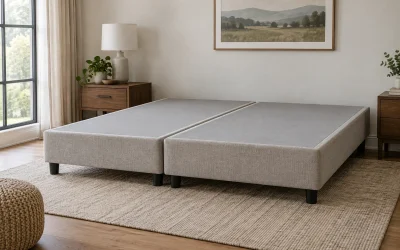
- Verify your foundation. Slats should be no more than 3 inches apart, or foam will sag prematurely and may void the warranty.
- Rotate head-to-foot every three to six months. Never flip a single-sided mattress — the comfort layers only work in one orientation.
Frequently Asked Questions
How thick should my mattress be?
Ten inches is adequate for lighter sleepers and guest rooms; 12 to 14 inches gives more comfort-layer depth, which matters if you’re over roughly 230 pounds or sleep on your side. Also check your sheets — deep-pocket sheets are needed beyond about 12 inches.
Does mattress in a box mean lower quality?
No. Compression is a shipping method, not a construction shortcut. What matters is foam density, coil count and gauge, and layer design — which you should evaluate independently of how the bed arrived.
How long will one last?
Expect six to eight years from a quality foam or hybrid bed with normal use. Replace it sooner if you see visible indentations over an inch, or if you consistently sleep better away from home.
Are these good for back pain?
Medium-firm surfaces with strong lumbar support tend to perform best in the research literature. Models marketed for back-pain relief and lumbar support are reasonable candidates, but persistent pain warrants a clinician’s assessment, not a mattress purchase.
Conclusion
The best mattress in a box is the one matched to your sleep position, body weight, and thermal tendencies — not the one with the longest feature list. Narrow your choice to foam or hybrid first, confirm CertiPUR-US certification and fiberglass-free construction, then commit to a genuine three-week trial and let your mornings tell you whether you chose well.