Key takeaways
- You change sides during the night and do not want to move the pillow with you.
- You want back support while side sleeping without adding a separate pillow.
- You have enough room for roughly 30 inches of pillow width in addition to your sleeping space.
The best pregnancy pillows depend on your priority: choose a U-shaped pillow for the most complete full-body support, a C-shaped pillow for balanced belly-and-back support with less bed coverage, a J-shaped pillow for targeted head, neck, and leg alignment, or a wedge for compact support and easy repositioning.
Our top picks

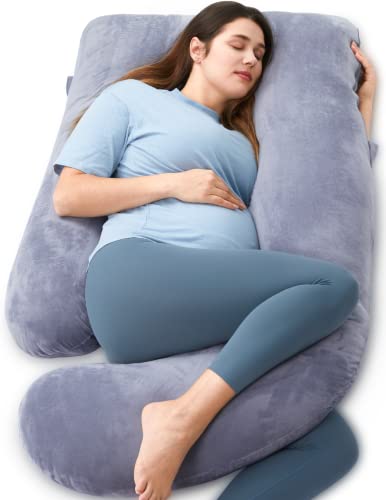
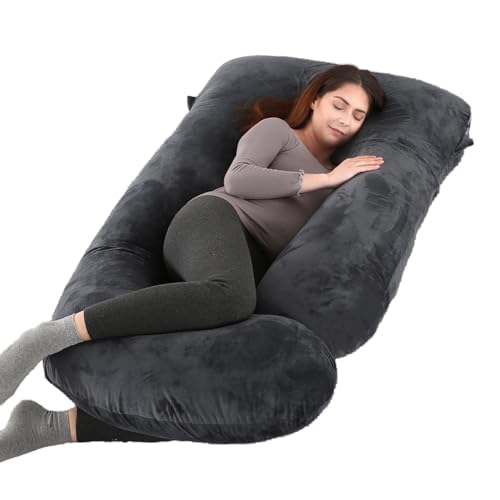

As an Amazon Associate we earn from qualifying purchases at no extra cost to you. Ratings are shown as listed on Amazon.
Quick comparison: which pregnancy pillow fits your situation?
| Pillow shape | Typical size | Body coverage | Best for | Main compromise |
|---|---|---|---|---|
| U-shaped | 55–70 in long, 25–35 in wide | Both sides of the body, back, belly, knees | Full-body support and frequent position changes | Uses the most bed space |
| C-shaped | 55–65 in long, 25–30 in wide | One side of the body plus back or belly | Side sleeping with support behind the back | Less symmetrical when you turn over |
| J-shaped | 55–65 in long, 20–28 in wide | Head, neck, belly, and legs on one side | People who prefer a narrower, directional pillow | Limited support on the opposite side |
| Wedge | 10–16 in wide, 12–16 in deep, 4–8 in high | Small area: belly, back, or knees | Small beds, travel, and targeted elevation | Does not support the entire body |
These are typical ranges rather than fixed standards. Check the compressed and expanded dimensions before buying, because a pillow that fits in its packaging may occupy considerably more room after it regains its shape.
U-shaped pillows: the strongest choice for full-body support
A U-shaped pregnancy pillow runs along both sides of the body and connects around the head or feet. It can support the belly on one side, the back on the other, and the knees between the two arms. This makes it the most comprehensive option for sleepers who want a supported “nest” rather than a conventional pillow.
Choose a U shape if:
- You change sides during the night and do not want to move the pillow with you.
- You want back support while side sleeping without adding a separate pillow.
- You have enough room for roughly 30 inches of pillow width in addition to your sleeping space.
The trade-off is bed space. In a 10-by-12-foot bedroom with a queen bed, a U-shaped pillow is usually manageable, but it can leave little usable room for a partner. On a full-size bed, measure the mattress first: a 30-inch-wide pillow can consume nearly half the bed’s 54-inch width. Its long, bulky form also makes it harder to store and carry through narrow hallways.
C-shaped pillows: the balanced all-rounder
A C-shaped pillow curves around the head, back, hips, and legs. Depending on how you position it, the outer curve can support your back while the inner curve cushions your belly and knees. It offers much of the support of a U shape with less material across the mattress.
C-shaped designs are often the best pregnancy pillows for a sleeper who usually stays on one side but wants help maintaining a stable side-sleeping position. They also work well for reading in bed because the curve can support the back and shoulders.
The limitation becomes noticeable when you turn over. You may need to rotate or reposition the pillow, and its back support is no longer behind you. Look for a model with a firm outer edge and a flexible central curve; a pillow that collapses at the bend may provide less useful lumbar support than its dimensions suggest.
J-shaped pillows: narrower support for one-sided sleepers
A J-shaped pillow resembles a long body pillow with a curved or hooked section at one end. It normally supports the head and neck at the top, the belly along the shaft, and the knees or ankles near the lower section. Because it lacks the second arm of a U pillow, it takes less bed space.
This shape suits people who have a preferred sleeping side and want a continuous support line from head to legs. It can also be easier to reposition than a large U shape. However, it offers little protection against rolling onto the back and does not provide equal belly and back cushioning at the same time. If back pain is your main concern, a C or U shape—or a J pillow paired with a small lumbar cushion—may be more effective.
Wedge pillows: compact, targeted, and easiest to move
A wedge is the most practical choice for a small apartment, shared bed, guest room, or travel. Place it under the belly when side sleeping, behind the back to discourage rolling, or between the knees. Some wedge pillows are triangular; others are curved to follow the abdomen.
A typical wedge measuring 12 by 14 inches can be moved with one hand and stored in a bedside drawer or under the bed. It also leaves most of the mattress available for a partner. Its weakness is limited coverage: you may need a separate head pillow, knee pillow, and lumbar cushion to match the support of a full-length design.
| Situation | Most suitable shape | Why | What to check before buying |
|---|---|---|---|
| Small apartment or full-size bed | Wedge or narrow J | Preserves mattress space and stores easily | Under-16-inch depth for a wedge; compressed storage bag |
| Frequent turning at night | U | Support remains available on both sides | Width, weight, and whether the cover has carry handles |
| Back discomfort while side sleeping | C or U | Allows a supported back-facing edge | Firm outer bolster and a height that fills the waist gap |
| Kids or pets on the bed | Wedge or C | Fewer oversized surfaces to climb over or displace | Removable washable cover and securely stitched seams |
| Renter or frequent mover | Wedge or J | Lower bulk and easier transport through doorways | Finished weight under about 8 lb and a washable cover |
Fill, firmness, and adjustability matter more than the shape
Polyester fiberfill is common, affordable, and washable when enclosed in a removable cover. It feels soft and can be suitable for a person who wants cushioning rather than strong elevation, but it may compress at the waist or under the knees over time.
Shredded memory foam generally provides more resilient support and often has a zippered compartment so you can remove some filling. That adjustability is useful when the pillow feels too tall under the neck or too firm against the belly. The trade-offs are greater weight, possible foam odor when new, and more complicated washing: the cover may be machine washable while the inner fill is not.
Microbead filling is lightweight and moldable, but beads can become noisy, escape through damaged seams, or lose volume. Solid foam wedges hold their shape well and provide predictable elevation, although they are less flexible and can feel warm.
| Construction detail | Useful target | Why it matters |
|---|---|---|
| Adjustable fill | Full-length zipper with removable fill | Lets you lower the neck section or soften the belly area |
| Cover fabric | Cotton, bamboo-viscose, or breathable polyester blend | Balances softness, airflow, and drying time |
| Cover closure | Covered zipper or overlapping envelope closure | Reduces skin contact and protects the fill |
| Seams | Double stitching around curves and handles | Helps resist pulling when the pillow is dragged or folded |
Cover care, moving, and durability realities
Prioritize a removable, machine-washable cover. Pregnancy pillows sit against skin for hours and may be exposed to sweat, lotions, snacks, or spills. A cover that requires cold washing and low-heat drying is easier to maintain than one that must be hand-washed. Check whether the cover can be dried completely; damp filling can develop an unpleasant odor.
Measure the pillow’s packed dimensions as well as your doorway. A bulky U-shaped pillow may fit through a standard 30-inch bedroom doorway when compressed, but it can be awkward on stairs and difficult to place in a washing machine. Look for a storage or carry bag, especially if the pillow weighs more than 8–10 pounds. The areas most likely to wear first are the inner curve, the seam beneath the neck, the bottom corners, and the zipper pull.
For long-term value, choose a pillow whose cover can be replaced or whose fill can be replenished. A low-priced pillow with permanently sealed fiberfill may cost less initially, but it is harder to reshape after compression. A pillow that is too tall can also encourage neck bending, so support should keep your head level with your spine rather than lift it sharply.
How to choose your best pregnancy pillow
- Measure your mattress width and reserve at least 20–24 inches for your partner if sharing the bed.
- Decide whether you need full-body support or only a lift under the belly, back, or knees.
- Choose U for two-sided coverage, C for balanced back-and-belly support, J for narrow one-sided support, or wedge for portability.
- Check the pillow height at the neck and belly area, not only its total length.
- Confirm that the cover is removable and washable and that the inner fill has suitable care instructions.
- Choose adjustable fill if your firmness preference may change as your pregnancy progresses.
Safety and comfort reminders
A pregnancy pillow should improve comfort, not force you into one position. Use it to support side sleeping, keep the spine reasonably aligned, and reduce pressure on the hips and knees. If a pillow causes numbness, pain, overheating, breathing difficulty, or persistent discomfort, stop using it and ask a qualified healthcare professional for advice. Your clinician can also address individual sleep-position concerns, particularly if you have a medical condition or pregnancy complication.